
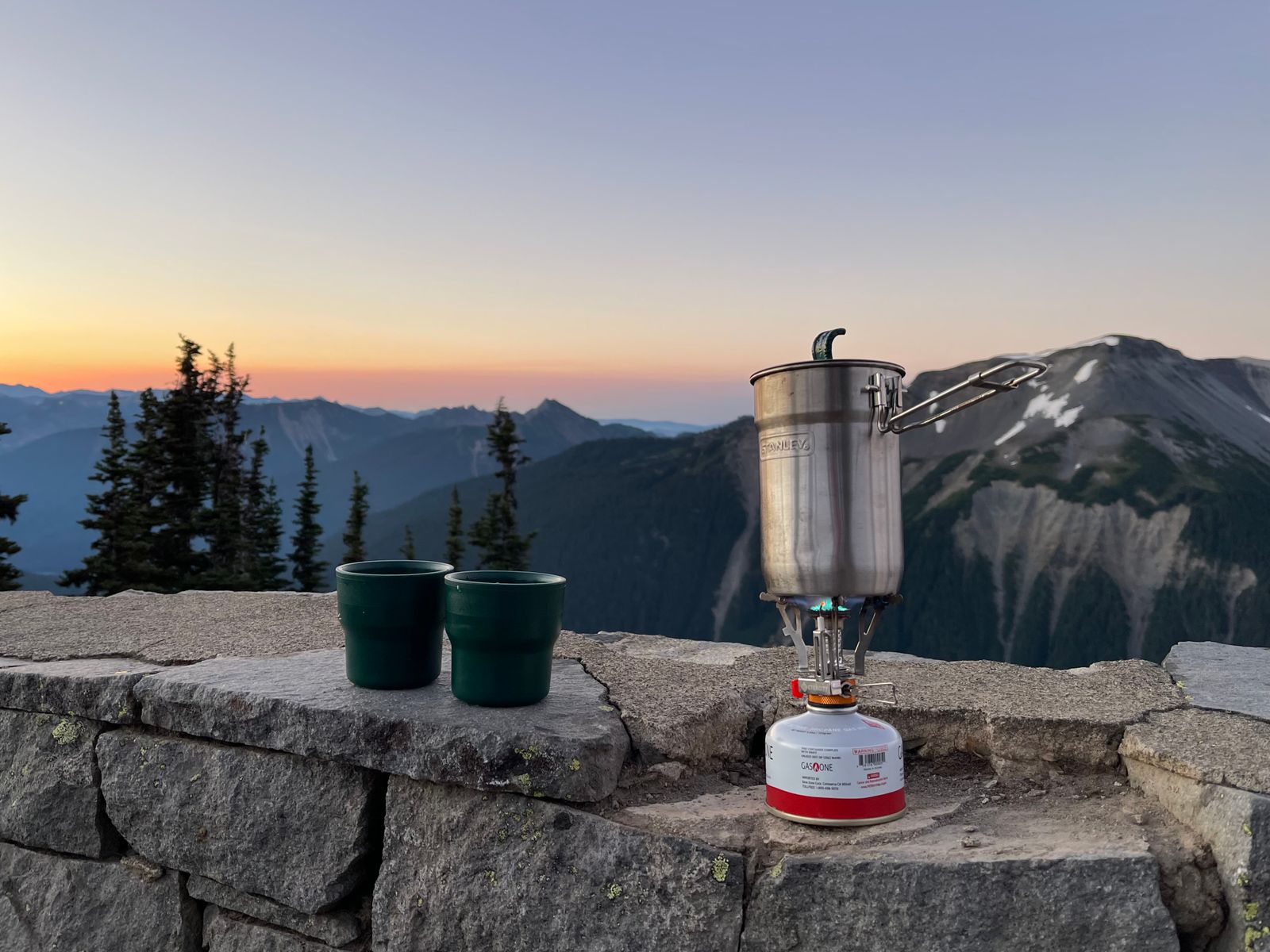
It’s 6 a.m. Frost is on the tent, mist is lifting off the lake, and your hands are wrapped around a hot mug of coffee you brewed yourself. Ask any hiker, and they’ll tell you that first sip is one of the best parts of the whole trip.
But “trail coffee” means very different things to different people. A thru-hiker counting grams might be happy with a filter that weighs less than half an ounce. A coffee nerd wants a real espresso shot at the summit. A car-camping family just wants a big pot for everyone.
So we compared nine of the best portable coffee makers for hiking: the AeroPress Go, three WACACO hand-pump espresso makers, the ultralight GSI Java Drip, the Stanley Boil + Brew, a classic Bialetti moka pot, and Hario and Melitta pour-over cones. You’ll also find a weight table, grind sizes, instant coffee options, simple trail recipes and how to deal with used grounds the Leave No Trace way.
Affiliate disclosure: As an Amazon Associate, JoinHikes earns from qualifying purchases. If you buy through Amazon links in this article, we may earn a commission at no extra cost to you.
Our review approach: We used official specs from AeroPress, WACACO, GSI, Stanley, Bialetti, Hario and Melitta plus real hiking needs. We haven’t run blind taste tests, and we don’t invent prices or ratings.
Quick Answer: What Is the Best Portable Coffee Maker for Hiking?
For most hikers, the AeroPress Go is the best portable coffee maker for hiking. It makes a smooth, rich cup with almost no grit, it’s nearly unbreakable, and the whole kit packs inside its own mug (323 g / 11.4 oz).
Counting every gram? The GSI Ultralight Java Drip weighs under half an ounce. Need real espresso at camp? The WACACO Nanopresso is easy, and the Picopresso is the enthusiast’s choice. Brewing for a group at the car? Grab the Stanley Boil + Brew.
All of them need hot water, so you’ll still want a backpacking stove or a kettle.
Quick Comparison: Best Portable Coffee Makers for Hiking
On a phone, swipe the table sideways.
| Coffee maker | Style | Weight | Makes | Best for | Shop |
|---|---|---|---|---|---|
| Best overall AeroPress Go | Press (immersion) | 323 g (packed) | 8 oz cup | Most hikers | Check price |
| Premium espresso WACACO Picopresso | Manual espresso | 350 g | Double shot | Coffee enthusiasts | Check price |
| Easy espresso WACACO Nanopresso | Manual espresso | 336 g | Single shot | Espresso lovers | Check price |
| Light espresso WACACO Minipresso GR2 | Manual espresso | 285 g | Single shot | Espresso on a budget | Check price |
| Ultralight GSI Ultralight Java Drip | Reusable pour-over | <0.5 oz | 1 mug | Backpacking | Check price |
| Groups Stanley Boil + Brew | French press + pot | 0.9 lb | 32 oz | Car camping | Check price |
| Strong coffee Bialetti Moka Express 3-Cup | Stovetop moka | Light aluminum | 3 small cups | Bold coffee fans | Check price |
| Pour-over Hario V60 Plastic 02 | Paper pour-over | Very light | 1–4 cups | Flavor chasers | Check price |
| Simplest Melitta Single-Cup Cone | Paper pour-over | Very light | 1 mug | Casual campers | Check price |
Weights are the brands’ published figures. AeroPress Go weight includes mug, lid, accessories and filters.
Weight Matters: Which Coffee Maker Belongs in Your Pack?
Under 1 oz: backpacking
GSI Java Drip, Hario V60 or Melitta cone. Pair them with a mug you’re already carrying.
10–12 oz: day hikes & short trips
AeroPress Go, Minipresso GR2, Nanopresso or Picopresso. That’s a treat worth carrying for coffee lovers.
Over 12 oz: car camping
Stanley Boil + Brew and Bialetti Moka. Weight doesn’t matter when the car is right there.
The 9 Best Portable Coffee Makers for Hiking, Reviewed
1. AeroPress Go Travel Coffee Press
Best for: Almost every hiker and camper who wants great coffee without fuss.
If you asked a hundred coffee-loving hikers what they brew with, a big chunk would say “AeroPress.” The Go is the travel version, and it’s built for the trail.
Here’s the clever part: the press, filters, scoop and stirrer all pack inside the included mug, with a lid to keep it all together. AeroPress lists the whole kit at 323 g (11.4 oz), including 20 paper filters. It’s made of tough plastic, so you can toss it in a pack without worrying.
Brewing is easy. Add coffee, pour in hot water, stir, wait about a minute and press. The paper micro-filter gives a clean, smooth cup with almost no sludge. That’s a big step up from cowboy coffee or a French press. It makes one 8 oz mug of regular coffee, up to three espresso-style shots, or cold brew. Cleanup is the best part: pop off the cap and push out a dry “puck” of grounds you can pack out in a zip bag.
Good to know: AeroPress also sells the Go Plus, with a bigger 10 oz insulated stainless tumbler. It’s nice for car trips, but heavier.
- Smooth, grit-free coffee.
- Everything packs in one mug.
- Tough and nearly unbreakable.
- Fast, easy cleanup.
- Very forgiving for beginners.
- Heavier than a simple filter.
- One cup at a time.
- Paper filters to pack out.
- Not true espresso.
Who should buy it?
Day hikers, campers, travelers and anyone who wants reliably great coffee.
Who should skip it?
Ultralight thru-hikers, and espresso purists.
2. WACACO Picopresso
Best for: Espresso lovers who want café-quality shots at camp.
The Picopresso is the most serious portable espresso maker WACACO makes, and one of the most respected hand-pump espresso makers anywhere. It’s built around the same parts a café machine uses: a 52 mm portafilter and an 18 g non-pressurized basket. That means a proper double shot, with rich crema and real flavor.
The catch is that it rewards skill. Non-pressurized baskets need a fine, even grind, which usually means a good hand grinder and fresh beans. You also need a bit of practice with tamping. Get it right, though, and you’ll be pulling shots on a mountain that rival your local coffee shop.
It weighs about 350 g, has an 80 ml water tank, and is rated up to 18 bar of pressure. Everything is hand-pumped, with no batteries.
- Best espresso quality here.
- Full double-shot basket.
- Café-style control.
- Compact and well built.
- Needs a fine, consistent grind.
- Learning curve.
- More parts to clean.
- Premium price.
3. WACACO Nanopresso
Best for: Espresso fans who want it easy.
The Nanopresso is the most popular portable espresso maker for a reason: it’s forgiving. Its pressurized basket helps you get a decent shot with crema, even with store-bought espresso grounds and no fancy tamping.
Add hot water to the tank and fine coffee to the basket (about 8 g), then pump. Up to 18 bar of pressure pushes out a single shot into the built-in cup. It weighs about 336 g. An optional “barista kit” lets you make doubles, but it’s usually sold separately.
- Easy, forgiving espresso.
- Works with pre-ground coffee.
- Built-in cup.
- Good value.
- Small single shot.
- Pumping takes effort.
- More cleanup than pour-over.
4. WACACO Minipresso GR2
Best for: Hikers who want espresso with the least weight and cost.
The newest Minipresso is the lightest espresso maker in this guide at 285 g (about 10 oz). It uses a simple semi-automatic hand pump and an adjustable basket that holds 8–12 g of coffee, so you can make a lighter or stronger shot. Like the Nanopresso, it’s rated up to 18 bar, and its 80 ml tank holds enough for a single espresso.
It’s a great “first espresso maker” for the trail. You don’t get the Picopresso’s café-level control, but it’s lighter, cheaper and easier.
- Lightest espresso option.
- Adjustable shot strength.
- Easy to use.
- Single shots only.
- Less control than Picopresso.
- Pumping takes effort.
5. GSI Outdoors Ultralight Java Drip
Best for: Thru-hikers and ultralight backpackers.
This little filter is a backpacker classic. It weighs less than half an ounce, folds nearly flat, and its legs clip onto the rim of most camp mugs. Add coffee, pour hot water over it slowly, and you’ve got a real cup of filter coffee for almost zero weight.
It uses a reusable nylon mesh, so there are no paper filters to carry. A few fine grounds and some coffee oils will get through, giving a slightly fuller body than paper. Shake the grounds into a zip bag to pack out, rinse, and you’re done.
- Almost weightless.
- Packs tiny.
- No filters to carry.
- Cheap.
- A little sediment.
- Check that it fits your mug.
- Coffee cools while it drips.
6. Stanley Adventure All-in-One Boil + Brew French Press
Best for: Car campers, couples and small groups.
The Stanley is two tools in one: a 32 oz 18/8 stainless steel pot to heat water, and a French press plunger that drops right into it. Boil, add coffee, wait four minutes, press and pour. You get enough for three or four mugs.
It weighs 0.9 lb, is dishwasher safe at home, and is basically indestructible. That’s classic Stanley. It’s too heavy for ultralight trips, but at a car campsite it’s hard to beat. You can even use it to cook oatmeal or soup.
- Brews for a group.
- Doubles as a cooking pot.
- Very durable.
- Simple to use.
- Heavy for backpacking.
- Some sediment, like any French press.
- Grounds are messier to clean.
7. Bialetti Moka Express (3-Cup)
Best for: Campers who love strong, bold coffee.
The Moka Express has been made in Italy since 1933, and its eight-sided aluminum shape is one of the most famous designs in the coffee world. Fill the bottom with water and the basket with coffee, then set it on your camp stove. Steam pressure pushes rich, strong coffee up into the top chamber.
The 3-cup size makes three small espresso-size cups (about 2 oz each), not three big mugs. Top it up with hot water for an “Americano.” It’s light for a stovetop brewer, but the wide base needs a stable stove. Keep the flame small so it doesn’t lick up the sides, and never leave it unattended.
- Strong, rich coffee.
- Iconic, simple design.
- No filters needed.
- Lasts for decades.
- Needs a stable stove.
- Small servings.
- Rinse only, no soap, to keep its seasoning.
8. Hario V60 Plastic Dripper (Size 02)
Best for: Coffee lovers who want clean, bright, flavorful coffee.
The V60 is the pour-over that specialty coffee shops use, and the plastic version is ideal for camping: it’s light, cheap and won’t break like ceramic or glass. Its cone shape, spiral ribs and big hole let you control how fast the water flows, so you can really bring out the flavor in good beans.
The size 02 brews 1–4 cups, so you can make coffee for two. You’ll need V60 paper filters and a steady pour. A gooseneck kettle helps, but a careful pour from a pot works too.
- Very clean, flavorful coffee.
- Light and unbreakable.
- Makes 1–4 cups.
- Cheap.
- Needs paper filters.
- Technique matters.
- Bulkier than the GSI filter.
9. Melitta Single-Cup Pour-Over Cone
Best for: Casual campers who just want an easy cup.
Melitta invented the paper coffee filter back in 1908, and this single-cup cone is as simple as camp coffee gets. Put it on your mug, add a #2 filter and coffee, then pour. Its small drain holes slow the water down, so it’s more forgiving than the V60 if your pouring is a bit messy.
It’s light, cheap and almost impossible to get wrong. That makes it great for beginners and for anyone who doesn’t want to think about coffee before sunrise.
- Very easy to use.
- Forgiving brew.
- Cheap.
- Easy-to-find filters.
- Needs paper filters.
- One cup at a time.
- Less flavor control.
Head-to-Head Comparisons
AeroPress Go VS GSI Java Drip
| Feature | AeroPress Go | GSI Java Drip |
|---|---|---|
| Weight | 323 g (with mug) | <0.5 oz Lighter |
| Cup quality | Very clean Smoother | Some sediment |
| Filters | Paper | Reusable No waste |
| Shop | Check price | Check price |
Picopresso VS Nanopresso VS Minipresso GR2
| Feature | Picopresso | Nanopresso | GR2 |
|---|---|---|---|
| Basket | 18 g Double | 8 g | 8–12 g |
| Ease | Skill needed | Forgiving Easiest | Easy |
| Weight | 350 g | 336 g | 285 g Lightest |
| Shop | Price | Price | Price |
Hario V60 VS Melitta Cone
| Feature | Hario V60 | Melitta |
|---|---|---|
| Flavor control | High More | Low |
| Ease | Technique matters | Very forgiving Easier |
| Makes | 1–4 cups | 1 cup |
| Shop | Check price | Check price |
Trail Coffee Brewing Methods Compared
| Method | Taste | Weight | Ease | Grind |
|---|---|---|---|---|
| AeroPress | Smooth, rich, clean | Medium | Very easy | Medium-fine |
| Manual espresso | Intense, crema | Medium | Moderate to advanced | Fine |
| Pour-over | Clean, bright | Very light | Easy to moderate | Medium |
| French press | Full-bodied, some silt | Heavy | Easy | Coarse |
| Moka pot | Strong, bold | Medium | Easy | Fine (not powder) |
| Cowboy coffee | Rustic, gritty | Zero extra gear | Easy | Coarse |
| Instant | Varies (good ones are good) | Zero extra gear | Easiest | None |
No-Gear Options: Instant Coffee, Coffee Bags & Cowboy Coffee
Many thru-hikers skip the brewer entirely. Here are the lightest ways to get your caffeine:
Specialty instant coffee
Today’s premium instant coffees taste far better than the jar stuff. They weigh a few grams, and work with hot or cold water.
See on Amazon
Coffee steep bags
Like tea bags, but full of coffee. Drop one in your mug, wait 5 minutes and pack out the bag.
See on Amazon
Cowboy coffee
Boil water, take it off the heat, stir in coarse grounds, wait 4 minutes, then splash in a little cold water to sink the grounds. Pour gently.
Buying Guide: How to Choose a Portable Coffee Maker for Hiking
1. Start with your favorite coffee
Love espresso? Get a WACACO. Big mug drinker? AeroPress or pour-over. Crowd? Stanley.
2. Match weight to the trip
Backpacking: under 1 oz. Day hikes: 10–12 oz is fine. Car camping: anything goes.
3. Remember the hot water
Only the Stanley and Bialetti heat water themselves (on a stove). Everything else needs a stove or kettle.
4. Count the whole kit
Mug, filters, grinder, beans and fuel all add weight. A hand grinder alone can weigh more than the brewer.
5. Think about cleanup
Water is precious on the trail. The AeroPress and GSI filter clean up fastest. Espresso makers take longest.
6. Durability
Choose plastic or steel over glass and ceramic for the backcountry.
Want fresh-ground coffee? A compact hand grinder makes a huge difference, especially for the Picopresso.
See travel hand grinders on Amazon
Best Coffee Maker by Trip Type
| Trip | Best pick |
|---|---|
| Thru-hiking / ultralight | GSI Ultralight Java Drip |
| Day hikes & weekend trips | AeroPress Go |
| Espresso at camp (easy) | WACACO Nanopresso |
| Espresso at camp (best quality) | WACACO Picopresso |
| Lightest espresso | Minipresso GR2 |
| Car camping with friends | Stanley Boil + Brew |
| Strong, bold coffee | Bialetti Moka Express |
| Best-tasting filter coffee | Hario V60 |
| Easiest possible cup | Melitta Cone |
How to Make Great Coffee on the Trail
- Pre-measure at home. Pack each morning’s coffee in a small zip bag (about 15–18 g for a mug).
- Don’t pour boiling water straight on. Let it rest 30 seconds. Around 195–205°F is ideal.
- Know the altitude effect. Water boils at a lower temperature up high, so give the coffee a little longer to brew.
- Match your grind to the brewer: fine for espresso, medium for AeroPress and pour-over, coarse for French press.
- Keep it warm. Pre-warm your mug, and brew out of the wind.
- Try cold brew in summer. Steep grounds in cold water overnight, then filter in the morning with the AeroPress or a pour-over.
- Carry a lighter backup. A few instant packets save the day if your stove fails.
Leave No Trace: What to Do With Coffee Grounds
- Pack out all grounds and filters in a sealed zip bag. Grounds don’t break down fast and they attract wildlife.
- Don’t dump coffee or rinse water in streams or lakes. Scatter strained wash water at least 200 feet from water sources.
- In bear country, store coffee and used grounds with your food in a bear canister or hang.
- Use stoves where fires are banned, and follow local fire restrictions.
Frequently Asked Questions
What is the best portable coffee maker for hiking?
The AeroPress Go is our best overall pick. For ultralight backpacking, choose the GSI Ultralight Java Drip. For espresso, choose the WACACO Nanopresso or Picopresso.
What is the lightest coffee maker for backpacking?
The GSI Ultralight Java Drip weighs less than half an ounce. Instant coffee and coffee steep bags weigh even less, since you carry no brewer at all.
Can I make real espresso while hiking?
Yes. WACACO’s hand-pump makers reach up to 18 bar of pressure. The Picopresso makes the most café-like shots, and the Nanopresso is easiest.
Does the AeroPress Go make espresso?
It makes strong, espresso-style concentrate, but not true high-pressure espresso.
Is the Picopresso worth it over the Nanopresso?
If you have a good grinder and enjoy dialing in shots, yes. If you want easy espresso with pre-ground coffee, the Nanopresso is better.
Which coffee maker is best for groups?
The Stanley Boil + Brew makes 32 oz at once and doubles as a pot to heat water.
Can I use a moka pot on a backpacking stove?
Yes, if the stove is stable and the pot sits securely. Keep the flame small and never leave it unattended.
Do I need a grinder?
Not for most brewers. Pre-ground coffee works fine. A hand grinder mainly matters for the Picopresso and for coffee lovers who want the freshest taste.
How do I make coffee without a coffee maker?
Use instant coffee, coffee steep bags, or “cowboy coffee”: steep coarse grounds in hot water, then settle them with a splash of cold water.
What should I do with used coffee grounds?
Pack them out in a sealed bag with your trash. Don’t bury or scatter them.
Can I make cold brew while camping?
Yes. Steep coarse grounds in cold water overnight, then filter. The AeroPress Go can also make quick cold brew.
Final Verdict: Best Portable Coffee Maker for Hiking
For most hikers, the AeroPress Go is the best portable coffee maker. It makes smooth, clean coffee, it’s tough and easy, and everything packs inside its own mug.
If you live for espresso, the WACACO Picopresso makes the best shots you can pull on a mountain, and the Nanopresso is the easy-going alternative. Thru-hikers should grab the featherweight GSI Java Drip, and car campers will love the Stanley Boil + Brew.
Whatever you choose, there’s nothing quite like that first warm sip with a view.
Our winner: Check the AeroPress Go on AmazonMore Camp & Trail Guides
Editorial disclosure: This guide is based on manufacturer specifications from AeroPress, WACACO, GSI Outdoors, Stanley, Bialetti, Hario and Melitta, plus product research. No lab or taste tests are claimed. Prices and versions change, so check the listing before you buy.