
A hot meal after a long hike is one of the simple pleasures of backpacking. But nobody wants to carry a heavy stove or spend more on cooking equipment than necessary.
The good news? You can find lightweight backpacking stoves for under $50. Some weigh less than an ounce, while others offer convenient push-button ignition, better pot support, or more control over the cooking flame.
The hard part is choosing the right one. A tiny stove might look perfect on paper but struggle in the wind. A heavier stove may actually be easier to cook with and could be a better choice for regular weekend trips.
We’ve researched ten budget backpacking stoves from BRS, SOTO, Fire-Maple, and AOTU. This guide compares their weight, features, strengths, weaknesses, and ideal uses so you can choose the right stove for your adventures.
Affiliate disclosure: As an Amazon Associate I earn from qualifying purchases. Some links in this article are affiliate links, meaning JoinHikes may earn a commission from qualifying purchases at no additional cost to you.
Our review method: These recommendations are based on manufacturer specifications and independent gear-testing publications. JoinHikes has not personally field-tested all ten stoves. The prices discussed are reference prices, and current Amazon offers may change.
Quick Answer: What Is the Best Ultralight Backpacking Stove Under $50?
For most backpackers, our research-based recommendation is the SOTO Amicus without Igniter. Its stable four-support design, manageable weight, and adjustable flame make it a practical choice for cooking on the trail.
If saving every gram matters, the BRS-3000T is difficult to ignore. At approximately 25 grams, it’s one of the lightest inexpensive canister stoves available.
For budget-conscious hikers who prefer built-in ignition, the Fire-Maple GreenPeak 1 offers a useful combination of price, portability, and convenience.
Comparison Table: 10 Best Ultralight Backpacking Stoves Under $50
On a phone, swipe the table sideways.
| Stove | Weight | Igniter | Best for | Shop |
|---|---|---|---|---|
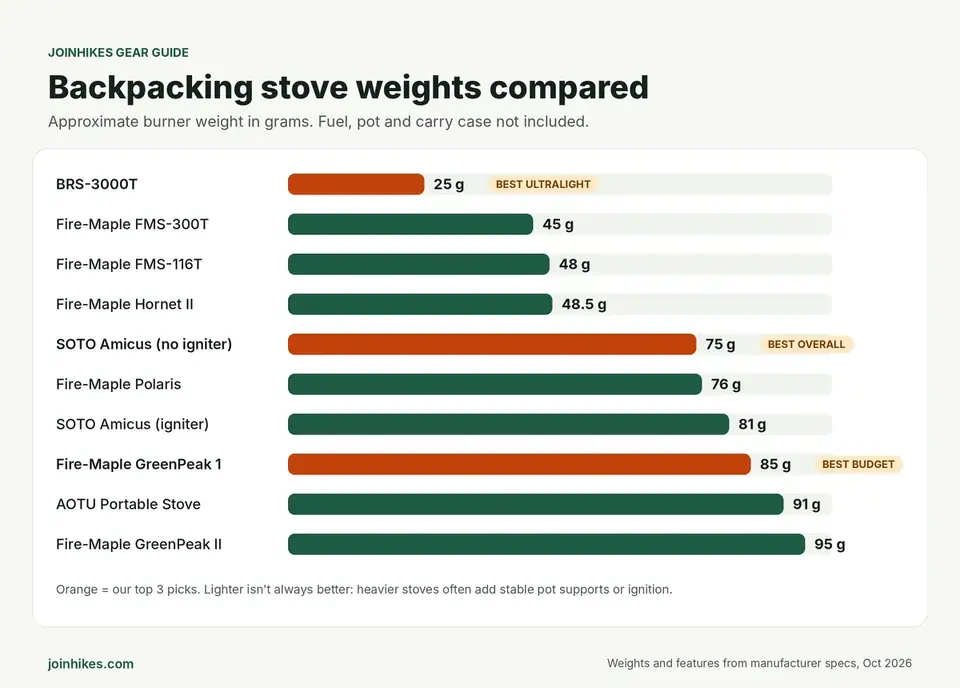
| BRS-3000T | 25 g | No | Absolute minimum weight | Check price |
| Best overall SOTO Amicus without Igniter | 75 g | No | Best overall | Check price |
| SOTO Amicus with Igniter | 81 g | Yes | Beginners | Check price |
| Fire-Maple FMS-300T | 45 g | No | Compact titanium cooking | Check price |
| Fire-Maple Hornet II | 48.5 g | No | Lightweight alternative | Check price |
| Fire-Maple FMS-116T | 48 g | No | Titanium stove buyers | Check price |
| Best budget Fire-Maple GreenPeak 1 | 85 g | Yes | Budget convenience | Check price |
| Fire-Maple Polaris | 76 g | No | Pressure regulation | Check price |
| Fire-Maple GreenPeak II | 95 g | Yes | Regulated cooking | Check price |
| AOTU Portable Stove | About 91 g | Yes | Occasional backpacking | Check price |
Weights are approximate burner weights and exclude cookware, fuel and accessories. Confirm the exact version before purchasing.
How We Selected These Backpacking Stoves
Our goal wasn’t simply to find the ten cheapest burners. We wanted a selection that helps different types of backpackers make an informed buying decision. We considered:
Weight: How much does the burner add to your pack?
Pot support: Will it support suitable cookware safely?
Fuel compatibility: Does it work with commonly available backpacking gas canisters?
Flame control: Can it do more than boil water at full power?
Ignition: Does it have a built-in igniter or require a lighter?
Wind performance: How vulnerable is the flame in breezy conditions?
Value: Are its features useful relative to its published price?
Independent evidence: What do established outdoor-equipment reviewers report?
We also looked at the difference between specialized ultralight burners and stoves better suited to occasional campers. A stove can be excellent for one hiking style and a poor choice for another.
1. BRS-3000T — Best for Absolute Minimum Weight
Best for: Solo backpackers who mainly boil water.
The BRS-3000T has become a well-known option among ultralight backpackers because it is extremely small and inexpensive. At approximately 25 grams, the burner weighs less than many pocket tools. When folded, it takes up very little space in a cooking kit.
It’s a straightforward canister stove designed for heating water and preparing simple meals. You attach it to a compatible threaded gas canister, unfold its supports, and light it with an appropriate ignition source. The BRS doesn’t try to offer the same level of cooking control or pot stability as a larger stove. That’s the compromise.
Watch out for copycats: Backpacking Light warns that quality can vary between units and that many copycat versions are sold. Choose a listing clearly branded BRS, and check that the pot supports lock firmly before your first trip.
- Exceptionally lightweight.
- Very small packed size.
- Inexpensive compared with many premium burners.
- Practical for simple boil-only cooking.
- Easy to fit inside a compact solo cooking setup.
- Vulnerable to wind.
- Narrow pot support compared with larger burners.
- Poor choice for oversized cookware.
- Less versatile for simmering.
- Requires a separate lighter.
Who should buy it?
Backpackers who prioritize pack weight and mainly heat water for dehydrated meals, coffee, or instant noodles. It makes the most sense with a small, compatible cooking pot.
Who should avoid it?
If you regularly cook elaborate meals, use a large pot, or camp in exposed conditions, a more substantial stove will probably be easier to use.
2. SOTO Amicus Without Igniter — Best Overall
Best for: Backpackers who want a reliable, lightweight all-round stove. Manufacturer reference price: $44.95.
The SOTO Amicus is the stove we would choose for most ordinary backpacking trips based on its published specifications and independent reviews. It weighs approximately 75 grams, which is still light enough for a compact cooking kit.
What makes it attractive is the balance between weight and cooking usability. The Amicus has four folding pot supports designed to create a more substantial cooking platform than many extremely small burners. Its concave burner head and raised rim are designed to improve combustion performance in breezy conditions, although the stove is not windproof. The adjustable flame also makes it more versatile for preparing simple meals.
- Good balance of weight and useful cooking features.
- Four pot supports.
- Better all-round usability than many tiny burners.
- Adjustable heat for simple meals.
- Established outdoor-equipment manufacturer.
- Heavier than the BRS-3000T.
- Separate lighter required.
- Costs more than basic inexpensive burners.
- Still affected by wind and exposed conditions.
Who should buy it?
Beginners, weekend backpackers, and hikers who want one stove that can handle ordinary water-boiling and simple cooking tasks.
Who should avoid it?
If minimum weight is your only priority, the BRS or a small Fire-Maple titanium burner may be more appealing.
3. SOTO Amicus With Igniter — Best for Beginners
Best for: First-time backpackers who want push-button convenience.
The SOTO Amicus with Igniter uses the same basic burner and pot-support design but adds an integrated ignition system. At approximately 81 grams, it weighs only six grams more than the no-igniter version.
The main advantage is convenience. Instead of using a separate lighter every time, you can activate the built-in piezo igniter to produce a spark. This doesn’t remove the need for a backup lighter. Igniters can fail or become unreliable.
- Convenient built-in ignition.
- Lightweight relative to many general-purpose stoves.
- Stable support design for compatible pots.
- Useful flame adjustment.
- Straightforward operation.
- More expensive than the no-igniter version.
- Slightly heavier.
- Built-in ignition can fail.
- Limited additional cooking advantages over the standard Amicus.
Who should buy it?
Choose this version if you value convenient ignition and want a beginner-friendly backpacking stove.
Who should avoid it?
If you already carry a lighter and don’t mind using it, the standard Amicus offers very similar cooking features.
4. Fire-Maple FMS-300T — Best Compact Titanium Alternative
Best for: Solo hikers who want a light titanium burner without going to the extreme.
The Fire-Maple FMS-300T is a small titanium backpacking burner weighing approximately 45 grams. It sits between the extremely light BRS-3000T and more substantial canister stoves like the SOTO Amicus. Its folding design makes it convenient for hikers who want to reduce cooking-kit weight without necessarily choosing the very lightest burner.
- Lightweight titanium design.
- Small packed size.
- Useful for compact solo cooking.
- Lower weight than most feature-rich stoves.
- Smaller pot support than a more substantial burner.
- Separate ignition required.
- Limited wind protection.
- Less appropriate for larger cooking pots.
Who should buy it?
Solo backpackers looking for a lightweight titanium burner for simple meals.
Who should avoid it?
Backpackers who carry large cookware or regularly cook for two or more people may prefer more stable support.
5. Fire-Maple Hornet II — Best Lightweight Titanium Option for Simple Meals
Best for: Lightweight solo cook kits.
The Fire-Maple Hornet II weighs approximately 48.5 grams and is designed for compact backpacking cook kits. Its titanium construction helps keep the burner light, while the foldable design makes it easy to pack. With a manufacturer-rated output of about 2.5 kW, it is positioned as a lightweight stove for heating water and preparing basic outdoor meals.
- Lightweight.
- Compact packed shape.
- Titanium construction.
- Well suited to small backpacking cook kits.
- No built-in igniter.
- Compact supports require appropriate cookware.
- Fewer convenience features than larger stoves.
- Actual wind performance requires careful consideration.
Who should buy it?
Hikers who want a titanium stove weighing less than 50 grams.
Who should avoid it?
If you mainly value stable support and convenient everyday cooking, compare the Amicus instead.
6. Fire-Maple FMS-116T — Best Alternative Titanium Burner
Best for: Hikers who mostly heat water.
The Fire-Maple FMS-116T is another lightweight titanium stove weighing approximately 48 grams. It is designed for backpackers who want a compact canister burner without carrying a heavy cooking unit. Compared with more feature-rich models, its selling point is straightforward portability.
- Low burner weight.
- Compact for packing.
- Suitable for simple solo cooking.
- Practical alternative to other small titanium burners.
- No integrated ignition.
- Less versatile for larger cookware.
- Similar in intended use to other compact titanium stoves.
- Limited direct comparative testing evidence.
Who should buy it?
Choose the FMS-116T if you prefer a small titanium burner and find a suitable offer within your budget.
Who should avoid it?
Buyers seeking better all-round cooking convenience may prefer the Amicus.
7. Fire-Maple GreenPeak 1 — Best Budget Stove with Piezo Ignition
Best for: Budget backpackers who want a compact stove with push-button ignition. Manufacturer reference price: $19.95.
If you want a simple, inexpensive stove with built-in ignition, the Fire-Maple GreenPeak 1 deserves attention. Unlike the tiny titanium burners, the GreenPeak 1 focuses more on convenience and everyday usability.
The stove has a folding support design, adjustable flame, and push-button piezo igniter. At approximately 85 grams, it’s still light enough for many weekend backpacking trips, and its reference price puts it among the more affordable products in this comparison.
- Affordable manufacturer price.
- Built-in ignition.
- More conventional cooking platform than tiny minimalist burners.
- Adjustable flame.
- Suitable for straightforward camp meals.
- Heavier than the BRS and several titanium options.
- Not pressure-regulated.
- Built-in ignition still requires a backup lighter.
- Not a fully wind-protected cooking system.
Who should buy it?
Beginners or occasional backpackers who want a reasonably light stove with convenient ignition.
Who should avoid it?
Strict ultralight hikers focused on cutting every gram should look at the BRS or lighter Fire-Maple models.
8. Fire-Maple Polaris — Best Pressure-Regulated Lightweight Stove
Best for: Buyers who want burner regulation at a moderate weight.
The Fire-Maple Polaris adds a pressure-regulated burner design to a relatively lightweight stove. At approximately 76 grams, it weighs about the same as the standard SOTO Amicus. Its regulator is designed to help manage fuel delivery as canister pressure changes. That can be useful, but a regulated burner isn’t automatically windproof or suitable for all cold-weather conditions.
- Pressure regulation.
- Moderate weight for its feature set.
- Adjustable burner output.
- Compact for backpacking.
- Heavier than sub-50 g titanium burners.
- Does not eliminate wind-related heat loss.
- More expensive than basic burners.
- No guarantee of reliable performance in extreme cold.
Who should buy it?
Anyone who wants a lightweight regulated canister stove within a budget.
Who should avoid it?
If your main goal is simple, low-cost water boiling, a smaller burner may be sufficient.
9. Fire-Maple GreenPeak II — Best Budget Regulated Stove with Ignition
Best for: Hikers who prioritize cooking convenience over minimum weight. Manufacturer reference price under $50.
The Fire-Maple GreenPeak II is a more feature-focused option than GreenPeak 1. It adds pressure regulation while retaining built-in piezo ignition. At approximately 95 grams, it is among the heavier stoves in our selection, but remains compact compared with many full cooking systems. The additional weight may be worthwhile if the burner features suit your hiking style.
- Built-in ignition.
- Pressure-regulated burner.
- Practical support design.
- Suitable for ordinary backpacking meals.
- Manufacturer reference price under $50.
- Heavier than the leading titanium burners.
- More moving parts and features.
- Not a substitute for a protected cooking location.
- Less attractive for hikers who count every gram.
Who should buy it?
Hikers who prioritize cooking convenience and regulation over absolute minimum weight.
Who should avoid it?
Minimalists who mostly boil water may prefer the BRS or a 45–50 g titanium burner.
10. AOTU Portable Backpacking Stove — Best for Occasional Backpackers
Best for: People who backpack only occasionally.
The AOTU portable stove appeals mainly because of its extremely low purchase price. At approximately 91 grams without its case, it is not the lightest option here, but still compact enough for an inexpensive camping setup. It includes built-in piezo ignition and folding pot supports.
Independent reviewers found it capable of ordinary water-boiling tasks, although long-term durability and wind performance are notable concerns.
- Very inexpensive.
- Built-in ignition.
- Compact design.
- Reasonable for occasional simple cooking.
- Independent testing information is available.
- Poor performance in wind.
- Long-term durability concerns.
- Igniter reliability may be inconsistent.
- Less suitable for frequent remote backpacking trips.
Who should buy it?
People who go backpacking only occasionally and want to try canister-stove cooking at minimal cost.
Who should avoid it?
If you regularly hike into remote locations, prioritize durability and reliable equipment support.
Author’s Choice: SOTO Amicus Without Igniter
After comparing all ten models, the SOTO Amicus without Igniter remains our research-based overall recommendation. It’s not the lightest stove, and it’s certainly not the cheapest. What makes it attractive is the balance of useful features: the four pot supports provide a more substantial platform than many miniature burners, adjustable flame control helps when you’re cooking something other than boiling water, and it remains light enough for most weekend trips.
Our recommendation by type of backpacker:
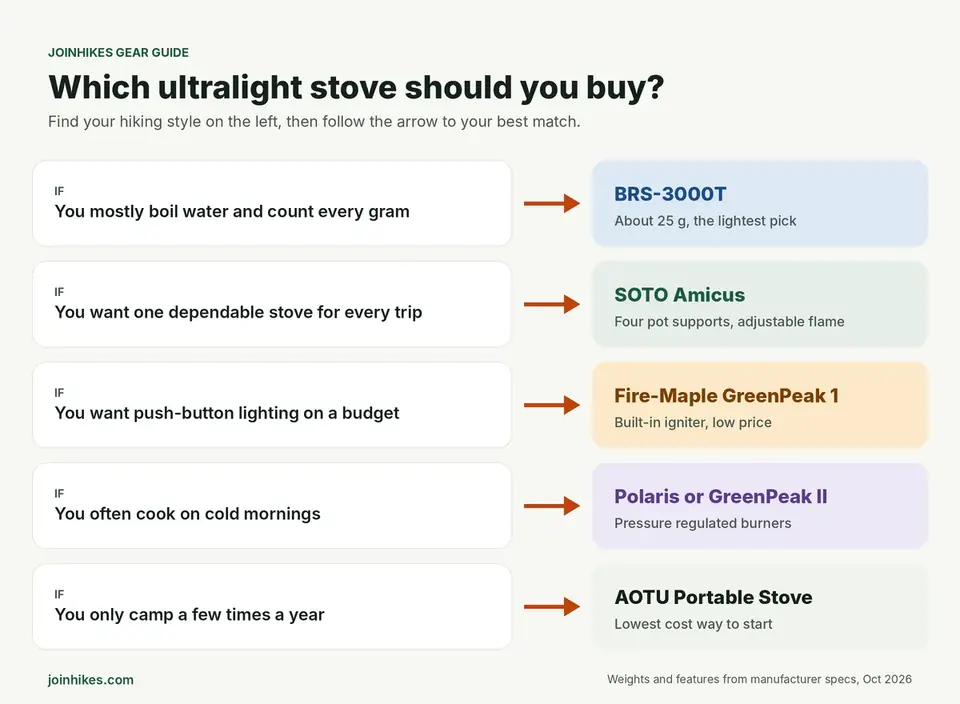
| Type of backpacker | Recommended stove |
|---|---|
| First-time backpacker | SOTO Amicus with Igniter |
| Best all-round stove | SOTO Amicus without Igniter |
| Strict ultralight hiker | BRS-3000T |
| Budget beginner | Fire-Maple GreenPeak 1 |
| Lightweight regulated burner | Fire-Maple Polaris |
| Regulated burner with ignition | Fire-Maple GreenPeak II |
| Occasional camping | AOTU Portable Stove |
Buying Guide: What to Look for in an Ultralight Backpacking Stove
1. Don’t judge a stove only by its weight
Your cooking kit also includes a pot, a fuel canister, and an ignition source, so the complete weight matters more than burner weight alone. Choosing a 25-gram stove over a 75-gram model saves 50 grams, which may not be worthwhile if your pot is unstable or the stove struggles in your usual conditions.
2. Decide what you’ll cook
If your meals mostly need boiled water, a small burner may be enough. For oatmeal, rice, soup, or anything that needs lower heat, adjustable flame control matters more. A stove designed mainly for fast boiling may be frustrating for controlled cooking.
3. Check pot support and stability
Consider the width of the pot supports and the manufacturer’s recommended cookware limits. Small supports usually suit compact solo pots, and a full pot of water is surprisingly heavy.
4. Understand wind performance
Wind is one of the biggest challenges for small burners: heat escapes around the pot, increasing fuel use and cooking time. Find a sheltered spot with stable ground and safe airflow. Never surround a canister with an improvised enclosed windscreen that could cause overheating.
5. Compare ignition systems
Some stoves need a lighter or match; others have push-button piezo ignition. Built-in ignition is convenient, but it shouldn’t be your only way to start the stove. Carry a backup lighter.
6. Make sure your fuel canister is compatible
Most upright canister stoves here use compatible threaded backpacking canisters. Don’t assume all propane, butane or camping fuel containers share the same connector. Use only fuel approved by the manufacturer; fuel is usually sold separately.
7. Consider fuel use, not only burner price
Fuel use depends on flame setting, cookware, wind, temperature, meal type, and how much water you heat. On longer trips, cooking efficiency may matter more than saving a few dollars on the burner.
8. Consider cold-weather limitations
Fuel pressure changes with temperature. Pressure regulation can help in some conditions, but it doesn’t guarantee reliable cold-weather performance. Check the stove’s operating requirements before cold trips.
9. Always prioritize cooking safety
Fuel-burning stoves create fire and carbon-monoxide hazards. Use them outside in a well-ventilated area, never inside a tent, vehicle, or enclosed shelter. Keep the stove stable, inspect the fuel connection, and follow local fire restrictions.
Head-to-Head Comparisons
Stuck between two stoves? Here’s how the most common matchups compare, side by side.
BRS-3000T VS SOTO Amicus
| Feature | BRS-3000T | SOTO Amicus (no igniter) |
|---|---|---|
| Weight | About 25 g Lighter | 75 g |
| Built-in igniter | No | No |
| Pot support | Narrow, compact | Four folding supports |
| Wind | Vulnerable to wind | Concave burner helps, but not windproof |
| Best for | Boiling water with minimum weight | All-round trail cooking |
| Shop | Check price | Check price |
SOTO Amicus VS Fire-Maple GreenPeak 1
| Feature | SOTO Amicus (no igniter) | Fire-Maple GreenPeak 1 |
|---|---|---|
| Weight | 75 g Lighter | About 85 g |
| Built-in igniter | No | Yes (piezo) |
| Reference price | $44.95 | $19.95 Cheaper |
| Rated output | 3,020 W | 2.8 kW |
| Pot support | Four folding supports | Folding supports |
| Best for | Frequent backpacking | Occasional budget trips |
| Shop | Check price | Check price |
GreenPeak 1 VS GreenPeak II
| Feature | Fire-Maple GreenPeak 1 | Fire-Maple GreenPeak II |
|---|---|---|
| Weight | About 85 g Lighter | About 95 g |
| Built-in igniter | Yes | Yes |
| Pressure regulator | No | Yes |
| Reference price | $19.95 Cheaper | Under $50 |
| Rated output | 2.8 kW | 2.6 kW |
| Best for | Budget convenience | Regulated cooking with ignition |
| Shop | Check price | Check price |
Hornet II VS FMS-300T
| Feature | Fire-Maple Hornet II | Fire-Maple FMS-300T |
|---|---|---|
| Weight | 48.5 g | About 45 g Lighter |
| Material | Titanium | Titanium |
| Built-in igniter | No | No |
| Rated output | About 2.5 kW | 2.6 kW |
| Best for | Simple meals in light solo kits | Compact solo cooking |
| Shop | Check price | Check price |
Polaris VS GreenPeak II
| Feature | Fire-Maple Polaris | Fire-Maple GreenPeak II |
|---|---|---|
| Weight | About 76 g Lighter | About 95 g |
| Built-in igniter | No | Yes |
| Pressure regulator | Yes | Yes |
| Rated output | 2.5 kW | 2.6 kW |
| Best for | Regulation at a lower weight | Regulation plus push-button start |
| Shop | Check price | Check price |
Build a Complete Cook Kit for Around $50
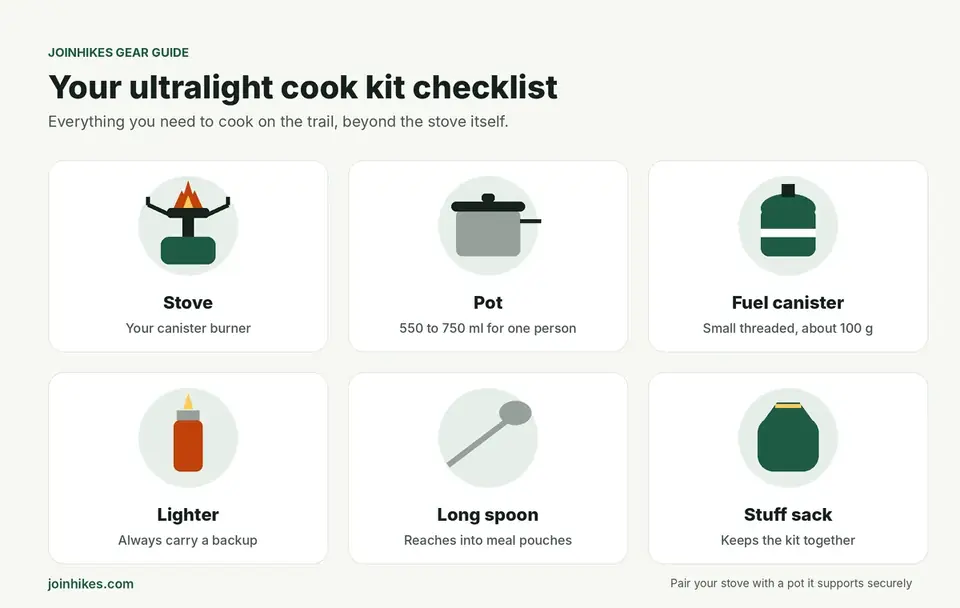
A stove alone won’t cook dinner. You also need a pot, fuel, and a way to light it. Here’s a simple solo setup built around the stoves in this guide:
| Item | What to choose |
|---|---|
| Stove | BRS-3000T for the lightest kit, or Fire-Maple GreenPeak 1 if you want push-button ignition. |
| Pot | A 550–750 ml pot for one person. The BRS’s pot supports span only about 82 mm, so small solo pots sit most securely on it. |
| Fuel | A small threaded isobutane-propane canister for short solo trips; a medium one for longer trips or two people. |
| Lighter | A mini lighter or waterproof matches, even if your stove has a built-in igniter. |
| Extras | A long-handled spoon and a small stuff sack to keep everything together. |
Bikepacking.com put together a BRS-based cook kit for about $50 that weighs under 200 grams in total, which shows how light a budget setup can be. Prefer a ready-made bundle? CleverHiker names the SOTO Amicus Stove Cookset Combo, around $50, as its best budget stove-and-cookset bundle.
Fuel Canisters Explained
Which canisters fit?
These stoves screw onto threaded backpacking canisters, the common type sold by outdoor brands. They do not fit the green propane bottles or the push-in butane cans used by tabletop camp stoves.
Which size to buy
Small canisters (about 100–110 g of fuel) suit short solo trips. Medium ones (about 220–230 g) suit longer trips or two people. Larger canisters are better left for car camping.
Flying to your hike?
Fuel canisters are not allowed in carry-on or checked bags on US flights. Pack the stove clean and empty, then buy fuel at an outdoor store near the trailhead.
Cold mornings
Canisters lose pressure in the cold. Keep yours in your sleeping bag or a jacket pocket overnight so it’s warmer when you light the stove.
How to Use and Care for Your Stove
- Check that the threads and rubber O-ring are clean and undamaged.
- Screw the stove onto the canister hand-tight. Don’t force it.
- Unfold the pot supports fully and set the stove on flat, stable ground outdoors.
- Open the valve slightly, light it, then adjust the flame.
- Center your pot on the supports and stay with the stove while it burns.
- Close the valve, let the stove cool completely, then remove it from the canister.
- Store the stove and canister separately. Replace the O-ring if it looks cracked or the connection smells of gas.
When Is It Worth Spending More Than $50?
MSR PocketRocket 2
The stove many reviewers treat as the benchmark. CleverHiker lists it at about $50, and 99Boulders found it had the best wind performance of the ultralight canister stoves they tested. We left it out because its price often sits at or above our $50 limit, but it’s worth a look if you can stretch your budget and often cook in wind.
Integrated systems (like Jetboil Flash)
The stove and pot lock together for fast, wind-resistant boiling. CleverHiker lists the Flash at about $130. They’re heavier and bulkier, so they suit coffee lovers and dehydrated-meal fans more than strict ultralight hikers.
Liquid-fuel stoves
Stoves like the MSR WhisperLite handle winter conditions better than canister stoves, but they cost more, weigh more, and need priming.
Alcohol and wood stoves
Very cheap or fuel-free, but slower, harder to control, and often banned during fire restrictions. Check local rules before relying on one.
Common Backpacking Stove Buying Mistakes
- Buying only by weight: A very small stove may not suit your cooking pot or meals.
- Ignoring fuel compatibility: Not all fuel containers connect to the same type of stove.
- Assuming built-in ignition never fails: A backup lighter is still important.
- Using oversized cookware: A tiny burner can be unstable under a large, full pot.
- Overlooking wind exposure: Wind can increase fuel use and cooking time.
- Forgetting total cooking-system weight: Burner weight is only one part of your kit.
- Cooking in enclosed spaces: This creates serious carbon-monoxide and fire hazards.
- Choosing a stove because of Amazon stars alone: Ratings don’t establish suitability for your cookware or hiking conditions.
Frequently Asked Questions
What is the best ultralight backpacking stove under $50?
The SOTO Amicus without Igniter is our overall research-based recommendation for a useful balance of lightweight construction, pot support, and flame control. For strict ultralight hikers, the BRS-3000T is a lighter alternative.
What is the lightest stove in this guide?
The BRS-3000T is the lightest in our comparison at approximately 25 grams.
Are cheap backpacking stoves worth buying?
They can be worthwhile when their intended use matches your hiking conditions. A simple inexpensive burner may work well for occasional water boiling. More frequent backpackers may benefit from stronger support, better cooking control, and established product reliability.
Do I need a stove with built-in ignition?
Not necessarily. Built-in ignition is convenient, but a separate lighter is still a useful backup.
Can I cook actual meals on an ultralight stove?
Yes, but cooking ability varies. Stoves with more adjustable flames and suitable pot supports are generally better choices for meals requiring lower heat.
Are titanium stoves better than stainless-steel stoves?
Titanium can reduce weight, but the material alone doesn’t determine flame performance, support stability, or fuel efficiency.
Is a pressure-regulated stove worth it?
A regulator can help manage fuel delivery as canister pressure changes. Whether it’s worth the additional cost depends on the conditions where you usually cook and the stove’s overall performance.
Can I use any fuel canister?
No. Always use the specific fuel and connection type approved by the stove manufacturer.
How much fuel should I carry for a weekend trip?
It depends on the number of meals, water volume, weather, fuel type, and cooking style. Plan around your actual meals and manufacturer guidance rather than assuming one fixed fuel quantity works for everyone.
Can I use a backpacking stove inside my tent?
No. Fuel-burning stoves should not be used in tents or other enclosed shelters because of carbon-monoxide poisoning and fire hazards.
Why isn’t the MSR PocketRocket 2 on this list?
It’s an excellent stove, but its price often sits at or above $50. If you can stretch your budget, see our “When Is It Worth Spending More” section above.
How do I know my BRS-3000T is genuine?
Copycat versions are common. Buy a listing clearly branded BRS, check recent buyer comments for quality complaints, and test the stove at home before your trip.
Can I take a backpacking stove on a plane?
The stove itself can usually travel if it’s completely empty and clean, but fuel canisters are not allowed in carry-on or checked bags on US flights. Buy fuel near the trailhead.
What size pot works best with an ultralight stove?
For one person, a 550–750 ml pot is a good match. Small stoves have narrow pot supports, so wide or heavy pots can become unstable.
Final Verdict: Which Stove Should You Buy?
You don’t need to spend a fortune to build a lightweight cooking kit. For most weekend backpackers, the SOTO Amicus without Igniter is our preferred all-round option.
If you’re trying to keep your kit as light as possible, the BRS-3000T is an attractive minimalist burner. If you want an inexpensive stove with push-button ignition, the Fire-Maple GreenPeak 1 is a good budget candidate. For pressure regulation, compare the Fire-Maple Polaris and GreenPeak II. And if you only backpack occasionally, the AOTU may be enough for basic cooking, provided its durability limitations fit your needs.
The best backpacking stove isn’t always the lightest, most powerful, or cheapest. It’s the one that safely supports your cookware, works with your fuel, and matches the meals you actually cook on the trail.
Our final choice: Check SOTO Amicus on AmazonPlan Your Next Trip
Editorial disclosure: JoinHikes researches outdoor equipment using manufacturer information and available independent testing, including SOTO and Fire-Maple product information, OutdoorGearLab reviews, Bikepacking.com, Backpacking Light, CleverHiker and 99Boulders. Product recommendations in this article do not represent a hands-on comparison conducted by JoinHikes. Amazon offers, availability, ratings and selling prices can change. Check product details before purchasing.
5 thoughts on “Best Ultralight Backpacking Stoves Under $50: 10 Picks Compared”