
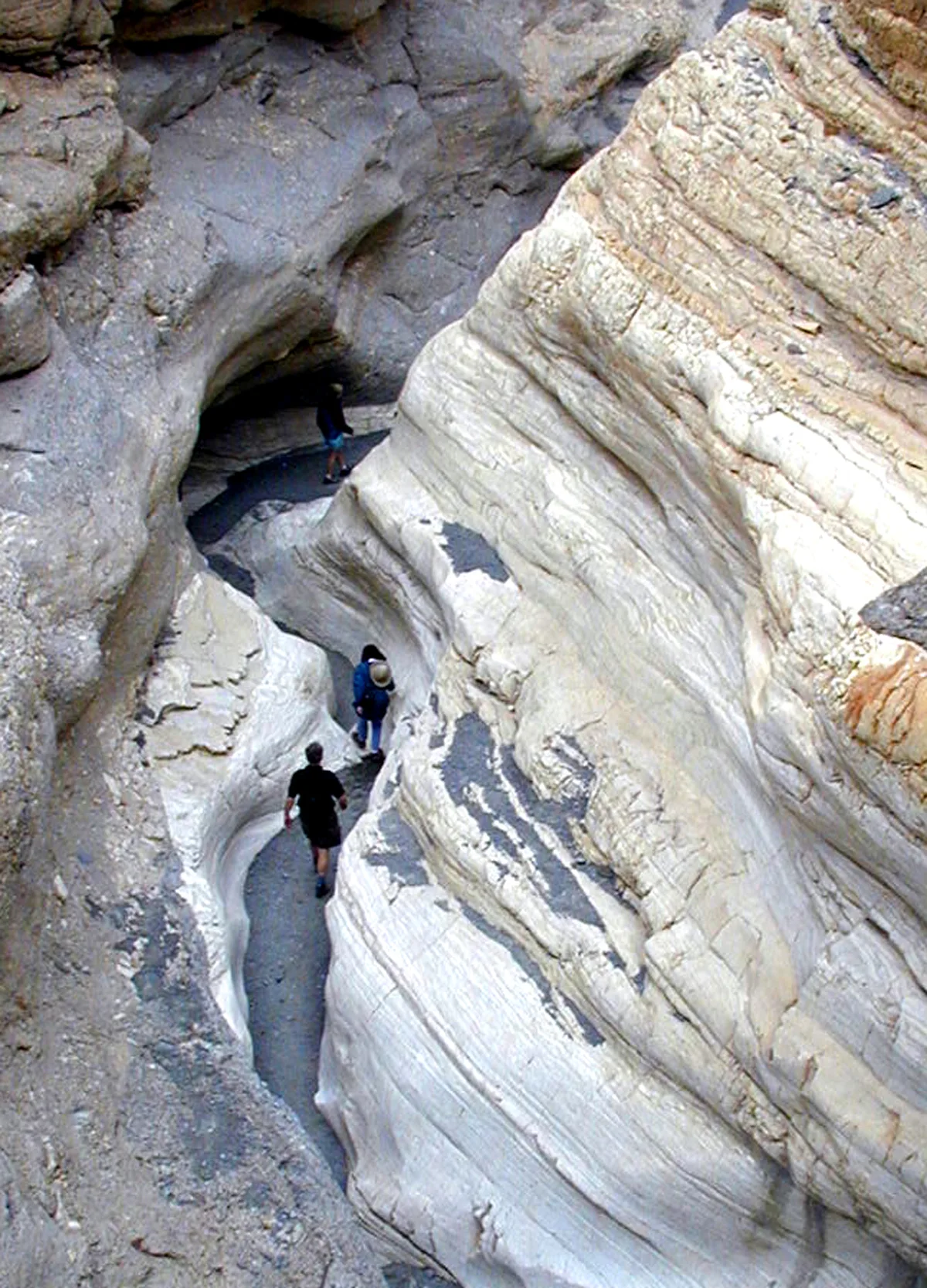
Imagine running your hand along a canyon wall that feels like a smooth kitchen countertop. Then look closely and see it’s swirled with gray, white and black bands, like marble cake. That’s Mosaic Canyon.
The Mosaic Canyon Trail in Death Valley is short, but it packs in a lot: polished marble narrows, walls made of colorful “mosaic” rock, a fun boulder jam to scramble over, and a dead end at a tall dry waterfall. It’s the closest thing to a slot canyon most visitors will find in the park, and it’s just a few minutes from Stovepipe Wells.
This guide walks you through the whole hike in plain English: how to get there on the dirt road, what each section looks like, where people get stuck (and how to get past), how hard it really is, the best time to go, and how to stay safe.
Quick answer
- Distance: about 4 miles round trip to the end of the canyon (NPS).
- Time: 2.5 to 3 hours.
- Elevation gain: about 1,200 feet.
- Difficulty: moderate to difficult, with some scrambling.
- Short option: the first narrows are just 0.25 miles in. A 30–45 minute walk shows you the best marble.
- Getting there: 2.3-mile gravel road from Stovepipe Wells, usually fine for regular cars.
- Best time: November to March. Never during rain.
Mosaic Canyon Trail at a Glance
| Location | Death Valley National Park, near Stovepipe Wells Village |
| Trailhead | End of Mosaic Canyon Road, 2.3 miles from Highway 190 |
| Distance | About 4 miles round trip (out and back) |
| Elevation gain | About 1,200 ft |
| Time | 2.5–3 hours |
| Difficulty | Moderate to difficult (scrambling) |
| Road | Unpaved, usually passable by sedans. Buses and large RVs not recommended. |
| Parking | Large gravel lot |
| Restrooms / water | None at trailhead. Nearest at Stovepipe Wells General Store and Restaurant. |
| Dogs | Not allowed |
| Best season | November to March |
Why Mosaic Canyon Is Worth Hiking
Most canyons in Death Valley are wide washes with crumbly walls. Mosaic Canyon is different. Floods carrying sand and gravel have scoured the narrow parts for thousands of years, sanding the rock until it’s glassy smooth. In places it almost shines.
Here’s what makes it special:
- Polished marble narrows you can touch, slide down and squeeze through.
- “Mosaic” walls made of broken rock pieces cemented together like a tile mosaic.
- Fun scrambling that feels adventurous but isn’t technical for most of the way.
- Easy access, just minutes from Stovepipe Wells and the Mesquite Flat Sand Dunes.
- Flexible length: walk 15 minutes or the full 4 miles.
The Geology, Made Simple
You don’t need to know any geology to enjoy this hike, but knowing two words makes it more fun.
Noonday Dolomite (the smooth marble)
The smooth gray and white walls in the narrows are Noonday Dolomite that has turned into marble over a very long time. When flash floods rush through, the sand and gravel in the water work like sandpaper and polish the walls smooth.
Mosaic Canyon Breccia (the “mosaic”)
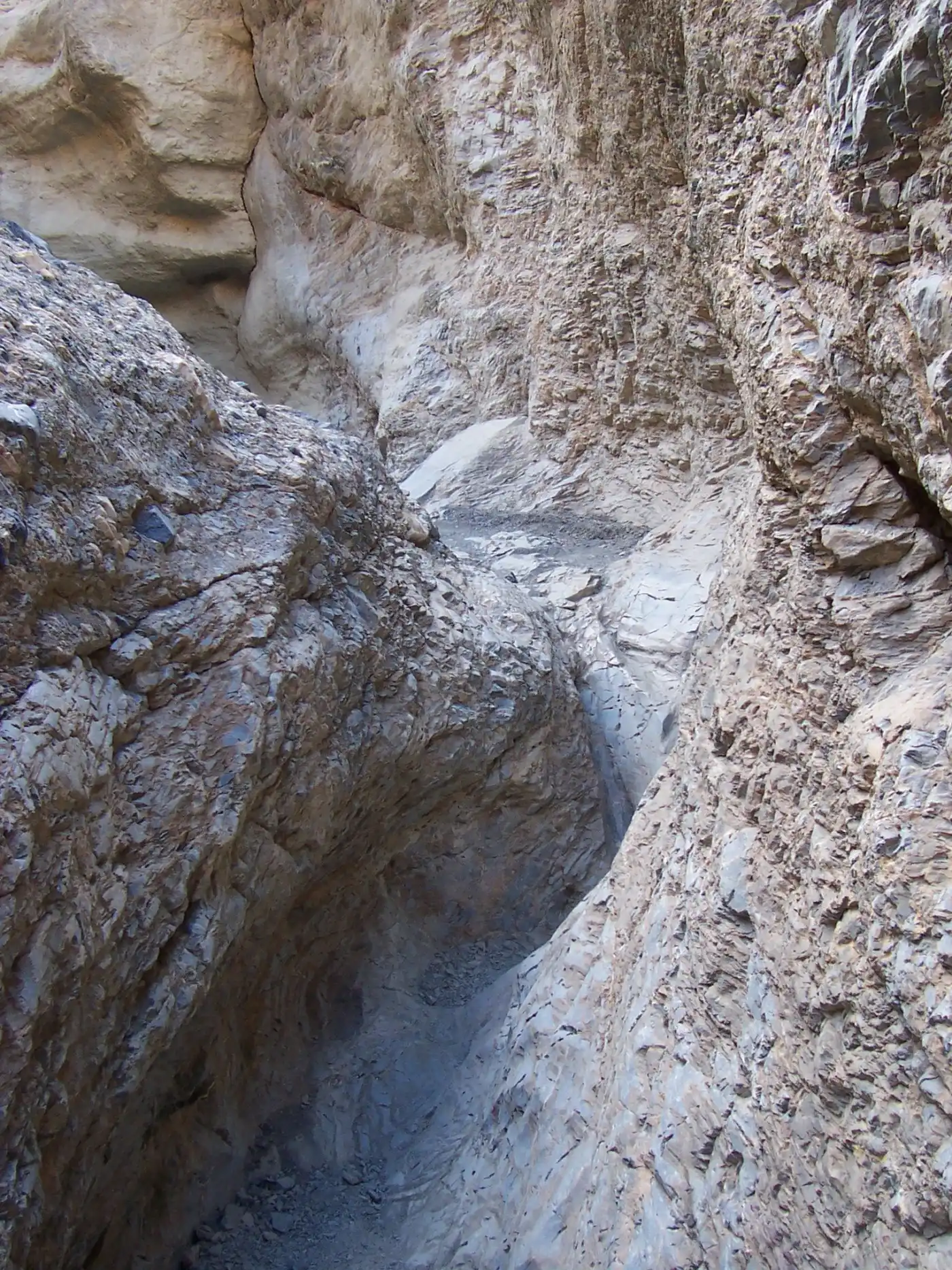
The canyon gets its name from this rock. Breccia (say “BRETCH-ee-uh”) is made of sharp, angular chunks of different rocks that got cemented together. Look at the walls in the wider sections and you’ll see what looks like a giant mosaic of stones in a natural concrete.
How to Get to the Mosaic Canyon Trailhead
- Drive to Stovepipe Wells Village on Highway 190. It’s about 25 miles west of Furnace Creek.
- Just west of the village, across from the Stovepipe Wells campground, turn south onto Mosaic Canyon Road.
- Drive the 2.3-mile gravel road uphill to the large parking lot at the end.
Can a regular car make it?
Usually, yes. The NPS says the road is typically passable by sedans. It can be bumpy and washboarded, so drive slowly. Buses and large RVs aren’t recommended. After storms, the road can be damaged or closed, so check the NPS conditions page before you go.
Restrooms and water
There are no toilets or water at the trailhead. Use the facilities and fill your bottles at Stovepipe Wells (General Store and Restaurant) before you drive up.
Mosaic Canyon Trail: Step-by-Step
The trail follows the canyon floor the whole way, so you can’t really get lost in the main canyon. But a few spots confuse people. Here’s what to expect, section by section.
1. Trailhead to the first narrows (0 to 0.25 miles)
From the parking lot, walk into the wide wash heading uphill. Within about a quarter mile, the walls squeeze together and you enter the first narrows. You also enter official wilderness here.
This is the most famous part of the hike. The marble is polished smooth, and the floor curves and dips like a frozen river. Kids love sliding down the smooth chutes. It’s also the most photographed spot, so it can be busy mid-morning.
Short on time? Walk through the first narrows, enjoy them, and turn around. That’s about 30 to 45 minutes round trip and shows you the best of Mosaic Canyon.
2. The open middle section (about 0.5 to 1.3 miles)
After the first narrows, the canyon opens up into a wider, gravelly wash. This is a good place to look at the breccia walls up close. The walking is easy, with a steady uphill grade. You’ll see a few side canyons. Stay in the main, widest wash.
3. The boulder jam (about 1.3 miles)
Around 1.3 miles in, big boulders block the canyon. Many people think this is the end and turn around. It isn’t.
How to get past: look to the left (east) side. You can crawl and scramble around the jam there. Past it, you reach the second narrows, which are quieter and just as pretty as the first.
4. The slanted dryfall (about 1.5 miles)
About 0.2 miles past the boulder jam, you hit a slanted dryfall about 20 feet high. This is where people get into trouble. Don’t try to climb it. The polished rock is slippery, and people have been hurt here.
The bypass: walk back down canyon about 180 feet and look for a faint path climbing the western (right-hand going up) wall. It takes you up and around the dryfall, about 40 feet above the canyon floor, then back down.
This bypass is exposed in places. If you’re afraid of heights or not comfortable on loose rock, the NPS suggests turning around at the first dryfall. That’s a perfectly good hike.
5. The third narrows and the end (about 1.8 to 2 miles)
About 0.3 miles further, you reach the third narrows. Then the canyon ends in a small amphitheater at a vertical dryfall about 25 feet high. This is the turnaround point for hikers. Have a snack in the shade and head back the same way.
Going back down is easier on your lungs but harder on your knees, and the polished marble can be slippery when you’re stepping down. Take it slow.
| Point | Approx. distance from trailhead | What to do |
|---|---|---|
| First narrows | 0.25 mi | Enjoy the polished marble; good turnaround for families |
| Boulder jam | 1.3 mi | Bypass on the left (east) side |
| Slanted ~20-ft dryfall | ~1.5 mi | Go back ~180 ft; climb faint path on the west wall |
| Third narrows | ~1.8 mi | Keep going |
| 25-ft vertical dryfall | ~2 mi | End of hike; turn around |
How Hard Is the Mosaic Canyon Trail?
The NPS rates it moderate to difficult. Here’s why:
- Elevation: about 1,200 feet of gain over 2 miles. It’s uphill the whole way in.
- Scrambling: the boulder jam and dryfall bypass need hands and careful footwork.
- Slippery rock: polished marble has little grip, especially with dusty or smooth-soled shoes.
- Heat: the canyon blocks breezes, and the lower parts get very hot when the sun is high.
Mosaic Canyon difficulty by section
| How far you go | Round trip | Difficulty | Who it’s for |
|---|---|---|---|
| First narrows only | About 0.5–1 mi | Easy | Families, beginners, everyone |
| To the boulder jam | About 2.6 mi | Moderate | Most hikers |
| To the end (both dryfall areas) | About 4 mi | Moderate to difficult | Confident hikers who are fine with heights and scrambling |
Is Mosaic Canyon good for kids?
The first narrows are wonderful for kids. They’ll want to slide down every smooth chute. Keep a close eye on them on the slick rock, and turn back before the dryfall bypass, which has drop-offs.
Is it good for beginners?
Yes, up to the boulder jam. Beginners should skip the dryfall bypass. Our hiking for beginners guide has more tips on getting started.
Best Time to Hike Mosaic Canyon
By season
- November to March: the best time. Mild temperatures, mostly sunny days.
- October and April: fine if you start early. It can heat up quickly.
- May to September: dangerous heat. The NPS advises not to hike low-elevation trails after 10 a.m. in summer. If you go, start at sunrise and only explore the first narrows.
By time of day
Morning is best. It’s cooler, quieter, and the soft light makes the marble glow. By late morning, the first narrows fill up with visitors. Late afternoon is pretty too, but the canyon gets dark early in winter, so give yourself plenty of time.
Never hike in rain
Mosaic Canyon is a narrow drainage. During a storm, flash floods can fill it in minutes, and there’s often nowhere to climb out in the narrows. If rain is in the forecast for the area, even in the distant mountains, skip it.
What to Bring
- Water: at least 2–3 liters per person for the full hike in cool weather. More if it’s warm.
- Grippy shoes: trail runners or hiking shoes with sticky rubber soles. This matters more here than on most trails because of the slick marble.
- Snacks with some salt.
- Sun hat, sunglasses and sunscreen.
- A light jacket for chilly winter mornings in the shady narrows.
- Map and compass, plus your phone’s GPS. The NPS recommends a map and compass, with GPS as a backup.
- Small first aid kit for scrapes from the scrambling.
- Gloves (optional): helpful on the rough breccia when scrambling.
Want more support on the steep, slick sections? A pair of trekking poles helps a lot on the way down. See our guide to the best hiking poles. For a safety backup on remote desert trips, check out our best emergency radios for hiking.
Mosaic Canyon Safety Tips
- Don’t climb the dryfalls. Use the bypasses described above, or turn around.
- Watch your footing on polished rock. It’s especially slick when dusty or wet.
- Know when to turn back. If a move feels scary going up, it’ll be scarier coming down.
- Flash floods: stay out if rain is possible.
- Heat: turn back when half your water is gone, and watch for signs of heat illness like dizziness, headache or nausea.
- Wilderness rules: no bikes or vehicles past the trailhead. Don’t scratch or mark the marble.
- Tell someone where you’re going and when you’ll be back. Cell service is poor.
Park Rules and Fees
- Entrance fee: required for Death Valley, per vehicle, good for 7 days. Buy online before arriving. America the Beautiful passes work.
- No permit is needed for a day hike.
- No dogs on trails.
- No drones.
- Pack out all trash and leave rocks where you find them.
Mosaic Canyon vs. Golden Canyon: Which Should You Hike?
| Mosaic Canyon | Golden Canyon | |
|---|---|---|
| Area | Stovepipe Wells | Furnace Creek |
| Main highlight | Polished marble narrows | Golden badlands and Red Cathedral |
| Distance | Up to 4 mi round trip | 3 mi to Red Cathedral, loops up to 7.8 mi |
| Elevation gain | About 1,200 ft | About 577 ft (Red Cathedral) |
| Scrambling | More (boulder jam, dryfall bypass) | Less (a few ledges) |
| Access road | 2.3 mi gravel | Paved |
| Restroom at trailhead | No | Yes (vault toilet) |
Both are great, and many people do both on the same day. If you only have time for one: pick Mosaic for a narrow, adventurous canyon, or Golden Canyon for big colorful views and loop options.
Things to Do Near Mosaic Canyon
- Mesquite Flat Sand Dunes: just east of Stovepipe Wells. Perfect for sunset after your canyon hike. Read our full Mesquite Flat Sand Dunes hike guide.
- Stovepipe Wells Village: general store, restaurant, gas, lodging and a campground.
- Salt Creek Interpretive Trail: an easy boardwalk where you may see tiny pupfish in spring.
- Harmony Borax Works: a short historic walk near Furnace Creek.
- Stargazing: Death Valley is an International Dark Sky Park. The dunes area is a great spot.
Suggested One-Day Plan (Stovepipe Wells Area)
- Early morning: sunrise photos at the Mesquite Flat Sand Dunes.
- 8:30 a.m.: drive up Mosaic Canyon Road and hike the canyon.
- Noon: lunch at Stovepipe Wells.
- Afternoon: drive to Furnace Creek, stop at Salt Creek or Harmony Borax Works.
- Late afternoon: a short walk into Golden Canyon, then sunset at Zabriskie Point.
Frequently Asked Questions
How long is the Mosaic Canyon Trail?
About 4 miles round trip to the final 25-foot dryfall, according to the NPS. You can turn around anywhere. The first narrows are only a quarter mile from the trailhead.
How long does Mosaic Canyon take?
About 2.5 to 3 hours for the full hike. Just the first narrows take 30 to 45 minutes.
Is Mosaic Canyon hard?
The first narrows are easy. The full hike is moderate to difficult because of about 1,200 feet of climbing, a boulder jam and an exposed dryfall bypass.
How do you get past the boulder jam in Mosaic Canyon?
Crawl and scramble around it on the left (east) side.
How do you get around the dryfall in Mosaic Canyon?
Don’t climb the slanted dryfall. Walk back about 180 feet and take the faint path up the western wall, which passes about 40 feet above the canyon floor and drops back in above the dryfall.
Can you drive a regular car to Mosaic Canyon?
Usually, yes. The 2.3-mile gravel road is typically passable by sedans. Buses and large RVs aren’t recommended. Check road conditions after storms.
Is there a bathroom at Mosaic Canyon?
No. The nearest restrooms are at Stovepipe Wells General Store and Restaurant.
Is Mosaic Canyon good for kids?
Yes, the first narrows are great for kids. Turn back before the dryfall bypass.
Can you bring dogs to Mosaic Canyon?
No. Pets aren’t allowed on Death Valley trails.
Is Mosaic Canyon a slot canyon?
Not a true slot canyon, but its narrows are the closest thing many visitors will find in Death Valley, with walls close enough to touch in places.
When is the best time to hike Mosaic Canyon?
November to March, in the morning. Avoid summer afternoons and never go when rain is possible.
Why is it called Mosaic Canyon?
Because of the Mosaic Canyon Breccia, a rock made of broken, angular pieces cemented together, which looks like a natural tile mosaic.
Final Thoughts
Mosaic Canyon is one of those hikes that’s fun from the very first minute. Even if you only walk to the first narrows, you’ll get to touch marble polished by thousands of years of floods. If you’re up for more, the boulder jam, the second and third narrows, and the final dryfall make it a real little adventure.
Go on a cool morning, wear shoes with good grip, use the bypasses instead of climbing the dryfalls, and stay away when rain is coming. Then finish your day with sunset at the dunes just down the road.
Keep planning: read our guides to Golden Canyon, the Mesquite Flat Sand Dunes, and the best winter hiking trails in the USA. Also exploring California’s desert parks? See the best hikes in Joshua Tree.
Before you go: check the official NPS Mosaic Canyon page and current park conditions.