
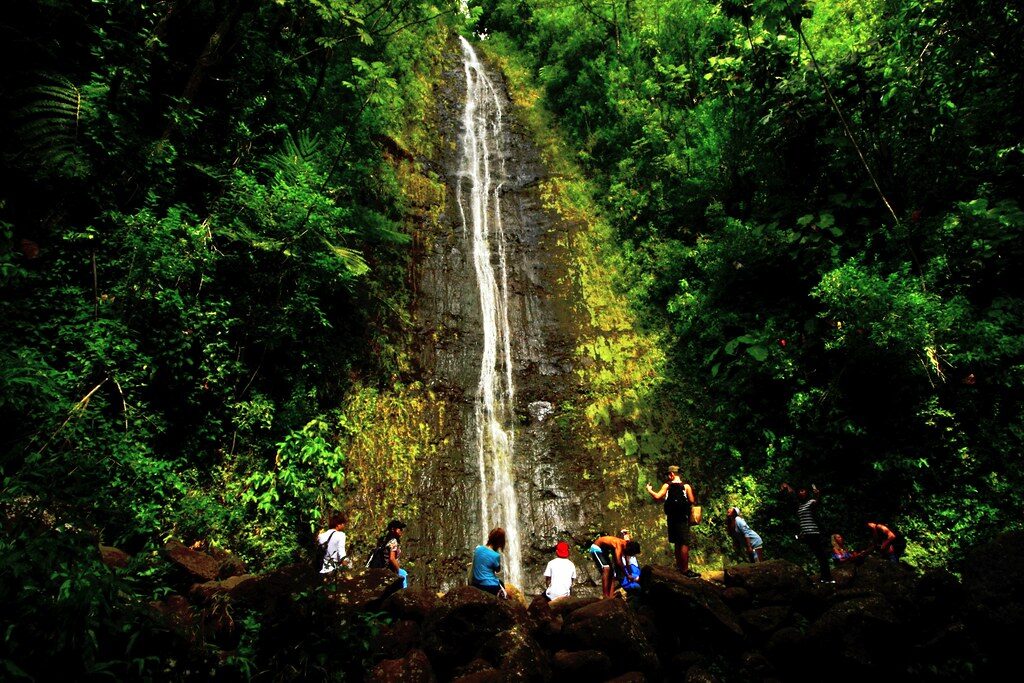
Fifteen minutes from the high-rises of Waikiki, the road through Mānoa Valley narrows, the houses thin out and the air turns cool and damp. Then you step onto the trail and Honolulu simply disappears. Giant banyans, towering eucalyptus and creaking bamboo close in overhead, birds call from somewhere you can’t see, and a muddy path leads you deeper into one of the wettest corners of Oahu. At the end, a slender ribbon of water drops about 150 feet down a mossy cliff. That’s Manoa Falls.
It’s one of Oahu’s most popular hikes, with around 200,000 visitors a year, and it’s easy to see why. It’s short, close to town, free, and it feels like walking into the opening scene of Jurassic Park (which, in fact, filmed here). But “easy” comes with an asterisk: this valley gets rain on most days of the year, and the mud is very real.
This guide covers everything you need: distance, difficulty, how long it takes, the mud and what to wear, parking and its hours, the bus, whether you need a reservation, the latest 2026 trail updates, swimming rules, the best time to go, the longer Aihualama Trail to a hidden lookout, and what to do nearby.
Cover photo: Manoa Falls at the end of the trail. Photo: Edmund Garman / Flickr, CC BY 2.0
Manoa Falls Hike: The Short Answer
The Manoa Falls Trail is a 1.6-mile round-trip hike (0.8 mile each way) at the back of Mānoa Valley in Honolulu, climbing roughly 600–800 feet through rainforest to a waterfall about 150 feet tall. It’s rated easy to moderate and takes most people 1 to 2 hours. The trail is free, open sunrise to sunset, and needs no reservation. Parking at the Paradise Park lot costs about $7 ($4 for Hawaii residents and military) and is open roughly 8 a.m. to 6 p.m. Expect mud on any day, wear shoes with real grip, bring bug spray, and don’t swim or go past the barrier at the falls. As of late October 2026, the trail is open.
Manoa Falls Hike at a Glance
| Detail | Information |
|---|---|
| Location | Back (mauka end) of Mānoa Valley, Honolulu, Oahu |
| Managed by | Hawaii DLNR, Nā Ala Hele Trail and Access Program |
| Distance | About 1.6 miles round trip (0.8 mile each way); 1.7 miles with the walk from parking |
| Elevation gain | Roughly 600–800 feet, depending on the source and start point |
| Waterfall height | About 150 feet |
| Time | 1–2 hours round trip |
| Difficulty | Easy to moderate (harder when wet) |
| Trail surface | Gravel, dirt, roots, rocks, some steps and lots of mud |
| Trail hours | Sunrise to sunset |
| Trail fee | Free |
| Reservation | Not required |
| Parking | Paradise Park lot, about $7 ($4 kamaʻāina and military), roughly 8 a.m.–6 p.m. |
| Restrooms | Near the parking area only |
| Swimming | Not allowed |
| Strollers | Not suitable |
| Drive from Waikiki | About 15–25 minutes (roughly 5–6 miles) |
| Bus | TheBus Route 5 from Ala Moana Center, then about a 10-minute walk |
Is the Manoa Falls Trail Open Right Now?
Yes. As of late October 2026, there’s no closure posted for the Manoa Falls Trail. But this trail does close from time to time, so it’s worth a quick check before you drive up. Here’s the recent history:
- Spring 2026 maintenance: from March 30 to April 10, 2026, the trail was closed on weekdays from 6 a.m. to 2 p.m. while state crews and volunteers repaired storm damage, erosion and slippery sections. It returned to normal hours by April 11.
- July 2024 upgrade: the trail closed for a week so crews could harden the surface, widen the path, control runoff and remove invasive plants. Most of the route now has gravel, which makes it far less of a mud slide than it used to be.
- Recent rescues: on September 13, 2026, a hiker in his 20s slipped and fell about 30 feet near the trail in the evening and was airlifted out by the Honolulu Fire Department. Firefighters responded to other hikers in trouble here in August and October 2026, too. Most incidents involve slips on wet ground or people leaving the official trail.
Check the Nā Ala Hele Trail and Access website (hawaiitrails.ehawaii.gov) for closures, and the National Weather Service for flash flood watches, before you go.
Where Is the Manoa Falls Hike?
The trailhead sits at the very top of Mānoa Road, at the back of Mānoa Valley, just above the University of Hawaiʻi’s Lyon Arboretum. The valley runs inland from the University of Hawaiʻi at Mānoa campus into the Koʻolau mountains, which is why it catches so much rain.
From Waikiki it’s only about 5–6 miles: up through the university area, then all the way up Mānoa Road until it ends. That closeness is a big part of the appeal. You can be in the rainforest by 9 a.m. and back on the beach before lunch.
How Long Is the Manoa Falls Hike?
The Manoa Falls hike is about 1.6 miles (2.6 km) round trip: 0.8 mile from the trailhead to the falls and 0.8 mile back the same way. If you count the short walk from the parking lot up the road to the trailhead, most GPS watches read about 1.7 miles.
The climb is gradual for most of the way, then gets steeper and rockier in the last stretch before the falls. You’ll gain somewhere between 600 and 800 feet, depending on which app or guide you trust. Either way, it’s a steady uphill, not a brutal one.
How Manoa Falls Compares With Other Oahu Hikes
| Trail | Round trip | Climb | Difficulty | Reservation | Shade |
|---|---|---|---|---|---|
| Manoa Falls | 1.6 miles | 600–800 ft | Easy–moderate | No | Lots |
| Diamond Head | 1.6 miles | About 560 ft | Moderate | Yes, for nonresidents | Very little |
| Koko Head (Koko Crater Stairs) | 1.6 miles | About 990 ft | Strenuous | No | None |
Same distance on paper, three totally different days. Diamond Head is a hot, crowded climb with history and a crater view. Koko Head is a punishing stair workout in full sun. Manoa Falls is the cool, shady, muddy one.
How Long Does the Manoa Falls Hike Take?
Most people need 1 to 2 hours for the round trip, including time at the falls.
| Part of the outing | Typical time |
|---|---|
| Parking lot to trailhead | 5 minutes |
| Trailhead to the falls | 25–45 minutes |
| At the falls | 10–20 minutes |
| Back down | 25–45 minutes (slower when muddy) |
| Total hike | About 1–2 hours |
| Whole trip from Waikiki, including driving and parking | About 2.5–3 hours |
- Fit hikers on a dry day: often done in 45–60 minutes.
- Beginners: allow 1.5–2 hours so you can take the muddy parts slowly.
- Families with young kids: plan on 2 hours or a bit more. Kids love it, but they stop a lot (and so will you, to take photos).
Interestingly, the way down often takes as long as the way up. Going downhill on slick mud and roots is slower than climbing them.
Manoa Falls Hike Difficulty: How Hard Is It?
On a dry day it’s easy to moderate. After rain, it’s moderate, and your shoes become the deciding factor. The distance and climb are gentle by Oahu standards. What makes the trail tricky is the ground:
- Mud: the back of Mānoa Valley averages about 150 inches of rain a year, with measurable rain on roughly 280 days. Even on a sunny afternoon, the ground under the canopy rarely dries out.
- Roots and rocks: tree roots cross the path like slippery steps, and the upper section has wet rocks and uneven stone steps.
- The final stretch: the last few hundred yards before the falls are the steepest and rockiest part of the hike.
- Humidity: it’s shady and cooler than the coast, but the air is thick, so you’ll still sweat.
Is Manoa Falls Good for Beginners?
Yes. It’s one of the best first hikes on Oahu. The path is obvious, there’s shade the whole way, and you can’t really get lost. Just take your time on wet sections, use small steps going downhill, and don’t be embarrassed about using a hand on a tree or rock for balance. If you’re new to hiking, our hiking for beginners guide covers the basics.
Is Manoa Falls Good for Kids and Older Visitors?
School-age kids usually love it: giant trees to look at, bamboo that knocks in the wind, streams and bridges, and a waterfall at the end. Toddlers can do it in a carrier. Leave the stroller at home, because the trail has steps, roots and mud. Older visitors who walk regularly are usually fine; anyone with balance or knee problems should consider trekking poles and a dry day, or stop partway and enjoy the forest.
What to Expect on the Manoa Falls Trail, Step by Step
1. Parking Lot to the Trailhead
From the Paradise Park parking area, walk up the paved road past the Lyon Arboretum entrance and keep right where the road splits. You’ll pass a small trailhead area with signs and a boot-cleaning station. Use it on the way in and out. Cleaning your shoes helps stop invasive seeds, like those of the aggressive weed miconia, from spreading to other forests.
2. Into the Rainforest
Within a few steps the canopy closes overhead. You cross a small footbridge over the stream and walk through a grove of tall, peeling eucalyptus trees. The gravel path is wide and fairly flat here, and it’s a good time to just slow down and listen: dripping leaves, running water and birdsong.
3. Banyans, Ginger and Bamboo
The middle section is the most photogenic part of the hike. Huge banyan trees drop curtains of aerial roots, wild ginger and ti plants line the path, and then you walk into a bamboo forest, with stalks so tall and close together that they knock and creak in the wind. A few benches along the way make good rest stops. Most of what you see here isn’t native: much of the valley was planted with trees from around the world in the early 1900s to stop erosion.
4. The Final Climb
In the last part, the trail steepens, with rocky steps, roots and the muddiest ground of the hike. You’ll hear the falls before you see them. Near the end, the signed ʻAihualama Trail branches off to the left (more on it below).
5. Manoa Falls
The trail ends at a viewing area with a rock wall and a cable barrier. In front of you, Manoa Falls slides about 150 feet down a dark, moss-covered rock face into a small pool. It’s not the most powerful waterfall in Hawaii, but in a green bowl of rainforest, it’s a beautiful sight.

How Much Water Will the Falls Have?
It depends entirely on recent rain. After a wet few days, especially from fall through spring, the falls can be a wide, roaring curtain. In a dry spell, they may be a thin trickle down the rock. Don’t let a low flow put you off: for most people, the rainforest walk is the real highlight, and the falls are the bonus.
Can You Swim at Manoa Falls?
No. Swimming is not allowed, and the area past the rock wall and cable at the falls is closed. You’ll still see people climbing over. Please don’t. There are good reasons:
- Falling rocks: the cliff above the pool regularly sheds rocks, especially after rain. Rockfall is the main reason the pool was closed.
- Leptospirosis: this bacterial infection is found in many Hawaii freshwater streams and pools. It enters through cuts, eyes, nose or mouth, causes flu-like symptoms and can become serious. Don’t swim, don’t drink the stream water, and cover any cuts.
- Slippery rocks: the boulders around the pool are coated in algae and moss. Falls here have caused serious injuries.
- Flash floods: streams in Hawaii can rise in minutes after heavy rain up in the mountains, even when it’s not raining where you stand.
Manoa Falls Hike Parking
The Main Lot (Paradise Park)
- Where: at the very end of Mānoa Road, next to the old Paradise Park buildings (around 3737 Mānoa Rd, Honolulu, HI 96822).
- Cost: about $7 per car, or about $4 for Hawaii residents (kamaʻāina) and military with ID. Prices change, so check the sign.
- Hours: roughly 8 a.m. to 6 p.m. This is the catch: the lot opens later and closes earlier than the trail, which is open sunrise to sunset. Plan to be back at your car before closing.
- Facilities: restrooms and a small snack spot near the lot. There are no toilets on the trail.
- Busy times: the lot fills on weekends, holidays and late mornings. Arrive right at opening or come in the afternoon.
Other Parking Options
- Street parking is possible lower down Mānoa Road, where it’s legally allowed, but it adds a 10- to 20-minute uphill walk each way. Read every sign, don’t block driveways, and remember this is a quiet residential neighborhood.
- Lyon Arboretum’s lot is not for hikers. The arboretum uses its own parking reservations for its visitors.
- Break-ins happen at trailheads all over Oahu. Leave nothing visible in your car.
How to Get to Manoa Falls From Waikiki
- By car: about 15–25 minutes depending on traffic. Head toward the University of Hawaiʻi at Mānoa, get onto Mānoa Road and follow it until it ends at the parking area.
- By bus: take TheBus Route 5 (Mānoa Valley) from Ala Moana Center to the end of the line on Mānoa Road, then walk about 10 minutes uphill to the trailhead. From Waikiki, connect to Route 5 at Ala Moana. Check TheBus app for the current schedule.
- By rideshare: easy to get there; getting a ride back can take a while, since cell service is patchy at the top of the valley. Walk down toward the houses if your app struggles.
- By tour: several companies offer guided hikes with hotel pickup (see below).
Manoa Falls Hike Hours
The trail is open from sunrise to sunset. Keep these three things in mind:
- The parking lot has shorter hours (about 8 a.m.–6 p.m.), so sunrise hikers need to park legally on the street or come by bus or rideshare.
- It gets dark early under the canopy. Start by 4:30 or 5 p.m. at the latest so you’re back in daylight. The September 2026 rescue happened in the evening.
- Maintenance can change hours, as it did in spring 2026. Check the Nā Ala Hele website before you go.
Do You Need a Reservation for Manoa Falls?
No. The trail is free and open to everyone without a booking. People get confused because a few things nearby are booked separately:
- Parking is paid on the spot, no reservation needed.
- Lyon Arboretum, right next door, requires an online parking reservation for its own visitors.
- Guided tours are booked with the tour company.
That makes Manoa Falls one of the easiest big-name Oahu outings to do on a whim, unlike Diamond Head or Hanauma Bay.
Guided Manoa Falls Hike: Is a Tour Worth It?
You don’t need a guide to find the falls. The trail is short, well used and signed. A tour can still make sense if:
- You don’t have a car and don’t want to deal with buses or parking.
- You’d like a guide to explain the plants, birds, Hawaiian history and film locations.
- You want to combine Manoa Falls with other stops, like a city tour or a food stop.
Before booking, check whether hotel pickup and parking are included, how long you actually spend on the trail, the group size and the cancellation policy (useful in this rainy valley).
Best Time to Hike Manoa Falls
Best Time of Day
- Right when the lot opens (around 8 a.m.): the quietest trail, soft light and the best chance of having the falls almost to yourself.
- 10 a.m. to 2 p.m.: the busiest time, especially with tour groups.
- Mid-afternoon: crowds thin out, but leave enough time to be out before dark and before the lot closes.
Best Time of Year
There’s no truly dry season here. Lyon Arboretum, right beside the trailhead, records rain on most days of the year, with the wettest months usually July and November and the driest February. In practice:
- Fall through spring: bigger, more impressive falls, but more mud and more flash flood risk.
- Summer: often a little less slippery, with smaller falls and bigger crowds.
- Any time: skip it during heavy rain or a flash flood warning. A roaring waterfall is not worth it.
One bonus of all that rain: Mānoa is famous for rainbows. They show up so often that the University of Hawaiʻi at Mānoa’s sports teams are called the Rainbow Warriors and Rainbow Wahine.
What to Wear and Bring
- Shoes with real grip: trail runners or hiking shoes. Flip-flops and smooth-soled sneakers are how most people end up sliding on their backside. Wear shoes you don’t mind getting muddy; the red dirt stains.
- Mosquito repellent: non-negotiable. This is a wet rainforest, and they’ll find you.
- A light rain jacket or poncho: showers come and go fast. See our waterproof hiking jacket and hiking poncho guides.
- Water: about half a liter to a liter per person. It’s shady, but humid.
- A dry bag or zip bag for your phone (our waterproof bags guide has options).
- Trekking poles (optional): helpful on the muddy descent, especially in winter and spring. A budget pair is plenty.
- A change of shoes and a plastic bag to leave in the car. Your rental car will thank you.
Insider Tips for a Better Manoa Falls Hike
- Look at the sky over the mountains, not over Waikiki. It can be sunny on the beach and pouring at the back of the valley.
- Walk on the gravel, not the edges. The sides of the path are where the deepest mud collects.
- Step on roots carefully. Wet roots are slicker than mud. Step between them when you can.
- Go down with short, flat-footed steps and keep your weight over your feet.
- Stay on the official trail. Side paths near the falls are steep, unofficial and behind many of the rescues.
- Brush your shoes at the cleaning station on the way in and out to protect Oahu’s forests.
- Be patient with photos. The falls area is small. Wait your turn, and you’ll often get a clear shot within a minute or two.
- Leave the drone at home. The canopy, crowds and narrow valley make it a bad idea.
Common Mistakes to Avoid
- Thinking “short” means “easy” in any weather. After heavy rain, 1.6 miles of mud can take twice as long.
- Arriving at sunrise and expecting to park in the lot. It usually doesn’t open until about 8 a.m.
- Starting too late. It’s dark under the trees well before official sunset, and the lot closes earlier.
- Climbing past the barrier for a closer photo or a swim.
- Not checking for closures after storms or during maintenance.
Want More? The ʻAihualama Trail to Nuʻuanu Lookout
If the falls feel too short, look for the ʻAihualama Trail, which branches off to the left just before Manoa Falls. It climbs out of the valley on rocky switchbacks and through a dense, eerie bamboo forest, then meets the Pauoa Flats Trail. Turn right there and walk about a quarter mile to the Nuʻuanu Valley Lookout, a perch with a bench and a dramatic view down the other side of the mountains toward the windward coast.
- Distance: about 5 miles round trip from the parking lot
- Climb: about 1,300–1,400 feet
- Time: about 3–4 hours
- Difficulty: moderate, but muddier and more slippery than the main trail, especially across Pauoa Flats
It’s a great choice for experienced hikers who want fewer people and a bigger reward. Start early, carry more water, and check for closures.
A Little History: Mānoa Valley and the Movies
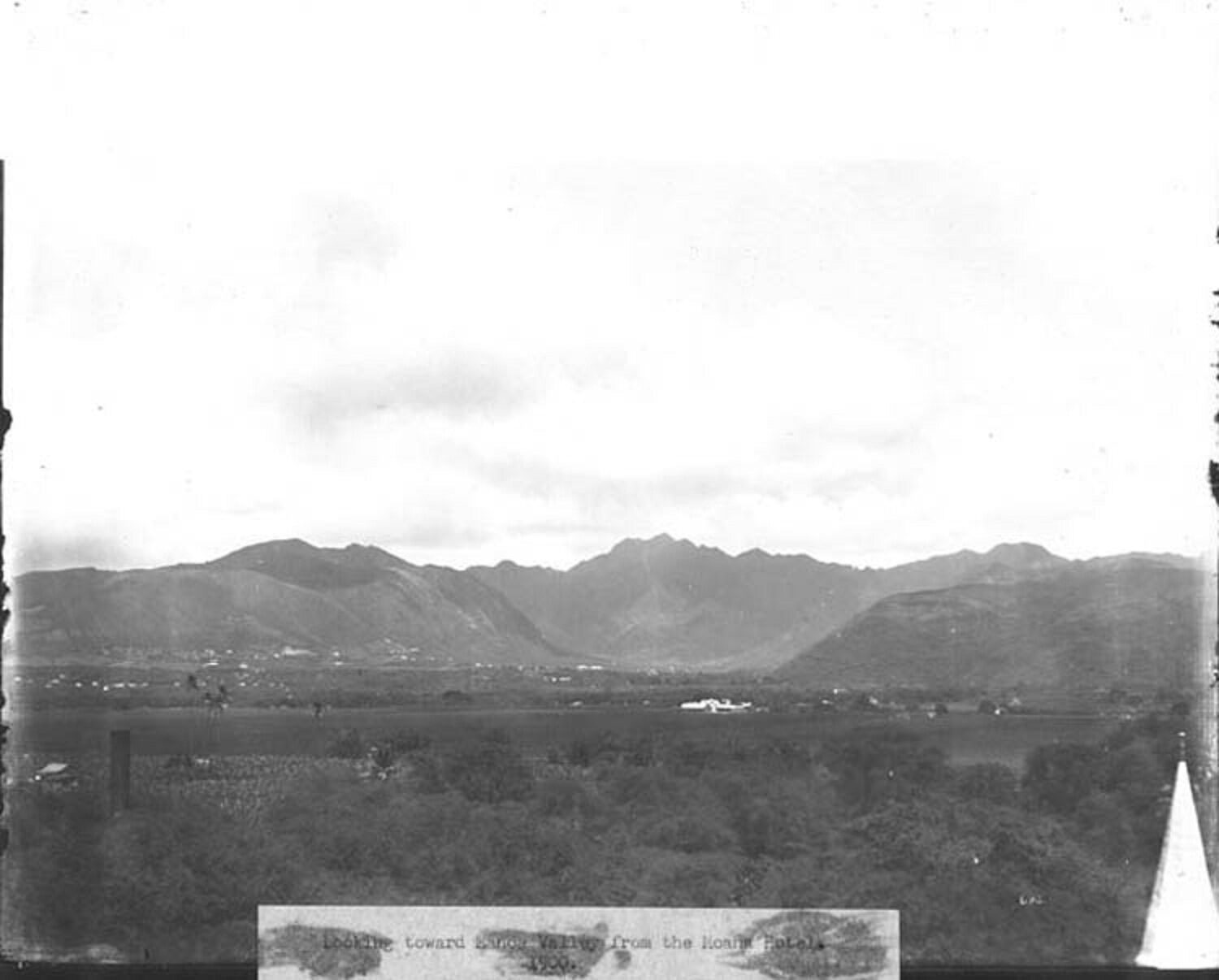
In Hawaiian, Mānoa means something like “thick” or “vast,” a fitting name for this deep, green valley. For centuries, Hawaiians farmed taro in its rich, well-watered soil. Much of the forest you walk through today was planted in the early 1900s, when foresters introduced trees from all over the world to protect the watershed from erosion. That’s why the trail feels like a botanical garden gone wild.
Hollywood noticed, too. The valley and falls area appear in the original Jurassic Park (1993) and in the TV series Lost, among other productions. Stand in the bamboo grove for a minute, and it’s easy to imagine something large moving through the trees.
What to Do Near Manoa Falls
- Lyon Arboretum: the University of Hawaiʻi’s 200-acre rainforest garden, right next to the trailhead, with more than 6,000 kinds of tropical plants and miles of quieter paths. Entry is by donation, but you need an online parking reservation; check its days and hours before you go.
- Puʻu Pia Trail: a short, quiet ridge walk lower in the valley with a view back toward Manoa Falls’ cliffs. The state suggests it as an alternative when the main trail is closed.
- Makiki Valley Loop: another nearby forest loop in the hills above Honolulu.
- Food in Mānoa: the Mānoa Marketplace and the university area have casual spots for post-hike shave ice, coffee or a plate lunch.
- A bigger challenge: if you want a workout with a view instead of shade, try the Koko Head hike on the other side of town.
Sample Morning Plan
- 7:30 a.m.: Leave Waikiki with bug spray, a rain jacket and spare shoes in the car.
- 8:00 a.m.: Park when the lot opens; use the restroom.
- 8:10 a.m.: Clean your shoes at the trailhead and start walking.
- 8:45 a.m.: Enjoy the falls before the crowds.
- 9:45 a.m.: Back at the car; change shoes.
- 10:00 a.m.: Visit Lyon Arboretum (if you’ve reserved) or grab breakfast in Mānoa.
Manoa Falls Hike FAQs
How long is the Manoa Falls hike?
About 1.6 miles round trip (0.8 mile each way), or about 1.7 miles with the walk from the parking lot.
How long does the Manoa Falls hike take?
Most people take 1 to 2 hours, including time at the falls. Allow longer after heavy rain.
Is the Manoa Falls hike hard?
No. It’s easy to moderate. The distance and climb are gentle, but mud, roots and wet rocks make it slippery, especially after rain.
How tall is Manoa Falls?
About 150 feet.
Is the Manoa Falls hike free?
Yes. The trail is free. Parking in the main lot costs about $7 ($4 for Hawaii residents and military).
Do you need a reservation for Manoa Falls?
No. Only the separate Lyon Arboretum next door and guided tours need bookings.
What are the Manoa Falls hike hours?
The trail is open sunrise to sunset. The parking lot is open about 8 a.m. to 6 p.m.
Where do you park for Manoa Falls?
At the paid Paradise Park lot at the end of Mānoa Road, or legally on the street lower down the road.
Can you swim at Manoa Falls?
No. The pool is closed because of falling rocks, and freshwater in Hawaii can carry leptospirosis.
Can you take the bus to Manoa Falls?
Yes. TheBus Route 5 runs from Ala Moana Center up Mānoa Road; from the last stop, it’s about a 10-minute walk.
Is Manoa Falls good for kids?
Yes, for kids who can walk 1.6 miles on uneven ground. Use a carrier for toddlers; strollers won’t work.
Is the Manoa Falls Trail muddy?
Almost always, to some degree. The 2024 upgrades added gravel and drainage, which helped a lot, but the valley gets about 150 inches of rain a year.
Was Jurassic Park filmed at Manoa Falls?
Yes. Mānoa Valley appears in the original Jurassic Park, and the area was also used in Lost.
Do you need a guide for Manoa Falls?
No. The trail is easy to follow. A tour is only worth it for transport or a guide’s explanations.
Is the Manoa Falls Hike Worth It?
Yes, especially if you want to see a side of Oahu that has nothing to do with beaches. In about an hour, you trade traffic and sunscreen for giant trees, bamboo, birdsong and a waterfall in a green amphitheater, all within sight of Honolulu. The falls themselves can be modest in a dry spell, but the walk is the real treasure.
Come early, wear shoes that can handle mud, bring bug spray, check the weather over the mountains and stay behind the barrier at the end. Do that, and Manoa Falls is one of the easiest, most rewarding hikes on the island.
Love rainforest trails? Try the Hoh River Trail in Olympic National Park or the Fern Canyon hike in California next.