
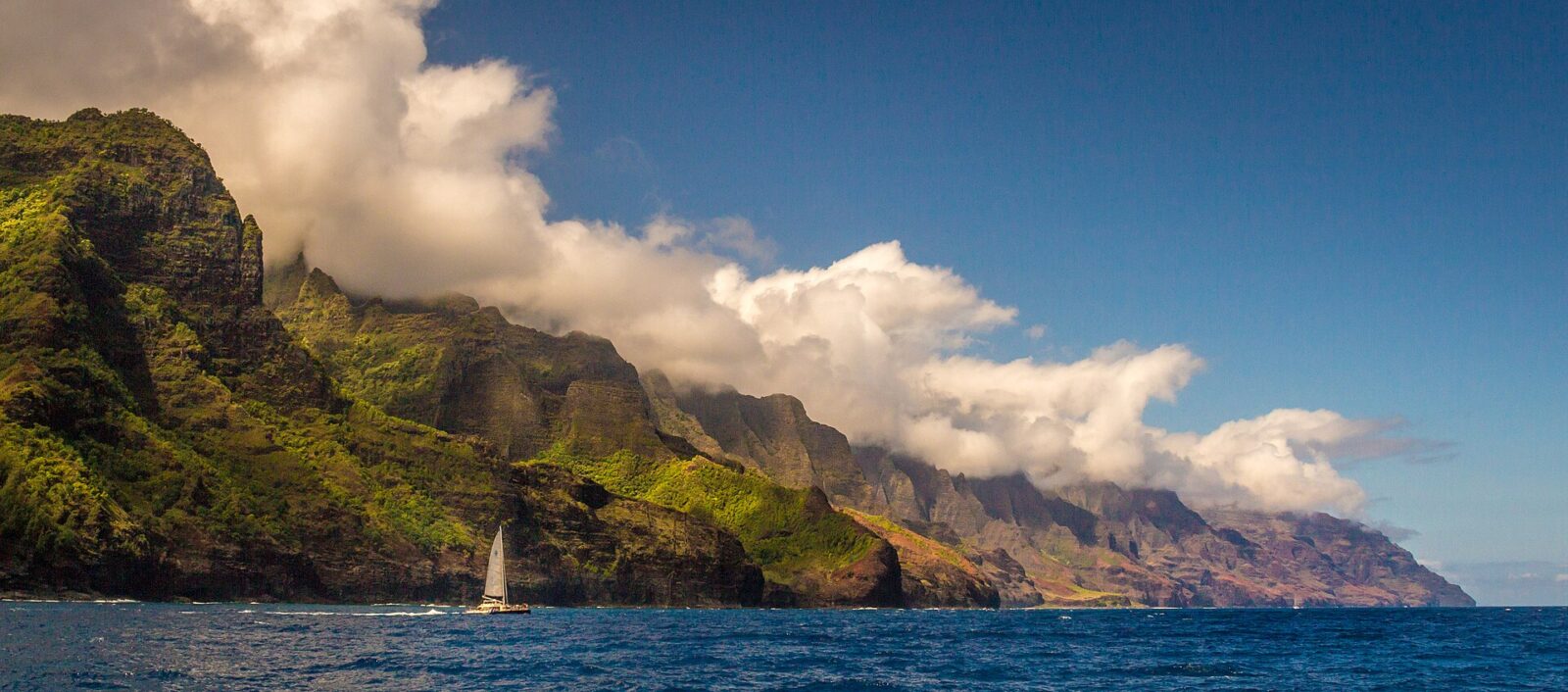
There’s a moment, about a mile up the Kalalau Trail, when the jungle opens and you see it for the first time: the Nā Pali Coast. Green cliffs, sharp as folded paper, drop thousands of feet straight into a blue-white sea. No roads. No buildings. Just cliffs, valleys and waves, going on as far as you can see.
The Kalalau Trail in Kauai is the only way to walk this coast. It runs 11 miles from the end of the road on Kauai’s North Shore to Kalalau Beach. It’s one of the most beautiful hikes in the world, and also one of the most serious.
The good news: most people only need the first 2 miles (to Hanakāpīʻai Beach) or 4 miles (to Hanakāpīʻai Falls) to fall in love with it. This guide explains, in simple words, what’s open right now, what permits you need, the distances, how hard it is, the real dangers, and how to plan a safe day.
Cover photo: The Nā Pali Coast of Kauai, which the Kalalau Trail follows. Photo via Unsplash / Wikimedia Commons (CC0)
Is the Kalalau Trail Open? (October 2026 Update)
Partly. Hāʻena State Park, where the trail starts, closed on September 6, 2026, as Hurricane Lowell approached, and it stayed closed for repairs. It reopened on October 15, 2026, but not everything is open yet.
| Area | Status (late October 2026) |
|---|---|
| Hāʻena State Park and Kēʻē Beach | Open, 7 a.m. – 6:45 p.m. |
| North Shore Shuttle | Running again |
| Kalalau Trail to Hanakāpīʻai Beach (first 2 miles) | Open |
| Hanakāpīʻai Falls trail | Open |
| Kalalau Trail beyond the 2-mile point | Closed until further notice |
| Overnight camping (Hanakoa and Kalalau) | Closed until further notice |
| Kalalau Lookout (Kōkeʻe, a different place) | Closed |
What this means for you: you can do the two most popular day hikes, but you can’t go to Kalalau Beach right now, even with a camping permit. The state is refunding camping reservations missed because of the closure. Check the Hawaiʻi Division of State Parks website before your trip, because the reopening date for the rest of the trail hasn’t been announced.
Don’t mix these up: the Kalalau Trail (on the North Shore) and the Kalalau Lookout (high above the valley in Kōkeʻe State Park, on the west side) are two completely different places, about three hours’ drive apart. As of late October 2026, Kōkeʻe and the Kalalau Lookout are also closed after storm damage.
Kalalau Trail: The Short Answer
The Kalalau Trail starts at Kēʻē Beach in Hāʻena State Park on Kauai’s North Shore and runs 11 miles one way (22 miles round trip) along the Nā Pali Coast to Kalalau Beach. Most people hike the first 2 miles to Hanakāpīʻai Beach (4 miles round trip, 3–4 hours) or continue inland to 300-foot Hanakāpīʻai Falls (8 miles round trip, 6–8 hours). Non-residents need a Hāʻena State Park reservation for parking, entry or the shuttle. Going past Hanakāpīʻai requires a camping permit, but that section is closed as of October 2026. The trail is strenuous, and the main dangers are flash floods, the deadly surf at Hanakāpīʻai Beach and falls on muddy, exposed ground.
Kalalau Trail at a Glance
| Detail | Information |
|---|---|
| Island | Kauai, Hawaiʻi |
| Parks | Hāʻena State Park and Nā Pali Coast State Wilderness Park |
| Trailhead | Kēʻē Beach, end of Highway 560 (Kūhiō Highway) |
| Full trail | 11 miles one way, 22 miles round trip |
| Hanakāpīʻai Beach | 2 miles one way, 4 miles round trip |
| Hanakāpīʻai Falls | About 4 miles one way, 8 miles round trip |
| Hanakoa Valley | About 6 miles from the trailhead |
| Difficulty | Moderate–strenuous to the beach; strenuous to the falls; very strenuous to Kalalau |
| Day-use access (non-residents) | Reservation required: $5 per person entry, plus parking or shuttle |
| Beyond Hanakāpīʻai | Camping permit required (closed as of October 2026) |
| Park hours | 7 a.m. – 6:45 p.m. |
| Dogs | Not allowed |
| Water | Streams only; must be treated |
Where Is the Kalalau Trail?
The trail is on Kauai, the oldest and greenest of Hawaiʻi’s main islands. It starts at Kēʻē Beach, at the very end of the road on the North Shore, past Hanalei and Hāʻena.
From there, it heads west along the Nā Pali Coast, a 17-mile stretch of cliffs and hanging valleys with no roads at all. The only ways to see it are on foot, by boat, by kayak in summer, or from the air.
- From Hanalei: about 25 minutes
- From Princeville: about 30–35 minutes
- From Līhuʻe (airport): about 1 hour 15 minutes
- From Poʻipū: about 1 hour 45 minutes
The last part of the drive crosses several one-lane bridges. Take turns, wave thanks, and drive slowly.
Hāʻena Reservations and Permits: What You Need
This is the part most visitors get wrong. You cannot just drive to the trailhead and start hiking. Here’s how it works, in plain terms.
For Day Hikes (Hanakāpīʻai Beach and Falls)
Non-residents must book ahead on the official Go Hāʻena website (gohaena.com). You have three choices:
| Option | What it includes | Price (late 2026) |
|---|---|---|
| Parking reservation | A parking spot for one time slot, plus entry for everyone in the car | Parking fee per car + $5 entry per person (check the total at checkout) |
| Shuttle | Round-trip ride from the North Shore; includes entry | About $45 adults (16+), $25 kids 4–15, free under 4 |
| Entry only (walk-in/bike) | Entry without parking | $5 per person |
- When to book: reservations open 30 days ahead, at midnight Hawaiʻi time. Morning parking slots often sell out within hours.
- Time slots: parking is sold in time slots (morning, afternoon and evening). For the 8-mile falls hike, the morning slot is essential; you’ll need most of the day.
- Shuttle tip: if parking is sold out, the shuttle often isn’t. It also means no stress about your time slot.
- Hawaiʻi residents enter free with a state ID and don’t need a day-use reservation; some parking stalls are set aside for residents.
For Hiking Past Hanakāpīʻai (When Open)
To go beyond Hanakāpīʻai Valley, toward Hanakoa and Kalalau, you need a Nā Pali Coast camping permit from Hawaiʻi State Parks, even if you’re only day hiking. Permits are limited, go on sale up to about 90 days ahead and sell out fast. Campers can stay up to five nights in total.
Right now, this section and camping are closed, so no permit lets you in. Don’t plan a Kalalau trip around a reopening date that hasn’t been announced.
How Long Is the Kalalau Trail?
| Destination | One way | Round trip | Time | Difficulty | Status (Oct 2026) |
|---|---|---|---|---|---|
| First ocean viewpoint | About 0.5 mile | About 1 mile | 45–60 minutes | Moderate | Open |
| Hanakāpīʻai Beach | 2 miles | 4 miles | 3–4 hours | Moderate–strenuous | Open |
| Hanakāpīʻai Falls | About 4 miles | About 8 miles | 6–8 hours | Strenuous | Open |
| Hanakoa Valley | About 6 miles | — | Overnight trip | Very strenuous | Closed |
| Kalalau Beach | 11 miles | 22 miles | 2–3 days or more | Very strenuous | Closed |
Don’t let the short distances fool you. Two miles on this trail can feel like five on a flat path. It climbs, drops, crosses streams and is often deep in mud.
The First 2 Miles: Kēʻē Beach to Hanakāpīʻai Beach
What It’s Like
The trail starts right across from the Kēʻē Beach parking area and climbs right away, on rocky, rooty steps through hala and kukui trees. You’ll gain a few hundred feet in the first mile.
Within about half a mile, the trees open and you get your first big view back over Kēʻē Beach and its reef, and then west along the Nā Pali cliffs. Many people turn around here, and it’s a great short outing.
After that, the trail curves in and out of small gullies, mostly in the shade, with more ocean views. The second mile drops steeply down to the Hanakāpīʻai Valley floor. This descent, on wet rock and red mud, is where most slips happen.
Hanakāpīʻai Beach
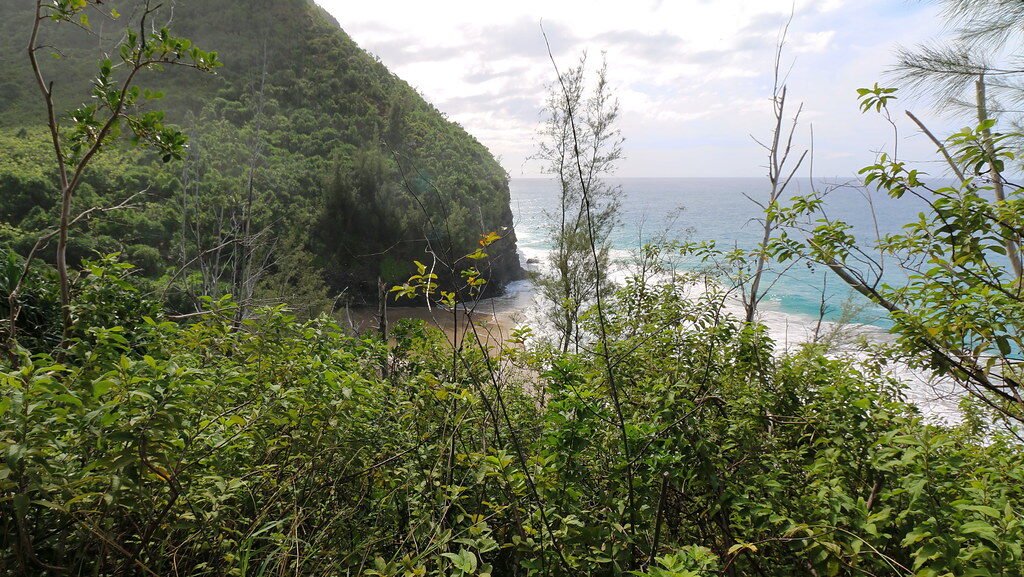
At 2 miles, you reach Hanakāpīʻai Stream and the beach beyond it, a wild, boulder-lined cove between towering cliffs. In summer, there’s usually some sand; in winter, big waves often strip it down to rocks.
To reach the beach or continue to the falls, you’ll cross the stream on boulders. On a normal day, it’s an easy rock-hop. After heavy rain, it can turn into a deadly torrent in minutes.
Do Not Swim at Hanakāpīʻai Beach
This can’t be said strongly enough. Hanakāpīʻai has no reef to protect it and no lifeguards, and it has powerful rip currents that pull straight out to sea. A hand-carved warning sign at the beach keeps a tally of the people who have drowned here, and the count runs into the dozens. Many were strong swimmers who only went in up to their knees.
Enjoy it from the rocks. Don’t go in the water, even to wade.
Hanakāpīʻai Falls: The Waterfall Hike
From the beach, a separate trail heads inland about 2 miles up Hanakāpīʻai Valley to Hanakāpīʻai Falls, a ribbon of water about 300 feet tall pouring into a pool in a deep green amphitheater of rock.
What the Falls Trail Is Like
- Rougher than the coastal trail: narrow, rocky, rooty and often very muddy.
- Several stream crossings, some without stepping stones. Expect wet feet.
- Beautiful on the way: bamboo groves, old stone walls from ancient Hawaiian taro terraces, giant mango trees and ginger.
- Total trip: about 8 miles round trip from the trailhead, 6–8 hours for most people.
State Parks recommends the falls hike only for experienced hikers. Don’t swim under the falls; rocks fall from the cliffs above. And if it starts raining hard, head back immediately, because the stream crossings can rise fast and trap you on the wrong side.

The Full Kalalau Trail: Hanakoa, Crawler’s Ledge and Kalalau Beach
This section is closed as of October 2026. Here’s what it’s like when it reopens.
Beyond Hanakāpīʻai, the crowds disappear and the trail becomes a true wilderness route. It climbs high onto the cliffs, then dives in and out of one hanging valley after another. Over the 11 miles to Kalalau, you’ll climb and descend several thousand feet in total.
- Hanakoa Valley (about mile 6): a lush valley with a campsite and a side trail to Hanakoa Falls. It’s the halfway point, and campers can stay one night here on the way in or out.
- Crawler’s Ledge (about mile 7): the most famous section. The trail becomes a narrow, crumbly ledge across a steep cliff, with a long drop straight to the ocean. In good weather, careful hikers cross it. In wind, rain or fog, it’s dangerous.
- Red dirt slopes (around mile 8–9): bare, red, eroded ridges with loose ground and huge views.
- Kalalau Beach (mile 11): a long sand beach under the jagged walls of Kalalau Valley, with a waterfall for rinsing off, sea caves and some of the best sunsets in Hawaiʻi.
Most backpackers take a full day to hike in and another to hike out, and stay at least two nights. A camping permit is required for all of it, even a day hike past Hanakāpīʻai.
How Hard Is the Kalalau Trail?
- To the first viewpoint: moderate. A steady, rocky climb.
- To Hanakāpīʻai Beach: moderate to strenuous. Climbs, drops, mud and slick rock. Many fit beginners make it, slowly.
- To Hanakāpīʻai Falls: strenuous. A long day with stream crossings and rough trail.
- To Kalalau Beach: very strenuous. Only for experienced backpackers.
Why Is It So Hard?
- Mud: the North Shore is one of the rainiest places in Hawaiʻi. The red clay turns slick as soap.
- Constant up and down: the trail rarely stays flat.
- Heat and humidity: you’ll sweat a lot, even in the shade.
- Stream crossings that change with the weather.
- Remoteness: help is far away, and some areas can only be reached by helicopter.
Kalalau Trail Elevation Gain
You’ll see small numbers like “800 feet” online, but that’s misleading. Because the trail goes up and down so many times, the total climbing adds up. The hike to Hanakāpīʻai Beach and back involves roughly 1,500 feet of climbing in total. The full trail to Kalalau and back involves several thousand feet. Plan by effort, not just miles.
Kalalau Trail Deaths and Dangers: How Dangerous Is It?
People ask this a lot, so here’s an honest answer. The trail is safe for prepared hikers who respect the weather and stay out of the ocean. But it has killed people, and it sends many more home in rescue helicopters.
How Many People Die on the Kalalau Trail?
There’s no official yearly death count for the whole trail, so be careful with numbers you see online. What we do know:
- Drowning at Hanakāpīʻai Beach is the biggest killer, by far, over the years.
- Flash floods have swept hikers away while crossing streams.
- Falls on steep, muddy or exposed sections have caused serious injuries and deaths.
- Medical emergencies happen, too. On May 19, 2026, a 37-year-old visitor from California was found unconscious near Crawler’s Ledge. Bystanders did CPR, Kauai Fire Department’s Air 1 helicopter flew him out, and he died at the hospital. The cause was pending an autopsy at the time it was reported.
Simple Safety Rules That Save Lives
- Never swim at Hanakāpīʻai Beach. Not even to wade.
- Never cross a stream that’s rising, brown or fast. Wait it out; streams usually drop within a few hours once the rain stops. If in doubt, stay on the safe side.
- Check the forecast and flash flood watches before you start, and watch the sky over the mountains.
- Turn around early. Set a time to head back, and stick to it.
- Treat all stream water; leptospirosis is found in Hawaiian streams.
- Stay off cliff edges, especially in wind or rain.
- Tell someone your plan, since cell service is spotty.
- In an emergency, call 911 if you can get a signal.
Kalalau Trail Map: The Route in Order
Kēʻē Beach (trailhead, mile 0) → first ocean viewpoint (about mile 0.5) → Hanakāpīʻai Stream and Beach (mile 2) → [side trail inland to Hanakāpīʻai Falls, about 2 more miles] → Hoʻolulu and Waiahuakua valleys → Hanakoa Valley and campsite (about mile 6) → Crawler’s Ledge (about mile 7) → red dirt slopes → Kalalau Beach (mile 11).
The coastal trail is easy to follow, but the falls trail and stream crossings can be confusing after storms. Download an offline map before you go; there’s no reliable signal. And remember: a map can’t tell you whether a section is open. Only the State Parks website can.
Best Time to Hike the Kalalau Trail
- Summer (May–September): the driest period on the North Shore and the calmest ocean, with a sandy beach at Hanakāpīʻai. Hot and busy, and hurricane season runs from June to November.
- Winter (November–March): the wettest season, with more mud, more flooded streams and huge North Shore surf. Some days the trail is a slip-and-slide.
- Spring and fall: mixed weather. Good days are great; just check the forecast.
Best time of day: start as soon as the park opens at 7 a.m. You’ll beat the heat and the crowds, and give yourself plenty of daylight. The park closes at 6:45 p.m.
What to Bring
For Hanakāpīʻai Beach or Falls
- Shoes with deep tread that you don’t mind ruining; the red mud stains forever. Some people prefer sturdy sports sandals with a strap for the stream crossings.
- 2–3 liters of water per person (more for the falls).
- Snacks or lunch.
- A light rain jacket (see our waterproof hiking jacket guide).
- Reef-safe sunscreen, hat and bug spray.
- A dry bag for your phone (our waterproof bags guide has options).
- Trekking poles for the slippery descents.
- Your Hāʻena reservation and a first-aid kit.
For the Full Trail (When It Reopens)
Add your camping permit, a lightweight tent, sleeping gear, a water filter, a stove and food for every day, a headlamp, a power bank and a way to call for help. Pack out everything you bring in.
Which Kalalau Hike Should You Do?
Short and Sweet: First Viewpoint (About 1 Mile Round Trip)
Perfect for families, beginners or anyone short on time. You get the classic first look at the Nā Pali cliffs, then spend the rest of the day swimming at calm Kēʻē Beach (on calm days only).
The Classic: Hanakāpīʻai Beach (4 Miles Round Trip)
The best choice for most visitors. Allow 3–4 hours. Have lunch on the rocks, watch the waves, and head back.
The Big Day: Hanakāpīʻai Falls (8 Miles Round Trip)
For fit, experienced hikers on a dry day. Book a morning parking slot or an early shuttle, start by 7:30 a.m., and turn around by 12:30 p.m. no matter what.
The Adventure: Kalalau Beach (22 Miles, Multi-Day)
For experienced backpackers with a camping permit, once the state reopens the trail. Plan at least two nights.
Common Mistakes to Avoid
- Showing up without a Hāʻena reservation. You’ll be turned away.
- Booking the afternoon parking slot for the falls hike. You won’t have time.
- Swimming at Hanakāpīʻai.
- Crossing a swollen stream to “get back to the car on time.”
- Going past Hanakāpīʻai without a permit, or into a closed section. Rangers patrol, and fines are steep.
- Confusing the Kalalau Trail with the Kalalau Lookout on the other side of the island.
Respect the Place
Hāʻena and the Nā Pali valleys were home to thriving Native Hawaiian communities for centuries. You’ll walk past old stone terraces where taro once grew. The reservation system exists partly to protect this place and the people of Hāʻena from overcrowding. Stay on the trail, don’t stack rocks or take anything, and pack out every bit of trash.
Exploring more of Hawaiʻi? See our guides to the Koko Head hike and the Manoa Falls hike on Oʻahu.
Kalalau Trail FAQs
Is the Kalalau Trail open right now?
Partly. Since October 15, 2026, you can day-hike to Hanakāpīʻai Beach and Hanakāpīʻai Falls. The trail beyond the 2-mile point and all camping are closed until further notice after Hurricane Lowell.
How long is the Kalalau Trail?
11 miles one way, 22 miles round trip, from Kēʻē Beach to Kalalau Beach.
How long is the hike to Hanakāpīʻai Beach?
2 miles each way, 4 miles round trip. Allow 3–4 hours.
How long is the hike to Hanakāpīʻai Falls?
About 8 miles round trip from the trailhead. Allow 6–8 hours.
Do you need a permit for the Kalalau Trail?
Non-residents need a Hāʻena State Park reservation (entry plus parking or shuttle) for the day hikes. Going past Hanakāpīʻai Valley requires a camping permit, even for a day hike, but that section is closed as of October 2026.
How much does it cost?
Non-residents pay $5 per person for entry, plus a parking reservation per car, or about $45 per adult for the round-trip shuttle. Hawaiʻi residents enter free with ID.
Can you hike the whole Kalalau Trail in one day?
It’s not recommended, and you’d still need a camping permit to go past Hanakāpīʻai. Most backpackers take a full day each way.
Is the Kalalau Trail dangerous?
It can be. The main dangers are drowning at Hanakāpīʻai Beach, flash floods at stream crossings and falls on muddy or exposed trail. Prepared hikers who stay out of the ocean and respect the weather usually have a great day.
How many people have died on the Kalalau Trail?
There’s no official yearly count. Over the years, dozens of people have drowned at Hanakāpīʻai Beach, and others have died from falls, floods and medical emergencies, including a visitor near Crawler’s Ledge in May 2026.
Can beginners hike the first 2 miles?
Fit beginners can usually reach Hanakāpīʻai Beach in dry weather if they go slowly. Wear real hiking shoes and skip it after heavy rain.
Can you swim at Hanakāpīʻai Beach?
No. It has strong rip currents, no reef and no lifeguards, and many people have drowned there.
Where does the Kalalau Trail start?
At Kēʻē Beach in Hāʻena State Park, at the end of the road on Kauai’s North Shore.
Is the Kalalau Trail worth it without going to Kalalau Beach?
Yes. The first mile already gives you one of the best coastal views in Hawaiʻi, and the beach and falls hikes are memorable on their own.
Is the Kalalau Trail in Kauai Worth It?
Absolutely. Even a short walk on the Kalalau Trail puts you on one of the most famous coastlines on Earth. The cliffs, the colors, the sound of the surf below: it’s the Hawaiʻi people dream about.
Just plan around today’s reality: book your Hāʻena reservation 30 days ahead, check what’s open after Hurricane Lowell, start early, stay out of the ocean, and never cross a rising stream. Do that, and the Kalalau Trail will be a highlight of your trip.