
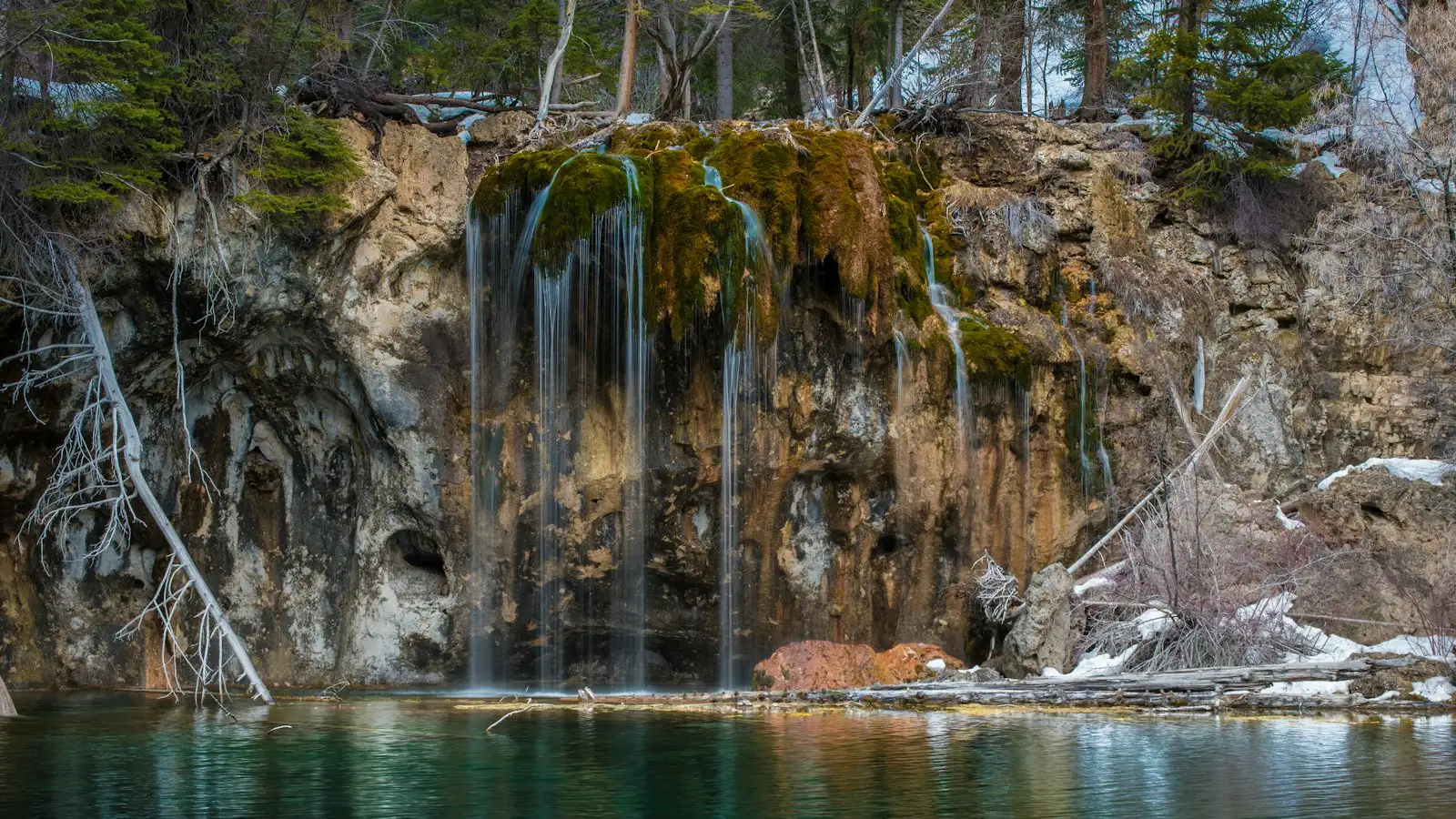
Picture a pool of water so clear you can count the stones on the bottom, colored a bright blue-green that almost doesn’t look natural. Thin waterfalls pour over a mossy ledge into it. An old fallen log stretches across the surface, coated in pale mineral crust. All of it sits on a shelf high up a steep side canyon, as if someone hung the lake on the cliff.
That’s Hanging Lake, near Glenwood Springs, and it’s one of the most photographed spots in Colorado. Getting there takes a little planning, though. You need a timed permit, the trail climbs about 1,200 feet in just over a mile, and the lake is so fragile that you can’t even dip a finger in it.
This guide walks you through everything: how to book, what it costs, how to get to the trailhead (the highway exit trips people up), what the newly rebuilt trail is like, the two waterfalls, the rules, and the best time to go.
Current status (checked November 2, 2026): The trail is open. The official permit site reported on October 30, 2026 that permits are available with daily availability through December 2026. A permit is required every day of the year. Winter conditions are starting, so expect icy steps on some days and bring traction. Heavy rain can still close I-70 and the trail at short notice, so check before you drive.
Hanging Lake Trail: The Short Answer
Hanging Lake is a turquoise lake in Glenwood Canyon, about 10 miles east of Glenwood Springs, Colorado. The trail is roughly 1.2 to 1.4 miles each way (about 2.5 to 3 miles round trip) with about 1,200 feet of climbing on rocky steps, and most people take about 3 hours. You must book a timed permit in advance at visitglenwood.com/hanginglake: $12 per person in summer and fall, $10 in winter. Drive to the Hanging Lake Rest Area at I-70 Exit 125, which you can only reach heading eastbound. No dogs, no swimming and no touching the water.
Quick Facts
| Detail | Information |
|---|---|
| Location | Glenwood Canyon, White River National Forest, near Glenwood Springs, CO |
| Trailhead | Hanging Lake Rest Area, I-70 Exit 125 (eastbound only) |
| Distance | About 1.2 to 1.4 miles one way; 2.5 to 3 miles round trip |
| Elevation gain | About 1,200 ft |
| Lake elevation | 7,323 ft |
| Difficulty | Moderate to strenuous (short but steep) |
| Time | About 3 hours; you get a 3-hour window |
| Permit | Required year-round, booked in advance |
| Price | $12 per person (May to October); $10 in winter |
| Waterfalls | Bridal Veil Falls and Spouting Rock |
| Restrooms and water | At the trailhead only |
| Cell service | None on the trail |
| Dogs | Not allowed (service animals excepted) |
| Swimming / touching water | Not allowed |
| Status | Ecologically protected National Natural Landmark (since 2011) |
Where Is Hanging Lake?
Hanging Lake is in Glenwood Canyon, the dramatic gorge where the Colorado River and Interstate 70 squeeze between cliffs more than 1,000 feet tall. The lake itself sits up a side canyon carved by Dead Horse Creek, in the White River National Forest.
| Driving from | Approximate time |
|---|---|
| Glenwood Springs | About 15 minutes |
| Vail | About 1 hour |
| Aspen | About 1 hour 15 minutes |
| Denver | About 2.5 to 3 hours (traffic and weather can add a lot) |
| Grand Junction | About 1.5 hours (you’ll need the westbound turnaround; see below) |
Because your permit has a fixed time, staying in Glenwood Springs the night before makes the day much less stressful.
Hanging Lake Reservations: How to Book Your Permit
You can’t just show up. Every hiker needs a timed-entry permit, all year round. The permits limit how many people reach the lake each day, which protects it from damage.
How to Book
- Go to the official booking page at visitglenwood.com/hanginglake. Watch out for look-alike sites. The Forest Service points visitors to Visit Glenwood Springs.
- Pick your date and an entry time. Slots run hourly, roughly from 7 a.m. to 5 p.m.
- Add everyone in your group. There’s no child, senior or military discount for ages 3 and up; call the permit office about children under 2.
- Pay and save your confirmation on your phone. There’s no cell service at the trailhead, so take a screenshot.
How Much Does It Cost?
| Season | Price per person |
|---|---|
| Summer and fall (about May through October) | $12 |
| Winter (about November through March or April) | $10 |
Exact season dates and prices can shift each year, so go by the price the booking site shows for your date. Parking is included.
Timing Rules
- Arrive within 30 minutes of your reserved time.
- You get a 3-hour window to hike up, enjoy the lake and come back down.
- In summer, morning slots and weekend slots go first. Book a few weeks ahead for summer weekends. Winter and weekday permits are usually much easier to get.
Changes and Cancellations
Use the links in your confirmation email, or call the permit provider, H2O Ventures, at 970-384-6309. Changes close to your date are often not allowed (the current rules mention a 48-hour cutoff), so read the terms before you pay. If the trail or I-70 closes for weather, follow the provider’s instructions for rebooking or refunds.
Getting There: Exit 125 and the Westbound Trap
The trailhead is the Hanging Lake Rest Area at I-70 Exit 125. Here’s the catch: you can only get into it while driving east. There’s no exit from the westbound lanes.
- From Glenwood Springs (the west): Get on I-70 eastbound and take Exit 125. Easy.
- From Denver, Vail or Aspen (the east): You’ll be heading west. Drive past the rest area, continue to Glenwood Springs (the Forest Service directs drivers to Exit 116), turn around, and come back east to Exit 125. This adds about 8 miles each way, so leave extra time to make your entry window.
Parking and Transportation Rules
- Drive your own car. Parking at the rest area is included with your permit and is for permit holders only.
- No Uber, Lyft or taxi drop-offs, according to the Forest Service.
- No vehicles over 25 feet. Big RVs and trailers can’t use the lot.
- Shuttles: The Forest Service currently says there’s no shuttle, while the permit provider mentions one “when conditions allow.” Plan to drive, and check the booking site if you were counting on a shuttle.
- By bike: In summer and fall you can ride the paved Glenwood Canyon Recreation Path about 10 miles from Glenwood Springs to the trailhead. You still need a permit. The path closes in winter.
Use the restrooms and fill your water bottles at the rest area. They’re the only ones you’ll get.
The Rebuilt Trail: What Changed
If you hiked Hanging Lake years ago, it’s going to feel different. In 2020, the Grizzly Creek Fire burned through Glenwood Canyon. The next summer, heavy rain on the burn scar sent mud and debris down Dead Horse Creek, wiping out bridges and long stretches of trail.
What followed was a $4.9 million rebuild led by the U.S. Forest Service with the National Forest Foundation, the City of Glenwood Springs and Colorado Lottery funds. The work, celebrated with a ribbon-cutting in June 2026, included:
- Seven new bridges over Dead Horse Creek
- More than 1,000 hand-built stone steps
- A wider, stronger trail with reinforced creek walls and new railings
- A new boardwalk around the lake and an expanded trailhead
This is also why you’ll see slightly different distances online (anywhere from 1.2 to 1.38 miles each way). Older guides may also mention shuttles, temporary routes or closures that no longer apply.
Hiking Hanging Lake: Step by Step
1. From the Rest Area to Dead Horse Creek
From the parking lot, a paved path leads east along the Colorado River for a short way to the start of the trail. Enjoy the flat bit. It’s the last one for a while. The trail then turns up into the narrow mouth of Dead Horse Creek Canyon, and the climbing begins.
2. The Lower Canyon: Bridges and Steps
The trail follows the creek up a deep, shady gorge, crossing back and forth on the new bridges. You’ll climb a lot of stone steps here, with rock walls rising on both sides and the creek splashing beside you. Box elder, Douglas fir and wild raspberries grow along the way, and in spring the creek is loud with snowmelt.
Go at your own pace. There are plenty of benches and wide spots to catch your breath, and everyone uses them. You’re climbing more than 1,000 feet in about a mile, at over 6,000 feet of elevation.
3. The Final Climb
The last stretch is the steepest. Stone stairs climb a rocky slope, with a handrail to help on the hardest part. Take your time, especially coming down later, and keep kids close. When the stairs finally level out, you’ll step onto the boardwalk at the lake.
4. Hanging Lake
And there it is. The water is so clear and so blue-green that people often go quiet when they first see it. Across the lake, Bridal Veil Falls spills over a mossy ledge in several thin streams. A long fallen log reaches out into the water, crusted with pale minerals. Trout sometimes drift through the shallows.
Stay on the boardwalk and enjoy it from there. Give yourself 20 to 30 minutes. It’s worth just sitting and looking.

5. Spouting Rock
Don’t turn around yet. A short, steep spur trail climbs about 200 yards above the lake to Spouting Rock. Here, Dead Horse Creek doesn’t come over a cliff. It bursts straight out of a hole in the limestone wall and plunges into a mossy grotto below. You can walk behind the falls into a shallow, dripping cave and look out through the water. Many visitors say it’s their favorite part of the hike.
6. Heading Down
Go back the way you came. The descent is easier on your lungs but harder on your knees, and wet or icy stone steps are slippery. Trekking poles really help here. Keep an eye on the time so you’re back within your 3-hour window.
How Long and How Hard Is It?
| Question | Answer |
|---|---|
| Distance | About 1.2 to 1.4 miles each way. The permit site lists 2.76 miles round trip; Visit Glenwood says about 3.1 miles including Spouting Rock. |
| Climbing | About 1,200 feet, almost all on the way up |
| Typical time | About 2 hours up (with breaks), 1 hour down, so 3 hours total |
| Difficulty | Moderate to strenuous. Short, but steep and rocky the whole way. |
The most common surprise is how hard it feels for such a short hike. Think of it like climbing the stairs of a 100-story building on uneven stone steps, at altitude.
- Beginners: Doable if you’re reasonably fit and go slowly. If you rarely hike uphill, try a shorter climb first. (Our hiking for beginners guide can help.)
- Kids: Active kids who are used to hiking usually do fine. The permit provider warns it can be very hard for young children, and there’s no discount for kids 3 and up, so be honest about your little ones’ stamina.
- Older hikers: Many make it at a slow, steady pace. If you have knee, heart or balance issues, think twice.
- Wheelchairs and strollers: Not possible. The trail is steep, rocky and mostly steps. Carry little ones in a hiking carrier.
The Waterfalls: Bridal Veil Falls and Spouting Rock
| Bridal Veil Falls | Spouting Rock | |
|---|---|---|
| Where | At the lake, falling into it | A short, steep walk above the lake |
| What it looks like | Several thin, delicate streams over a mossy ledge | A powerful jet bursting out of a hole in the cliff |
| Can you get close? | No. View from the boardwalk only. | Yes. You can walk behind it into a shallow cave. |
| In winter | Often lined with ice formations | Flows more gently; the path behind can be icy |
Don’t confuse this Bridal Veil Falls with the famous one in Telluride. They’re completely different waterfalls on opposite sides of the state.
Why Is Hanging Lake So Turquoise?
It’s all about rock and minerals. Long ago, a piece of the valley floor, about an acre and a half, dropped down along a geologic fault, creating a little basin high above the canyon. Water then filled it.
That water is special. Dead Horse Creek flows through limestone and picks up dissolved calcium carbonate. When it spills into the lake, some of those minerals come back out of the water and harden into travertine, a pale, crusty kind of limestone. Over thousands of years, travertine built up the lake’s rim and coats the logs and rocks in the water. The dissolved carbonate minerals are also what give the water its glowing turquoise color, while the pale bottom makes it look even brighter.
This is also why the rules are so strict. Travertine grows incredibly slowly, and oils from skin, sunscreen and even a single footstep can damage it. That fallen log everyone photographs? It’s slowly being turned to stone, and standing on it can break it.
Hanging Lake Rules (and Why They Matter)
- No swimming, wading or touching the water. Not even fingers or feet.
- Don’t stand on the fallen log.
- No fishing.
- No dogs or other pets, and you can’t leave them in your car while you hike. Trained service animals are allowed.
- No drones.
- No camping anywhere in the Hanging Lake area.
- Stay on the trail and boardwalk. No cutting switchbacks.
- Pack out all trash. There are no bins on the trail.
Rangers and staff patrol the area in busy seasons, and breaking these rules can get you a fine. More importantly, the lake has been closed before because of damage from visitors. Following the rules is what keeps it open.
Best Time to Hike Hanging Lake
| Season | What to expect |
|---|---|
| Spring (April to June) | The waterfalls are at their fullest from snowmelt, and the canyon turns green. Lower steps can be wet; early spring can still be icy. |
| Summer (July to August) | Warm, green and busy. Permits sell out fastest, and afternoon thunderstorms are common. Book a morning slot. |
| Fall (September to October) | Cooler hiking, yellow leaves in the canyon and easier permits. A great time to go. |
| Winter (November to March) | Quiet and magical, with ice around the falls and snow on the trees. Cheaper permits, but icy steps. Microspikes are a must. |
Best time of day: Mid-morning, when sunlight starts reaching the water and makes the color glow. An early slot also beats the heat and summer storms.
Hiking Hanging Lake in Winter
Yes, you can, and it’s beautiful. Ice crusts form over the waterfalls, the lake edges may freeze, and you’ll share the trail with far fewer people. But the stone steps get icy, especially in the shade.
- Wear waterproof hiking boots, not sneakers or sandals.
- Bring microspikes and trekking poles (see our budget trekking poles guide).
- Pack a hat, gloves, a warm layer and a windproof jacket.
- Choose a midday slot so you’re hiking in the warmest, brightest part of the day.
- Check I-70 conditions on COtrip.org before you leave. Glenwood Canyon can close for storms or rockfall.
Weather, Closures and Safety
- Flash floods: The burned slopes above Glenwood Canyon still shed mud in heavy rain. When a flash flood warning is issued, I-70 and Hanging Lake can close, sometimes for hours. Don’t argue with a closure.
- Thunderstorms: Common on summer afternoons. Morning permits are safer.
- No cell service: Tell someone your plan. In peak season, staff are on site for emergencies.
- Heat: The canyon can be hot in July and August. Carry more water than you think you need.
Check the permit site’s trail status page, the White River National Forest alerts page, and COtrip.org for I-70 before every trip.
What to Pack
- Hiking shoes with good grip. The steps are uneven and can be wet.
- At least 1 to 2 liters of water per person. There’s none on the trail.
- Snacks for the top.
- Sunscreen, a hat and sunglasses. Colorado sun is strong.
- A light rain jacket (see our waterproof hiking jacket picks).
- Trekking poles for the descent.
- Microspikes and warm layers from late fall to spring.
- Your permit, saved offline on your phone.
Photography Tips
- For the brightest color, go when the sun is reaching the water, usually late morning to early afternoon.
- A polarizing filter (or simply tilting your phone) cuts glare so you can see the log and bottom through the water.
- Go wide. Fit the falls, the log and the lake into one frame from the boardwalk.
- At Spouting Rock, shoot from inside the cave looking out through the falling water. Protect your lens from spray.
- No drones, and never step off the boardwalk for a better angle.
A Little History
Stories say a gold prospector stumbled onto the lake in the late 1800s. Later it became a family’s homestead and retreat. After a 1910 act of Congress, the town of Glenwood Springs bought the land and ran it as a tourist stop. By the 1940s there was even a small resort and cafe here. That ended when construction of I-70 through the canyon began in 1968. The Forest Service took the lake and trail back in 1972, and in 2011 Hanging Lake was named a National Natural Landmark for its rare travertine geology.
Where to Stay and What Else to Do
Glenwood Springs is the obvious base, about 15 minutes away, with plenty of hotels, restaurants and the best way to rest sore legs: hot springs. Carbondale and the Roaring Fork Valley are a bit farther and quieter. There’s no camping at Hanging Lake itself, but national forest and private campgrounds are found around the region; book legal sites ahead in summer.
Make a day of it:
- Soak at one of Glenwood Springs’ hot springs pools after your hike.
- Bike the Glenwood Canyon Recreation Path along the Colorado River in summer and fall.
- Raft the Colorado River through the canyon with a local outfitter.
- Ride the gondola and cave tours at Glenwood Caverns Adventure Park.
A Simple Half-Day Plan
- Night before: Check your permit, the weather and I-70 conditions. Screenshot your confirmation.
- 8:30 a.m.: Leave Glenwood Springs heading east on I-70.
- 9:00 a.m.: Park at Exit 125, use the restroom, fill water bottles, start hiking.
- 10:30 a.m.: Reach the lake. Enjoy the boardwalk, then walk up to Spouting Rock.
- 11:15 a.m.: Start down carefully.
- 12:00 p.m.: Back at the car, with the afternoon free for lunch and a hot springs soak.
Common Mistakes to Avoid
- Showing up without a permit. You’ll be turned away.
- Driving westbound and missing your slot because of the turnaround.
- Thinking “short” means “easy.” It’s 1,200 feet of steps.
- Booking from a look-alike website. Use visitglenwood.com/hanginglake.
- Bringing your dog, or leaving it in the car.
- Wearing sandals, especially in winter.
- Skipping Spouting Rock. It’s just a few minutes above the lake.
Hanging Lake Trail FAQs
Do you need a reservation to hike Hanging Lake?
Yes. A timed permit is required for every hiker, every day of the year. Book at visitglenwood.com/hanginglake.
How much is a Hanging Lake permit?
$12 per person in summer and fall, and $10 per person in winter. Parking is included.
How long is the Hanging Lake Trail?
About 1.2 to 1.4 miles each way, or roughly 2.5 to 3 miles round trip including Spouting Rock.
How hard is the Hanging Lake hike?
Moderate to strenuous. It’s short, but you climb about 1,200 feet on steep, rocky steps.
How long does it take?
About 3 hours round trip for most people, which matches the 3-hour permit window.
Is Hanging Lake open right now?
Yes. On October 30, 2026, the permit site reported the trail open, with permits available through December 2026. Weather can close it, so check before you go.
How do you get to Hanging Lake?
Drive I-70 eastbound to Exit 125, the Hanging Lake Rest Area. If you’re coming from the east, continue to Glenwood Springs, turn around and come back east.
Can you swim in Hanging Lake?
No. Swimming, wading and touching the water are all banned to protect the lake’s fragile travertine.
Are dogs allowed at Hanging Lake?
No. Pets aren’t allowed on the trail or left in cars. Trained service animals are permitted.
Can you hike Hanging Lake in winter?
Yes. Permits are cheaper and crowds are smaller, but bring microspikes, poles and warm clothes for icy steps.
What is Spouting Rock?
A waterfall a short walk above the lake where the creek bursts straight out of a hole in the cliff. You can walk behind it.
Why is Hanging Lake so blue-green?
Dissolved carbonate minerals in the water, plus a pale travertine bottom, give it that turquoise glow.
Is Hanging Lake Worth It?
Yes, a hundred times over. In about three hours you climb a beautiful creek canyon on brand-new bridges and steps, stand beside one of the clearest, most colorful lakes in the Rockies, and walk behind a waterfall pouring out of a cliff. Few short hikes in Colorado give you that much.
Just plan ahead: book your permit, head east on I-70, wear good shoes, and treat the lake gently. It took thousands of years to build. With a little care, it’ll be here for thousands more.