
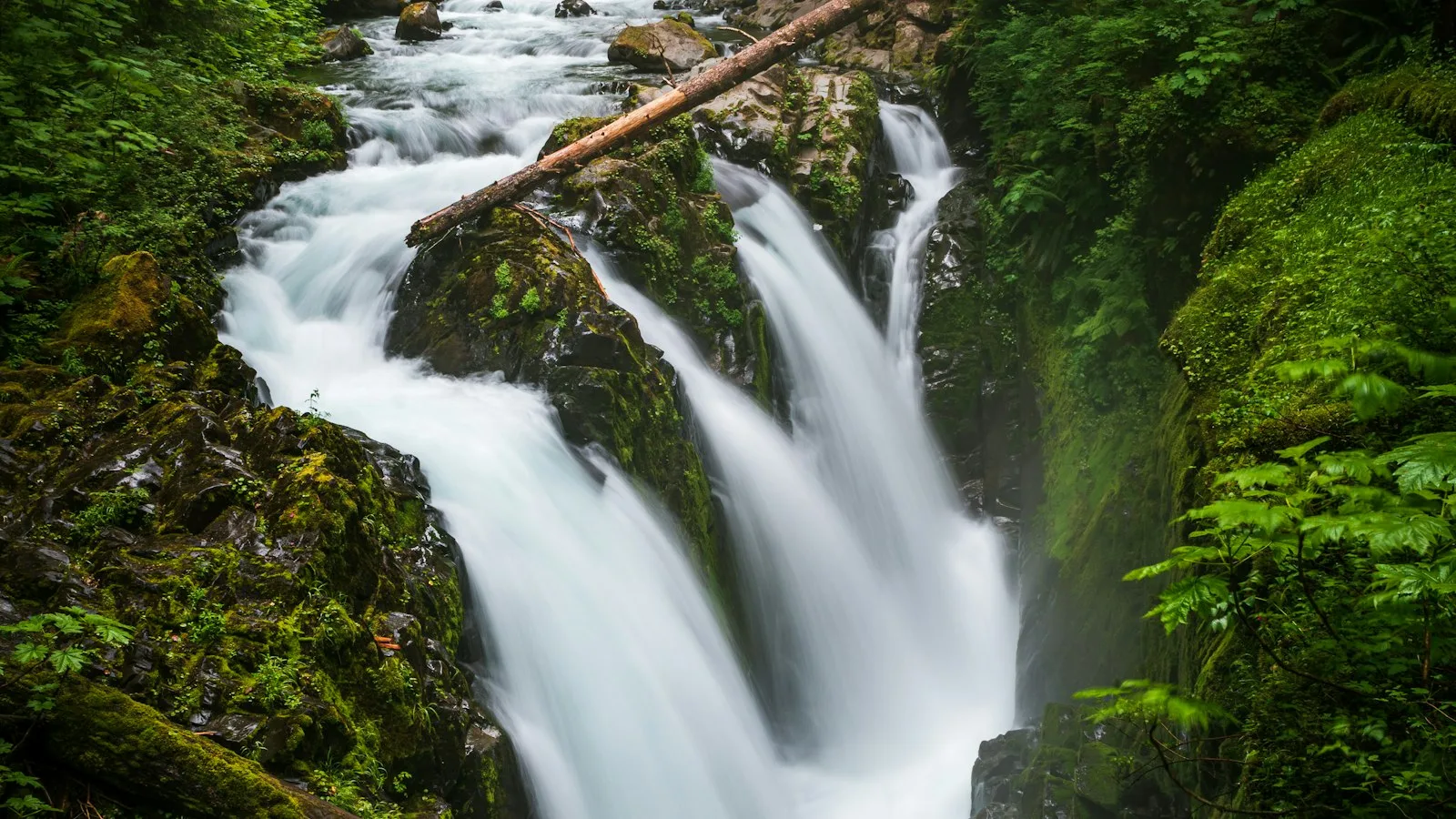
You hear Sol Duc Falls before you see it. After a short walk through giant, moss-draped trees, a low roar starts to fill the forest. Then the trail reaches the edge of a narrow canyon, and there it is: the Sol Duc River splitting into three or four white ribbons and crashing about 48 feet into a slot of dark, mossy rock. A wooden footbridge spans the gorge right above the spray, giving you a front-row seat.
The best part? It only takes about 20 to 30 minutes to walk there. The Sol Duc Falls Trail in Washington is just 1.6 miles round trip with very little climbing, which makes it one of the most rewarding easy hikes in Olympic National Park.
This guide covers it all: the distance and route, what you’ll see step by step, parking and fees, the bridge, the old-growth forest, the best time to go, salmon season, the hot springs nearby, longer hikes from the same trailhead, and how to check if the road is open.
Current conditions (checked November 2, 2026): Olympic National Park’s conditions page, last updated October 27, lists the Sol Duc area and Sol Duc Hot Springs Road as open. Early November is actually a great time to visit: coho salmon are jumping at Salmon Cascades, and the falls are running strong after fall rains. The Sol Duc Hot Springs Resort is seasonal and usually closed by now, though, and winter storms can close the road at short notice. Before you drive, check the park’s Alerts & Conditions page or call the recorded road and weather line at 360-565-3131.
Sol Duc Falls Trail: The Short Answer
The Sol Duc Falls Trail is an easy 1.6-mile round-trip hike (0.8 mile each way) with about 200 feet of elevation gain in the Sol Duc Valley of Olympic National Park, Washington. It starts at the end of Sol Duc Road, about 14 miles south of Highway 101 and roughly an hour west of Port Angeles. The trail winds through old-growth forest, past a 1939 log shelter, to a footbridge over the 48-foot waterfall. Most people spend 45 minutes to 1.5 hours. A park entrance pass is required, no other permit is needed for a day hike, and dogs are not allowed.
Quick Facts
| Detail | Information |
|---|---|
| Location | Sol Duc Valley, Olympic National Park, Washington |
| Trailhead | End of Sol Duc Road (Sol Duc Trailhead) |
| Distance | 0.8 mile one way; 1.6 miles round trip |
| Elevation gain | About 200 ft |
| Highest point | About 1,950 ft |
| Difficulty | Easy |
| Time | 45 minutes to 1.5 hours |
| Waterfall height | About 48 ft, in up to four channels |
| Trail type | Out and back on a dirt and gravel path |
| Entrance fee | $30 per vehicle for 7 days, or a valid park pass |
| Day hike permit | Not needed |
| Dogs | Not allowed on the trail |
| Restrooms | At the trailhead |
| Best time | Late spring to fall; late October and November for salmon |
Where Is Sol Duc Falls?
Sol Duc Falls is in the northern part of Olympic National Park on Washington’s Olympic Peninsula. It sits deep in the Sol Duc Valley, a quiet, heavily forested valley southwest of Lake Crescent. The name “Sol Duc” (also spelled Soleduck) is often translated as “sparkling waters,” and the river lives up to it.
This isn’t the Hoh Rain Forest, which is on the west side of the park. But the Sol Duc Valley has the same lush feel: huge evergreens, thick moss on everything, ferns as tall as your waist, and fallen logs slowly turning back into soil.
| Driving from | Approximate time to the trailhead |
|---|---|
| Lake Crescent (Lake Crescent Lodge) | About 35 to 45 minutes |
| Port Angeles | About 1 hour (around 40 miles) |
| Forks | About 45 minutes |
| Hoh Rain Forest | About 1 hour 45 minutes |
| Seattle | About 3.5 to 4 hours, including the ferry or the drive around via Tacoma |
Directions to the Trailhead
- From Port Angeles, take US Highway 101 west. You’ll drive along the beautiful south shore of Lake Crescent.
- About 2 miles past the west end of the lake (roughly 29 miles from Port Angeles), turn left onto Sol Duc Hot Springs Road. Watch for the national park sign.
- Follow this paved road about 14 miles to the very end. You’ll pass the park entrance station, Salmon Cascades, the Ancient Groves trail, the hot springs resort and the campground along the way.
- The road ends at the Sol Duc Trailhead parking lot.
In Google Maps, search for “Sol Duc Falls Trailhead”. There’s very little cell signal in the valley, so download your map before you leave Port Angeles or Forks. And don’t stop at the hot springs resort thinking you’ve arrived: the falls trailhead is about 1.5 miles farther up the road.
Parking, Fees and Permits
- Parking: A paved lot at the end of the road, with restrooms. It’s free to park once you’re in the park, but it fills up on summer weekends between about 10 a.m. and 4 p.m. Arrive before 10 or after 4 for an easy spot and a quieter trail.
- Entrance fee: Sol Duc Road passes through a park entrance station. The current fee is $30 per private vehicle, good for 7 days anywhere in Olympic National Park. The Olympic Annual Pass is $55, and the America the Beautiful pass also works.
- Fee-free day: In 2026, Veterans Day (November 11) is a fee-free entrance day for U.S. citizens and residents.
- Permits: None needed for a day hike. Any overnight stay in the wilderness needs a wilderness permit.
Trail Map: The Route at a Glance
The route is simple, and the main trail is well signed. Here’s what you’ll pass on the way in:
| Point | Approx. distance from trailhead | What you’ll find |
|---|---|---|
| Sol Duc Trailhead | 0 miles | Parking, restrooms, trail signs |
| Old-growth forest | 0 to 0.5 mile | Giant Douglas-firs and western hemlocks, moss, ferns |
| Small stream bridge | About 0.3 to 0.5 mile | A short wooden bridge over a mossy creek |
| Canyon Creek Shelter | About 0.7 mile | Historic 1939 log shelter |
| Sol Duc Falls and footbridge | About 0.8 mile | The waterfall, the gorge and the classic bridge view |
Past the falls, the trail continues to Deer Lake, the Lover’s Lane loop and the High Divide. If you’re only here for the waterfall, turn around at the bridge.
Hiking Sol Duc Falls: Step by Step
1. Into the Old-Growth Forest
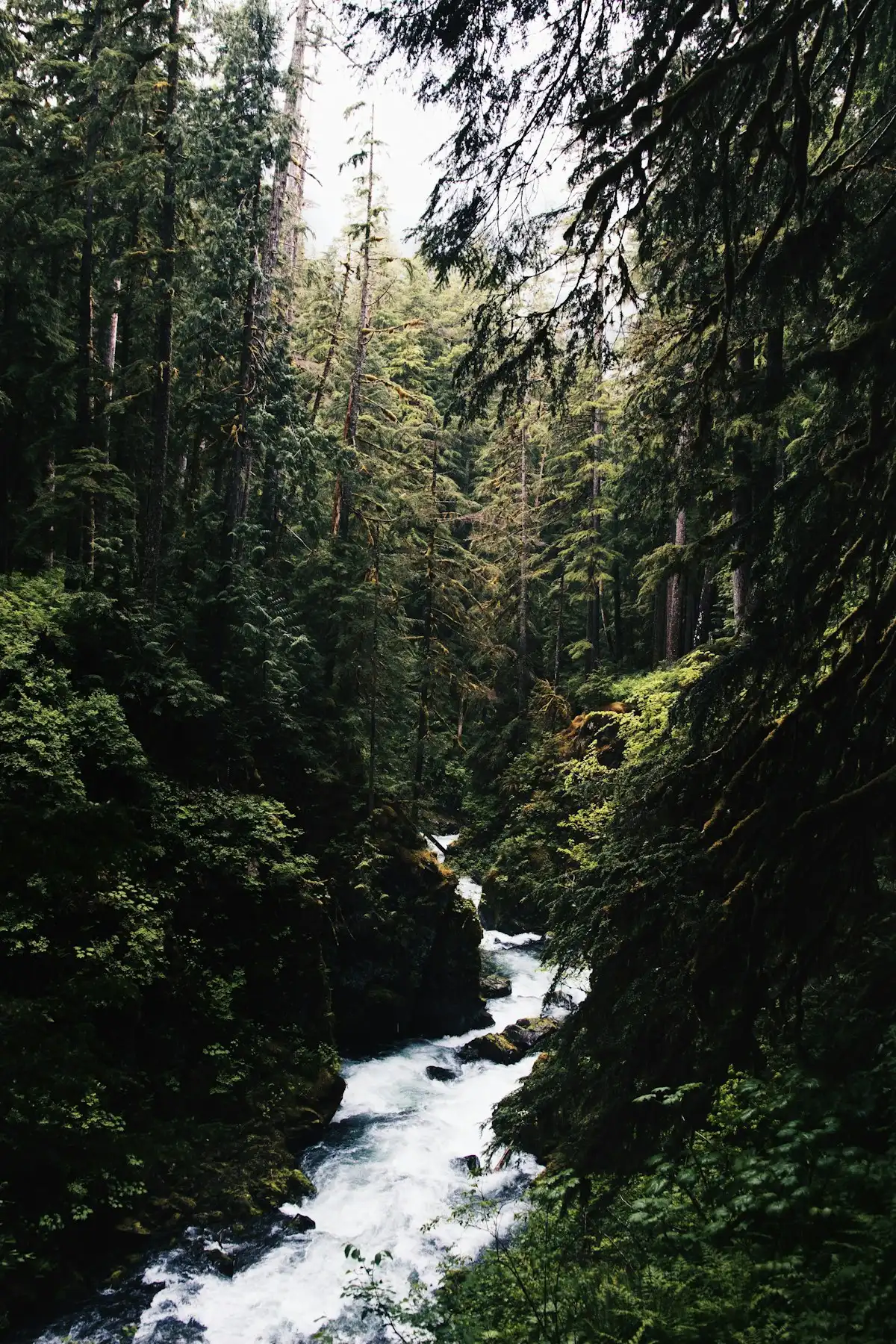
The moment you leave the parking lot, the forest closes in around you. Douglas-firs and western hemlocks, some of them hundreds of years old, rise straight up into the gray-green light. Their trunks are wrapped in moss, and long strands of it hang from the branches like curtains. On a damp morning, the air smells like wet earth and cedar.
The path is wide and mostly gentle, a mix of packed dirt, gravel and the odd short boardwalk. It’s not paved, though, so keep an eye out for roots and puddles.
2. The Little Stream Bridge
Partway in, the trail crosses a small side creek on a wooden bridge. The water trickles over mossy stones and logs, and it’s a lovely, quiet spot for a photo. This isn’t the main waterfall bridge, so keep going.
3. The Canyon Creek Shelter
Just before the falls, look for a small log shelter beside the trail. This is the Canyon Creek Shelter (also called the Sol Duc Falls Shelter), built in 1939 by the Civilian Conservation Corps, the Depression-era program that put young men to work building trails and structures in national parks. It’s now listed on the National Register of Historic Places. Its moss-covered roof makes it look like it’s part of the forest.
4. Sol Duc Falls and the Footbridge
By now the roar is loud. The trail drops slightly to the edge of the canyon, and suddenly you’re looking at the falls. What makes Sol Duc Falls different from most waterfalls is the way it falls sideways into the gorge. The river pours over a rock ledge and splits into several channels, usually three, sometimes four when the water is high, all plunging into a narrow slot just a few feet wide.
Walk out onto the wooden footbridge that crosses the canyon just downstream. From here you look straight up at the falls, with the mist drifting up through the ferns. This is the classic Sol Duc Falls view you’ve seen in photos. There’s also a viewing area on the near side of the canyon for a side-on look.

Stay safe here. The rocks around the gorge are always wet and slippery, the current is powerful, and the canyon is deep. Stay on the bridge, the trail and the viewing areas, never climb over railings, and hold on to young children. The park specifically warns that the falls can be dangerous.
5. Walking Back
Head back the way you came. It’s a slight uphill on the return, but nothing hard. Going slowly is worth it: you’ll notice things you missed on the way in, like nurse logs with baby trees growing out of them, mushrooms on old stumps, and tiny birds hopping through the ferns.
How Hard Is the Sol Duc Falls Trail?
It’s easy. With only about 200 feet of up and down over 1.6 miles, most people who can walk a mile or two comfortably will have no trouble. It’s one of the best “big reward, little effort” hikes in the park.
- Beginners: A perfect first hike in Olympic National Park. (New to hiking? See our hiking for beginners guide.)
- Kids: Great for families. The distance is short and there’s lots to look at. Keep little ones close near the gorge and on the bridge.
- Older adults: Generally fine at a relaxed pace. Trekking poles help on wet, rooty sections.
- Strollers: A sturdy all-terrain stroller can usually manage most of it, but expect roots, puddles and a few uneven spots. A baby carrier is easier.
- Wheelchairs: The trailhead restrooms are accessible, but the natural dirt trail with roots and slopes is not considered wheelchair accessible. Call the park to ask about current conditions if this matters for your group.
Best Time to Visit Sol Duc Falls
| Season | What to expect |
|---|---|
| Spring (April to June) | The falls are at their most powerful from rain and snowmelt, and the forest is bright green. Trails can be muddy. The hot springs resort usually reopens in late March. |
| Summer (July to August) | Driest and warmest weather, longest days, and the busiest time. Arrive early for parking. The falls are a little gentler but still impressive. |
| Fall (September to November) | Fewer people, moody mist, rising water after the rains, and salmon at Salmon Cascades, best in late October and early November. |
| Winter (December to March) | Quiet and wild, but the road can close for snow, ice or storm damage, and services are closed. Check conditions before every trip. |
Time of day: Early morning is the sweet spot. The trail is quiet, parking is easy, and the soft light is perfect for photos.
Weather and Road Conditions
The Olympic Peninsula is one of the wettest places in the continental U.S., so plan on damp air and possible rain at any time of year, even in July. Under the trees, the trail stays cool and shady. In winter, snow can fall at this elevation and storms can bring down trees across the road.
Is the trail open right now? The trail itself is rarely closed, but you can only reach it if Sol Duc Road is open. Before you go, check:
- The Olympic National Park Alerts & Conditions and Current Road Conditions pages on nps.gov
- The park’s recorded road and weather line: 360-565-3131
- Recent trip reports on the Washington Trails Association website
Why the Old-Growth Forest Is So Special
Many visitors come for the waterfall and leave talking about the trees. The Sol Duc Valley holds some of the finest lowland old-growth forest in the park: Douglas-fir, western hemlock and western redcedar, many of them centuries old.
- Why so green? Heavy rain and mild temperatures let mosses, lichens and ferns grow on nearly every surface.
- Nurse logs: When a giant tree falls, it becomes a “nurse log,” and seedlings sprout along its back. Look for rows of young trees growing in a straight line. That’s where a log once lay.
- Life everywhere: Old-growth forests are full of fungi, insects, birds and small animals that depend on standing dead trees and rotting logs.
For an even closer look, stop at the Ancient Groves Nature Trail on your drive in. It’s a flat, 0.6-mile loop through big old trees, with no climbing at all.
Salmon Cascades: Watch Salmon Jump
On the drive up Sol Duc Road, there’s a short walk to Salmon Cascades, a series of rapids where the river tumbles through a rocky channel. In the right season, you can watch salmon hurling themselves out of the water, trying to leap up the falls to reach their spawning grounds. It’s one of the most memorable sights in the park.
- Best time: Late October and early November for coho salmon. Chinook run in late summer.
- Year-round fish: The park says the Sol Duc is one of the few rivers where some kind of salmon or trout is running in every season.
- Tip: Stand quietly on the viewing platform and give it a few minutes. The jumps come in bursts.
Longer Hikes From the Same Trailhead
Sol Duc Falls is the doorway to some of Olympic’s best trails. If you want more than a short walk, here are your options:
| Trail | Distance | Climbing | Good for |
|---|---|---|---|
| Ancient Groves Nature Trail | 0.6-mile loop | None | Quick, flat forest walk |
| Lover’s Lane Loop | About 6-mile loop | About 200 ft | A longer, quiet forest walk linking the falls, resort and campground; good for spotting salmon in side channels |
| Mink Lake | 2.6 miles one way | About 1,500 ft | A steady climb to a forest lake (starts near the resort) |
| Deer Lake | About 3.8 miles one way | About 1,700 ft | A real workout past the falls to a pretty subalpine lake |
| High Divide and Seven Lakes Basin | About 18 to 19 miles loop | About 4,000+ ft | Experienced hikers and backpackers; huge views of Mount Olympus |
Lover’s Lane is the easiest way to stretch your visit. Cross the bridge at the falls, follow the trail down the opposite side of the river, then return to the trailhead on the road or campground trail.
High Divide and Seven Lakes Basin is a serious wilderness trip. Snow can linger into late summer, and the park notes that an ice axe and route-finding skills may be needed early in the season. Overnight trips need a wilderness permit, and quotas and reservations apply from May 1 to September 30.
Sol Duc Hot Springs: Soak After Your Hike
About 1.5 miles before the trailhead is Sol Duc Hot Springs Resort, with naturally heated mineral pools, a freshwater swimming pool, cabins, a restaurant and a small shop. Soaking in a hot pool after a misty forest walk is about as good as it gets.
- Season: The resort is seasonal. It usually opens in late March and closes for winter in late October, though exact dates change each year.
- Soaking: Day visitors can usually buy a soak session, but entry rules, time slots and prices change, so check with the resort before you go.
- Don’t mix them up: The resort is not the falls. Keep driving to the end of the road for the waterfall trail.
Camping and Where to Stay
| Option | Distance to the trail | Good to know |
|---|---|---|
| Sol Duc Hot Springs Campground | About 1 mile; trail link to Lover’s Lane | 82 sites by the river, run by the resort. Summer sites reserved on Recreation.gov (March 20 to November 1 in 2026). Off-season it’s primitive, with pit toilets and no water. |
| Sol Duc Hot Springs Resort cabins | About 1.5 miles | Rustic cabins, open spring to fall only. |
| Lake Crescent lodges | About 40 minutes | Lakeside lodging; great base for Marymere Falls and Mount Storm King. |
| Port Angeles | About 1 hour | The biggest choice of hotels, food and services. |
| Forks | About 45 minutes | Handy if you’re also visiting the Hoh Rain Forest or the coast. |
You can’t camp along the falls trail itself. Backcountry camps farther in (like Deer Lake) need a wilderness permit.
What to Wear and Bring
- Shoes with good grip. Roots and boardwalks get slick when wet.
- A rain jacket, even if the forecast looks dry (see our best waterproof hiking jackets).
- A warm layer in spring, fall and winter. The forest stays cool.
- Water and a snack, especially if you might add Lover’s Lane.
- A downloaded map, since cell service is poor in the valley.
- A cloth for your camera lens. Mist from the falls coats everything.
- Waterproof shoe covers or gaiters on very wet days (see our waterproof shoe cover picks).
Photography Tips
- Cloudy days are your friend. Soft, even light keeps the white water and dark rock from looking harsh, and the greens look richer.
- From the bridge, shoot upstream to fit all the channels and the canyon walls in one frame.
- Silky water: Try a slower shutter speed (around 1/4 to 1 second) with your phone’s long-exposure mode or a small tripod. Keep the tripod off the bridge walkway when it’s busy.
- Don’t forget the forest. Moss-wrapped trunks, ferns and the little stream bridge often make the most beautiful photos.
- Never step past railings for a better angle. It isn’t worth it.

Dogs, Wildlife and Park Rules
- No dogs or bikes are allowed on any Sol Duc trails. Some websites say leashed dogs are fine. They’re wrong, and you can be fined. Dogs are allowed on a leash in the campground and parking areas.
- Wildlife: Look for Douglas squirrels, wrens and woodpeckers. Black-tailed deer, Roosevelt elk and black bears live in the valley, though bears are rarely seen on this busy trail. Never feed animals or leave food out.
- Leave No Trace: Stay on the trail to protect the fragile moss and plants, and pack out all trash.
Sol Duc Falls vs. Marymere Falls
These are the two most popular short waterfall hikes in the north of the park, and many people ask which one to pick.
| Feature | Sol Duc Falls | Marymere Falls |
|---|---|---|
| Location | Sol Duc Valley, end of Sol Duc Road | Lake Crescent, near Lake Crescent Lodge |
| Round trip | 1.6 miles | About 1.8 miles |
| Waterfall | About 48 ft, wide, multi-channel, in a narrow gorge | About 90 ft, a tall, thin ribbon |
| Climbing | Gentle | Gentle, then a short steep loop of stairs at the end |
| Extra drive | About 14 miles off Highway 101 | Right off Highway 101 |
| Bonus nearby | Hot springs, salmon, old-growth groves | Lake Crescent, Mount Storm King |
Our take: They’re only about 40 minutes apart, so do both if you can. If you only have time for one, pick Sol Duc for the forest and the dramatic gorge, or Marymere if you’re short on time and staying at Lake Crescent.
A Perfect Day: Sol Duc Valley and Lake Crescent
- 8:00 a.m.: Leave Port Angeles and drive along Lake Crescent.
- 9:00 a.m.: Hike to Sol Duc Falls while it’s quiet.
- 10:30 a.m.: Walk the Ancient Groves loop and stop at Salmon Cascades on your way out (best in fall).
- Midday: Soak at Sol Duc Hot Springs if the resort is open, or picnic by Lake Crescent.
- Afternoon: Hike to Marymere Falls, or take on the steep climb up Mount Storm King for a famous view over the lake.
- Evening: Watch the sunset over Lake Crescent, then head back to Port Angeles.
Common Mistakes to Avoid
- Stopping at the hot springs and thinking it’s the falls trailhead. Keep driving to the end of the road.
- Bringing your dog. Pets aren’t allowed on the trail.
- Wearing smooth-soled shoes. Wet roots and boards are slippery.
- Climbing past railings for a closer look at the gorge.
- Not checking the road in winter. Storms can close Sol Duc Road with little warning.
- Arriving at noon on a summer Saturday and circling for parking.
- Wandering past the falls without a plan. The trail keeps climbing toward Deer Lake and the High Divide.
Sol Duc Falls Trail FAQs
How long is the Sol Duc Falls Trail?
0.8 mile each way, or 1.6 miles round trip, with about 200 feet of elevation gain.
How long does it take to hike to Sol Duc Falls?
About 20 to 30 minutes each way. Most visitors spend 45 minutes to 1.5 hours in total, including time at the falls.
Is the Sol Duc Falls hike easy?
Yes. It’s short and mostly gentle, and great for beginners and families. Just watch for wet roots and slippery spots.
How tall is Sol Duc Falls?
About 48 feet. It splits into as many as four channels, depending on how much water is flowing.
Do you need a pass to visit Sol Duc Falls?
Yes, a national park entrance pass. It’s currently $30 per vehicle for 7 days, or you can use an Olympic Annual Pass or America the Beautiful pass. No extra permit is needed for a day hike.
Is Sol Duc Falls open now?
As of the park’s October 27, 2026 update, the Sol Duc area and road were open. Conditions change quickly in late fall and winter, so check the park website or call 360-565-3131 before driving.
Can you bring dogs to Sol Duc Falls?
No. Pets aren’t allowed on any trails in the Sol Duc area.
Is Sol Duc Falls part of the Hoh Rain Forest?
No. They’re separate areas of Olympic National Park, about an hour and 45 minutes apart by car, though both have lush, mossy forest.
Can you swim at Sol Duc Falls?
No. The gorge is deep, the water is cold and fast, and the rocks are slippery. Enjoy it from the bridge and viewing areas. If you want to soak, go to the hot springs resort when it’s open.
When can you see salmon in the Sol Duc River?
Late October and early November are best for coho salmon jumping at Salmon Cascades. Chinook run in late summer.
Is Sol Duc Falls worth it?
Absolutely. For less than two miles of easy walking, you get ancient forest, a historic shelter and one of the most unusual waterfalls in Washington.
Is the Sol Duc Falls Trail Worth It?
If you’re visiting Olympic National Park, this one belongs on your list. It’s short enough for almost anyone, yet it feels wild: moss hanging from giant trees, mist rising out of a canyon, and the steady roar of the river in your ears. Pair it with a salmon stop in the fall, a soak at the hot springs in summer, or a drive along Lake Crescent any time of year.
Check the road before you go, wear shoes with good grip, bring a rain jacket, and give yourself time to slow down. On this trail, the journey is just as good as the waterfall.