
Your phone does a lot on the trail now. It’s your map, your camera, your weather app, and sometimes your only way to reach anyone. Then on day two, the battery icon turns red.
A portable solar panel can fix that, but only if you pick the right one. The wattage printed on the front is not what reaches your phone, and the wrong panel just adds weight to your pack.
This guide compares the best portable solar panels for hiking on Amazon right now: folding panels from BigBlue, ELECOM and NEBO, a cheap mini panel, two BLAVOR solar power banks, and a big 100W panel for car camping. You’ll see the real USB output of each one, how much it weighs, and how much charge you can actually expect from a lunch break in the sun.
Affiliate disclosure: As an Amazon Associate, JoinHikes earns from qualifying purchases. If you buy through links in this article, we may earn a commission at no extra cost to you. It never changes how we rank products.
How we chose: We compared manufacturer specs, Amazon listing details, ratings and review counts (checked November 2026), and published independent test results where they exist. We haven’t run our own hands-on tests, and charging claims below are the makers’ own unless we say otherwise. Prices and ratings change, so check the listing before you buy.
Quick Answer: What Is the Best Portable Solar Panel for Hiking?
For most hikers, the BigBlue 35W with 25W USB-C Power Delivery is the best portable solar panel for hiking. It’s one of the few folding panels here that can push fast-charging power into a modern USB-C power bank, and its split-circuit design keeps one half charging if the other gets shaded.
Want the best build? The ELECOM NESTOUT 28W uses SunPower Maxeon cells and has built-in stands. On a budget, the BigBlue 28W is the proven best-seller. Counting every ounce? The BigBlue 25W weighs just 0.84 lb. And if you’d rather carry one gadget, the BLAVOR 20,000mAh solar power bank combines a battery and fold-out panels.

Key Takeaways
- Ignore the big number on the box. Check the USB port output. A “28W” panel may only send 15W through one port.
- Charge a power bank, not your phone. Clouds and shade interrupt charging. A power bank stores the energy so you can charge your phone later.
- 10–25W suits most solo hikers. 28–35W makes sense for groups, several devices or long sunny trips.
- Solar works best in the open. Desert, alpine and lakeside routes give you far more charge than shady forest trails.
- On a short trip, a bigger power bank is often lighter than a panel plus a small bank.
What Is a Portable Solar Panel for Hiking?

A portable solar panel is a thin, folding panel that turns sunlight into electricity for your gear. You unfold it at camp or during a break, point it at the sun, and plug a USB cable into it. It charges your phone, power bank, GPS or headlamp, just like a wall charger, but powered by the sun.
Most hiking panels fold up like a small book and weigh around half a pound to a pound and a half. They don’t store any power themselves, so most hikers pair them with a power bank: the panel fills the power bank during the day, and the power bank charges your phone at night.
Best Portable Solar Panels for Hiking: Comparison
On a phone, swipe the table sideways. Specs as listed by each maker. Ratings from Amazon, checked November 2026.
| Panel | Rated power | Ports & max USB output | Weight | Rating | Shop |
|---|---|---|---|---|---|
| Best overall BigBlue 35W | 35W | 2 USB-C + 1 USB-A · USB-C PD up to 25W | 1.54 lb | 4.4 (1,595) |  Check Price |
| Best premium ELECOM NESTOUT 28W | 28W | 2 USB-A · built-in current meter | See listing | 4.5 (526) |  Check Price |
| Best value BigBlue 28W | 28W | 2 USB-C + 1 USB-A · 15W per port, 24W total | 1.5 lb | 4.3 (10,032) |  Check Price |
| Best ultralight BigBlue 25W | 25W | USB-C up to 15W + USB-A up to 12W | 0.84 lb | 4.3 (737) |  Check Price |
| Compact 10W NEBO Reliance 10W | 10W | 1 USB-C + 1 USB-A | See listing | New listing |  Check Price |
| Best budget Soshine 6W Mini | 6W | 1 USB-A · up to 1A (5W) | 8.88 oz | 4.1 (1,083) |  Check Price |
| Best solar power bank BLAVOR 20,000mAh | 4 small panels | USB-C PD 18W · USB-A QC 18W | See listing | 4.4 (2,496) |  Check Price |
| Budget power bank BLAVOR 10,000mAh | Built-in panel | USB-C up to 20W · wireless pad | See listing | 4.2 (48,012) |  Check Price |
| Car camping DOKIO 100W Kit | 100W | 12V via controller · 2 USB | About 5–6 lb | 4.2 (4,090) |  Check Price |
At the time of writing, the folding panels here cost roughly $50–$130 and the budget picks under $40. Prices change often, so tap through for today’s price.
The Best Portable Solar Panels for Hiking, Reviewed
1. BigBlue 35W Solar Charger (PD 25W USB-C)
Best for: Backpackers with a USB-C power bank who want the fastest refill during sunny breaks.
Most hiking solar panels only put out a slow 5-volt trickle through each port. This upgraded BigBlue is different. One of its USB-C ports supports Power Delivery up to 25W with PPS, and the USB-A port supports Quick Charge up to 18W. If your power bank can accept a fast USB-C input, this panel can make much better use of a short window of strong sun.
The other smart feature is the dual parallel circuit. The cells are wired in two sections, so if a tree branch or your backpack shades one half, BigBlue says the other half keeps charging. That’s a real help on partly shaded routes.
It folds to about 8.29 x 4.84 x 1.89 inches, weighs 1.54 lb, uses 25.4% efficiency monocrystalline cells (maker’s figure) and has an IP68 panel rating. BigBlue notes the USB junction box itself is not waterproof, so keep the ports out of the rain.
- Fast USB-C PD output, rare on hiking panels.
- One half keeps charging if the other is shaded.
- Three ports for phones, banks and GPS units.
- Small folded size for its power.
- Heavier than a 10W panel for solo minimalists.
- Junction box isn’t waterproof.
- Fast charging needs a PD-compatible power bank.
2. ELECOM NESTOUT 28W Portable Solar Panel
Best for: Hikers who want a well-built panel that’s easy to aim at the sun.
The NESTOUT is the most premium panel in this guide, and it shows in the details. It uses SunPower Maxeon cells, which ELECOM says give up to a 24% efficiency boost over traditional cells. The outdoor series also won an iF Design Gold Award.
Two touches make it nicer to use on the trail. Two built-in adjustable stands let you prop the panel at the right angle on a rock or the ground, no balancing against your pack. And a built-in current checker shows how much power is going out of the USB ports, so you can see right away if your angle is good.
The shell is water-resistant ripstop nylon. It has two USB-A ports, so you’ll need USB-A cables. The trade-offs: it costs the most here, and it has no USB-C or fast-charge output.
- Premium Maxeon cells.
- Stands make aiming easy.
- Live output display.
- Highest rating here (4.5).
- Highest price.
- No USB-C port.
- Weight not clearly listed.
3. BigBlue 28W Solar Panel Charger (Dual USB-C + USB-A)
Best for: Couples and small groups sharing one panel at camp.
This is one of the most popular hiking solar panels on Amazon, with over 10,000 ratings at 4.3 stars and 2,000+ sold a month. It has two USB-C ports and one USB-A port, each rated at 5V/3A (15W), with a combined maximum of 5V/4.8A (24W).
So while the box says 28W, no single device gets more than 15W, and all three together share 24W. That’s still plenty to charge two phones, or a phone and a power bank, in good sun.
BigBlue says the front has no metal lines across the cells for more light capture, and quotes 25.4% efficiency. It’s rated IP44 (splash-resistant), folds to 11 x 6 x 1.4 inches, weighs 1.5 lb, and comes with a USB-C cable and carabiners for hanging.
- Huge, proven review base.
- Three ports for sharing.
- Cable and carabiners included.
- No fast-charge PD output.
- Only splash-resistant (IP44).
- Long when unfolded.
4. BigBlue 25W Ultra-Light Solar Panel Charger
Best for: Backpackers and thru-hikers who watch every ounce.
At just 0.84 lb and folding to about the size of a small paperback (4.65 x 6.42 x 1.38 inches), this is the lightest true folding panel in this guide. It has a USB-C port (5V/3A) and a USB-A port (5V/2.4A), so up to about 15W through USB-C.
BigBlue uses N-type cells with no metal lines on the front, an ETFE coating, and a solid base plate to resist hidden cracks. It’s rated IP68 for splashes and light rain.
- Very light and small.
- USB-C and USB-A.
- Tough ETFE surface.
- No fast-charge PD.
- Smaller review base.
5. NEBO Reliance 10W Foldable Solar Panel
Best for: Day hikers and solo campers topping up one power bank.
NEBO’s trifold panel folds to about the size of a 3-ring binder and has an integrated storage pouch for your cable. It quotes a 24.7% conversion rate, uses ETFE-laminated cells, and is rated IP65 water-resistant.
You get both USB-C and USB-A outputs, which is handy at 10W. This is a new listing with no reviews yet, so it’s a less proven pick than the BigBlues.
- USB-C on a small panel.
- Built-in cable pouch.
- IP65 rated.
- No reviews yet.
- Pricey for 10W.
6. Soshine 6W Mini USB Solar Panel
Best for: Trying solar for the first time, emergency kits, or trickle-charging small gadgets.
This little single panel costs well under $20. It’s a flat 6.9 x 10.6 inch monocrystalline board weighing 8.88 oz, with one USB-A port. Soshine lists a maximum of 1,000mA, which works out to about 5W at 5V.
That’s slow for a modern phone, but fine for slowly topping up a power bank, a headlamp or a small fan over a sunny afternoon. Soshine notes it has no battery, so it only works while the sun is on it.
- Very cheap.
- Simple and light.
- Low output (about 5W).
- Doesn’t fold.
- Single USB-A port.
Best Solar Power Banks for Hiking
A solar power bank is a battery with a small solar panel built in. It’s one simple gadget instead of two, which many hikers like. But be realistic: the built-in panels are small, so treat the sun as a slow bonus. You’ll mostly charge it at home before the trip.
7. BLAVOR Solar Power Bank 20,000mAh with 4 Foldable Panels
Best for: Campers who want a big battery with solar backup in one unit.
BLAVOR adds four fold-out solar panels to a 20,000mAh battery. BLAVOR says together they produce up to 1.2A of solar charging current in strong sunlight, about six times what a single built-in panel manages.
For charging your gear, it has USB-C Power Delivery up to 18W, a Quick Charge 3.0 USB-A port up to 18W, a second USB-A port and a two-way USB-C port. It’s IPX5 water-resistant, uses a UL2056-certified battery, and adds a camping light, flashlight, compass and carabiner.
A full battery holds around 74 watt-hours, so refilling it from empty with the small panels would take many hours of full sun. Plan to charge it at home and use solar to stretch it.
- Big battery plus solar in one.
- 18W fast charging.
- Camping light and flashlight.
- Slow to refill by solar alone.
- Heavier than a basic power bank.
8. BLAVOR Solar Power Bank 10,000mAh with Wireless Charging
Best for: Day hikers and weekend campers who want a rugged backup battery.
With over 48,000 ratings and 10,000+ sold a month, this is one of Amazon’s best-selling solar power banks. It has a 10,000mAh battery, a USB-C output up to 20W, a wireless charging pad on top, and flashlights. It’s IPX5 waterproof, dustproof and shockproof according to BLAVOR.
The built-in panel is small, so think of it as an emergency trickle, not your main charger.
- Huge review base.
- 20W USB-C and wireless.
- Rugged and affordable.
- Very slow solar charging.
- Only 10,000mAh.
For Car Camping and Trail Cameras (Not for Backpacking)
These two came up in searches for hiking solar panels, but they’re built for different jobs. Here’s what they’re actually for.
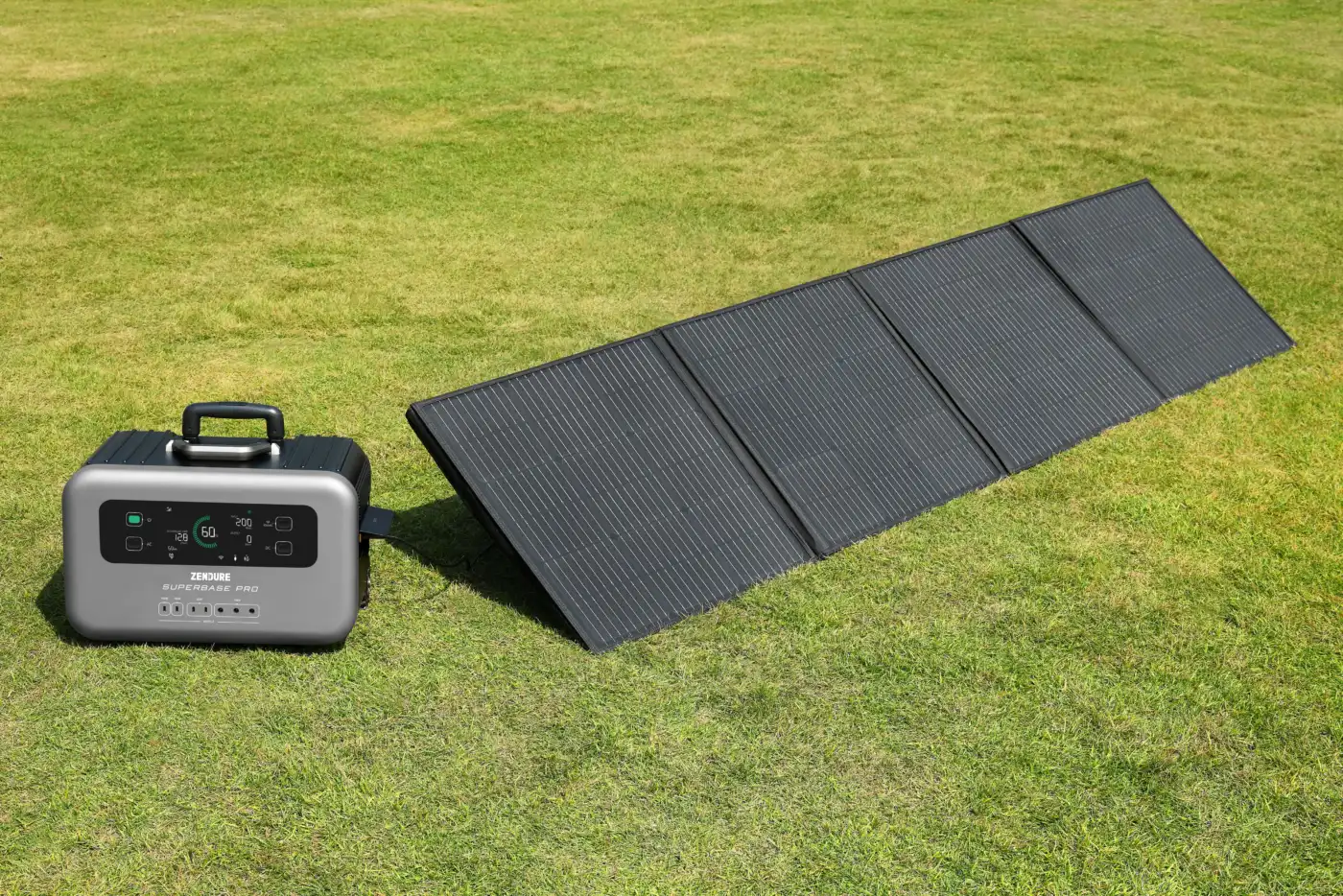
9. DOKIO 100W Portable Foldable Solar Panel Kit
Best for: Car campers, RVs, vans and basecamps with a 12V battery or power station.
At 100W and about 5–6 lb, this is far too big for a backpack, but it’s a strong pick for car camping. It comes with a separate PWM charge controller that protects a 12V battery from overcharge and short circuits, and a 9.84 ft cable so the panel can sit in the sun while the battery stays in the shade.
DOKIO reminds buyers that many portable power stations cap their solar input, so check yours before buying. With a 12V battery connected, the controller’s USB ports can also charge phones and lights.
Check Latest Price on Amazon10. Stealth Cam Sol-Pak Solar Battery Pack (12V)

Best for: Hunters and wildlife watchers running Stealth Cam cellular trail cameras.
This isn’t a hiking charger. It’s a solar battery pack that mounts near a trail camera and keeps it powered for months. It pairs a 12V panel with a 3,000mAh battery, adjustable swivel brackets and a 10 ft insulated cable, and Stealth Cam lists it as compatible with its wireless and cellular cameras. If you set cameras along trails you hike, it’s useful. For charging your phone, pick a panel above.
Check Latest Price on AmazonOther well-known hiking panels
A few specialist panels from outdoor brands are also worth knowing. The Goal Zero Nomad 10 has a built-in kickstand and Goal Zero lists up to 7.5W from its USB port. The Nitecore FSP30 offers 18W USB-C PD in a panel of about 1.38 lb. And the tiny FlexSolar E10 Mini weighs about 7.3 oz with a single USB-A port. Compare them with the picks above using the same rules: real port output, weight and folded size.
Head-to-Head Comparisons
BigBlue 35W VS BigBlue 28W
| Feature | BigBlue 35W | BigBlue 28W |
|---|---|---|
| Photo | | |
| Best single port | 25W USB-C PD Faster | 15W |
| Shade handling | Dual circuit Better | Standard |
| Weight | 1.54 lb | 1.5 lb |
| Reviews | 1,500+ | 10,000+ More |
| Shop | Check Price | Check Price |
BigBlue 25W VS NEBO 10W VS Soshine 6W
| Feature | BigBlue 25W | NEBO 10W | Soshine 6W |
|---|---|---|---|
| Photo | | | |
| Max USB | ~15W Most | 10W rated | ~5W |
| Weight | 0.84 lb | See listing | 8.88 oz Lightest |
| USB-C | Yes | Yes | No |
| Price | Mid | Mid | Lowest Cheapest |
| Shop | Price | Price | Price |
How to Choose a Portable Solar Panel for Hiking

1. Check the port output, not the box
The big wattage number is the panel’s rated power in perfect lab sun. What matters is how much each USB port can deliver, and what your power bank can accept.
2. Match your power bank’s input
A 25W USB-C PD port is wasted if your power bank only takes 10W. Check the input rating on your bank.
3. Think about your route
Open desert, alpine and lakeside trails give lots of sun. Thick forest and late arrivals at camp give very little.
4. Weigh the whole setup
Panel + cables + power bank. On a 2–3 day trip, a bigger power bank alone is often lighter.
5. Look at the folded size
Small, thick panels fit inside a pack. Long, thin ones are easier to hang on the outside.
6. Water resistance
Many panels are rated, but the USB box often isn’t. Keep the ports and your bank dry.
What size solar panel do you need?
| Your trip | Good panel size | Good picks |
|---|---|---|
| Day hikes, occasional top-ups | 6–10W, or just a power bank | Soshine 6W, NEBO 10W, BLAVOR 10,000mAh |
| Solo backpacking, sunny routes | 10–25W | BigBlue 25W |
| Long trips, phone + GPS + camera | 25–35W | BigBlue 35W, ELECOM 28W |
| Two or more people sharing | 28–35W, several ports | BigBlue 28W, BigBlue 35W |
| Car camping, power stations | 100W+ | DOKIO 100W |
How Much Charge Will You Actually Get?
Here’s a simple way to work it out. Say your panel feeds an average of 6 watts into your power bank during a 90-minute lunch stop. That’s about 9 watt-hours before losses.
A typical 10,000mAh power bank stores about 37 watt-hours (10,000mAh x 3.7V). So that lunch stop refills roughly a quarter of it, before charging losses. A 20,000mAh bank (about 74Wh) would gain about an eighth.
Real output swings a lot with sun angle, clouds, heat and shade. In practice, a panel rarely delivers its full rating for long. That’s why matching the panel to your power bank and your route matters more than chasing the biggest number.
How to Get More Charge From a Solar Panel on the Trail
- Leave home with a full power bank. Solar should extend it, not be your only plan.
- Unfold the whole panel in direct sun. Even a small shadow from a branch or your pack can cut output a lot.
- Aim it at the sun and move it during long stops as the sun moves. Panels with stands, like the ELECOM, make this easy.
- Keep the battery in the shade. Heat is bad for batteries. Let the panel bake, not the power bank.
- Charge at camp and at lunch. Hanging a panel on your pack works best on open, sunny trails where it stays pointed at the sky.
- Check it after clouds or shade pass. Some panel and device combos stop charging and need to be unplugged and plugged back in. Test your setup at home first.
- Save power, too. Airplane mode, a dim screen and downloaded offline maps make your battery last much longer.
Common Mistakes With Hiking Solar Panels
- Buying by wattage alone. Port output and your power bank’s input decide charging speed.
- Charging a phone directly in patchy sun. It keeps stopping and starting. Charge a power bank instead.
- Leaving the power bank in the hot sun.
- Bringing a panel on a forest trip where it’ll barely see sun.
- Forgetting the right cable. USB-A panels need USB-A cables. Pack a spare.
- Letting the USB box get wet. Many panels are only water-resistant at the cells, not the ports.
Frequently Asked Questions
What is the best portable solar panel for hiking?
For most hikers, the BigBlue 35W is the best pick thanks to its 25W USB-C PD output and shade-tolerant design. The ELECOM NESTOUT 28W is the premium choice, the BigBlue 28W the best value, and the BigBlue 25W the best ultralight option.
How many watts do I need in a hiking solar panel?
For one phone and a small power bank, 10–25W is usually enough. For several devices, two people or long trips, look at 28–35W. Always check the USB port output too.
Is a 10W or 20W solar panel better for backpacking?
A 10W panel saves weight and works for occasional top-ups. A 20–25W panel suits heavy phone use for navigation and photos. Lightweight 25W panels like the BigBlue 25W narrow the weight gap.
Can a portable solar panel charge my phone directly?
Yes, in steady sun. But clouds and shade interrupt charging, so most hikers charge a power bank from the panel and charge the phone from the bank.
Is a solar panel or a power bank better for hiking?
For day hikes and short trips, a charged power bank is simpler and often lighter. For long, sunny trips far from outlets, a panel plus a power bank lets you recharge again and again.
How long does it take to charge a power bank with a solar panel?
A 10,000mAh bank holds about 37Wh. At an average of 8W, that’s roughly five hours of good sun from empty, plus extra for losses and changing light.
Do portable solar panels work on cloudy days?
They still make some power under bright clouds, but output drops a lot. On dark, overcast days it may be too little to keep a phone charging.
Can a solar panel charge devices under trees?
Only a little. Charging starts and stops as shadows move. Find an open spot at lunch or camp.
Can I attach a solar panel to my backpack?
Yes. Most folding panels have loops for carabiners. It works best on open trails where the panel stays in direct sun.
Are portable solar panels waterproof?
It depends on the model. Many panels are water-resistant at the cells but not at the USB box. Keep the ports and your power bank dry.
What’s the difference between a solar panel and a solar power bank?
A solar panel makes power but stores none. A solar power bank is a battery with a small built-in panel. Panels charge much faster; solar power banks are simpler.
Is USB-C worth having on a hiking solar panel?
Yes if your phone and power bank use USB-C. For faster charging, look for USB-C Power Delivery (PD), like the BigBlue 35W’s 25W port. USB-C alone doesn’t guarantee fast charging.
Can a hiking solar panel charge two devices at once?
Many can, but they share a total limit. The BigBlue 28W, for example, gives up to 15W per port and 24W total. In weak sun, charge one device at a time.
Can it charge a GPS, headlamp or smartwatch?
Yes, if the device charges over USB and you bring the right cable. A power bank helps if the device keeps disconnecting as the light changes.
Is a 30W solar panel too big for hiking?
Not for groups or long trips. For a solo hiker charging one phone, a lighter 10–25W panel is usually a better fit.
Are solar panels useful on winter hikes?
On clear days, yes, though short days and a low sun reduce output. Also check your power bank’s charging temperature limits in freezing weather.
Can I use a 100W panel for backpacking?
No. Panels like the DOKIO 100W weigh around 5–6 lb and are built for car camping, RVs and power stations.
What should I check before buying a hiking solar panel?
Port output, your power bank’s input, packed weight, folded size, water resistance, attachment points and whether it recovers charging after shade.
Which Hiking Solar Panel Should You Buy?
For most hikers, the BigBlue 35W is the best portable solar panel for hiking: fast USB-C PD, three ports and a design that copes with partial shade.
Want the best build and easy aiming? Choose the ELECOM NESTOUT 28W. For proven value, the BigBlue 28W. To save weight, the BigBlue 25W. For an all-in-one battery, the BLAVOR 20,000mAh. And for car camping with a power station, the DOKIO 100W.
Our winner: Check BigBlue 35W on AmazonAll Solar Panels in This Guide: Tap to See Today’s Price
Every product from this guide in one place.
Complete Your Kit: Readers’ Favorite Picks From Our Other Gear Guides
One top pick from each of our other buying guides. Tap a photo to see it on Amazon.



More Trail Tech & Backpacking Guides
Editorial disclosure and sources: Specs come from each maker’s Amazon listing, checked November 2026. Background on hiking solar panel performance draws on OutdoorGearLab’s solar testing and manufacturer pages such as Goal Zero and Nitecore. No hands-on testing is claimed. Charging estimates are rough and vary with sunlight.
1 thought on “Best Portable Solar Panels for Hiking (2026): 10 Solar Chargers Compared”