
Stand in the camping aisle and you’ll see two kinds of little gas cans: the tall, skinny green propane bottle and the short, wide butane can that looks like a can of hairspray. They look like they do the same job. They don’t, at least not in every weather.
Pick the wrong one and you find out the hard way: a sad blue flame on a frosty morning, coffee that takes forever, or a can that dies halfway through dinner. Pick the right one and your camp kitchen just works.
This guide settles the propane vs butane camping stove question in plain English. You’ll learn how each fuel handles cold, wind, altitude, cost, weight and safety, where isobutane backpacking canisters fit in, and why a dual fuel stove is the easy answer for most campers. Then we compare 13 stoves and 2 fuel packs on Amazon so you can buy the right one.
Affiliate disclosure: As an Amazon Associate, JoinHikes earns from qualifying purchases. If you buy through Amazon links in this article, we may earn a commission at no extra cost to you. It never changes how we rank products.
How we chose: We compared manufacturer specs, Amazon listing details, ratings and review counts (checked November 2026), and published fuel data. We haven’t run our own hands-on tests and we don’t invent results. Boil times quoted below are the sellers’ own claims. Prices and ratings change, so check the listing before you buy.
Quick Answer: Propane or Butane for a Camping Stove?
Propane is better for cold weather, wind and big group cooking. It keeps working far below freezing, and you can run it from cheap refillable tanks. Butane is better for warm-weather, light and tidy cooking. The cans are smaller, lighter, cleaner-looking and easy to pack, but butane gets weak as temperatures drop toward freezing.
Can’t decide? Get a dual fuel stove. Our top pick, the Grill Boss Dual Fuel (12,000 BTU), runs on both. Use butane on summer trips and switch to propane when it’s cold. For the best value, the Gas One GS-3400P does the same for much less. Backpackers should look at isobutane-blend canister stoves instead (more on that below).
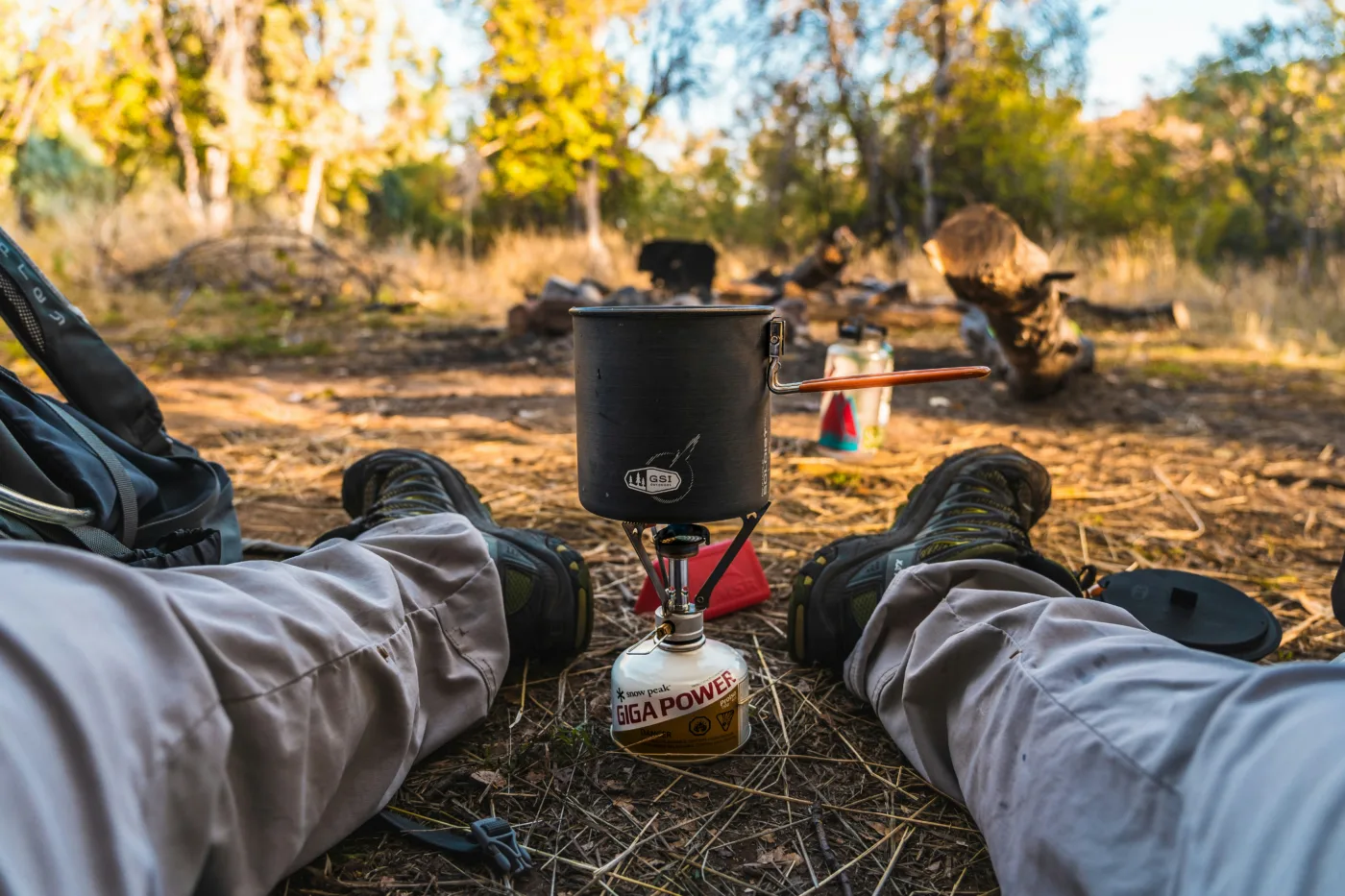
Key Takeaways
- Temperature decides it. Butane stops turning into gas near freezing (about 31°F / −0.5°C). Propane keeps going down to about −44°F (−42°C).
- Butane is lighter to carry. An 8 oz butane can is far smaller and lighter than a 16.4 oz steel propane bottle.
- Energy per pound is almost the same. The fuels pack nearly equal heat by weight, so “which is hotter” mostly comes down to the stove’s burner, not the fuel.
- Propane is usually cheaper long-term, especially if you hook a stove up to a refillable bulk tank.
- Dual fuel stoves remove the guesswork. Five of the stoves in this guide take both fuels.
- Never cook inside a tent or car with either fuel: both make carbon monoxide.
Propane vs Butane at a Glance
Propane and butane are cousins. Both are LPG (liquefied petroleum gas): they’re stored as a liquid under pressure and turn back into gas when you open the valve. That “turning into gas” step is where they differ, and it explains almost everything else.
| Factor | Propane | Butane |
|---|---|---|
| Boiling point (when it can turn into gas) | About −44°F (−42°C) | About 31°F (−0.5°C) |
| Cold-weather performance | Excellent, works well below freezing | Weak near freezing, poor below it |
| Container | Thick steel bottle (usually 16.4 oz) or refillable tank | Thin 8 oz can that slides into the stove |
| Weight & bulk to carry | Heavier and bulkier | Lighter and more compact |
| Heat per pound of fuel | About 21,600 BTU/lb | About 21,300 BTU/lb (nearly equal) |
| Heat per same-size container | Lower | About 12% more |
| Refillable? | Bulk tanks yes; standard 1 lb bottles are meant to be disposable | No, cans are single-use |
| Long-term cost | Usually cheaper, especially from a bulk tank | Cheap stoves, but fuel adds up |
| Where to buy | Hardware stores, big-box stores, many gas stations | Big-box and Asian grocery stores, online |
| Best for | Cold trips, groups, car camping, RVs | Warm-weather camping, tailgating, picnics, small trips |
Fuel figures are widely published approximations. Real burn time and heat depend on the stove, the pot, wind and temperature.
Cold Weather and Altitude: Where Propane Wins
A gas stove can only burn fuel that has turned into vapor. Inside the can, the liquid fuel boils into gas, and that gas is what pushes out through the burner. If it’s too cold for the fuel to boil, the pressure drops and the flame shrinks.
Butane boils at about 31°F (−0.5°C). So on a 35°F morning, a butane can is barely above its boiling point, and the flame gets weak. Below freezing, a pure butane stove may sputter or not light at all. Propane boils at about −44°F (−42°C), so it keeps strong pressure on any morning you’re likely to camp in.
Why butane cans “die” before they’re empty
Turning liquid into gas uses heat, so a can gets colder as you cook. On a cool, breezy evening a butane can can chill itself below the point where it vaporizes well. That’s why people find “half-full” cans that won’t run. Warm the can back up and it works again.
What about high altitude?
Thin mountain air doesn’t stop a canister stove by itself. The real problem at altitude is the cold that comes with it. Water also boils at a lower temperature up high, so cooking takes longer either way. For high, cold camps, propane (or an isobutane blend for backpacking) is the safer bet.
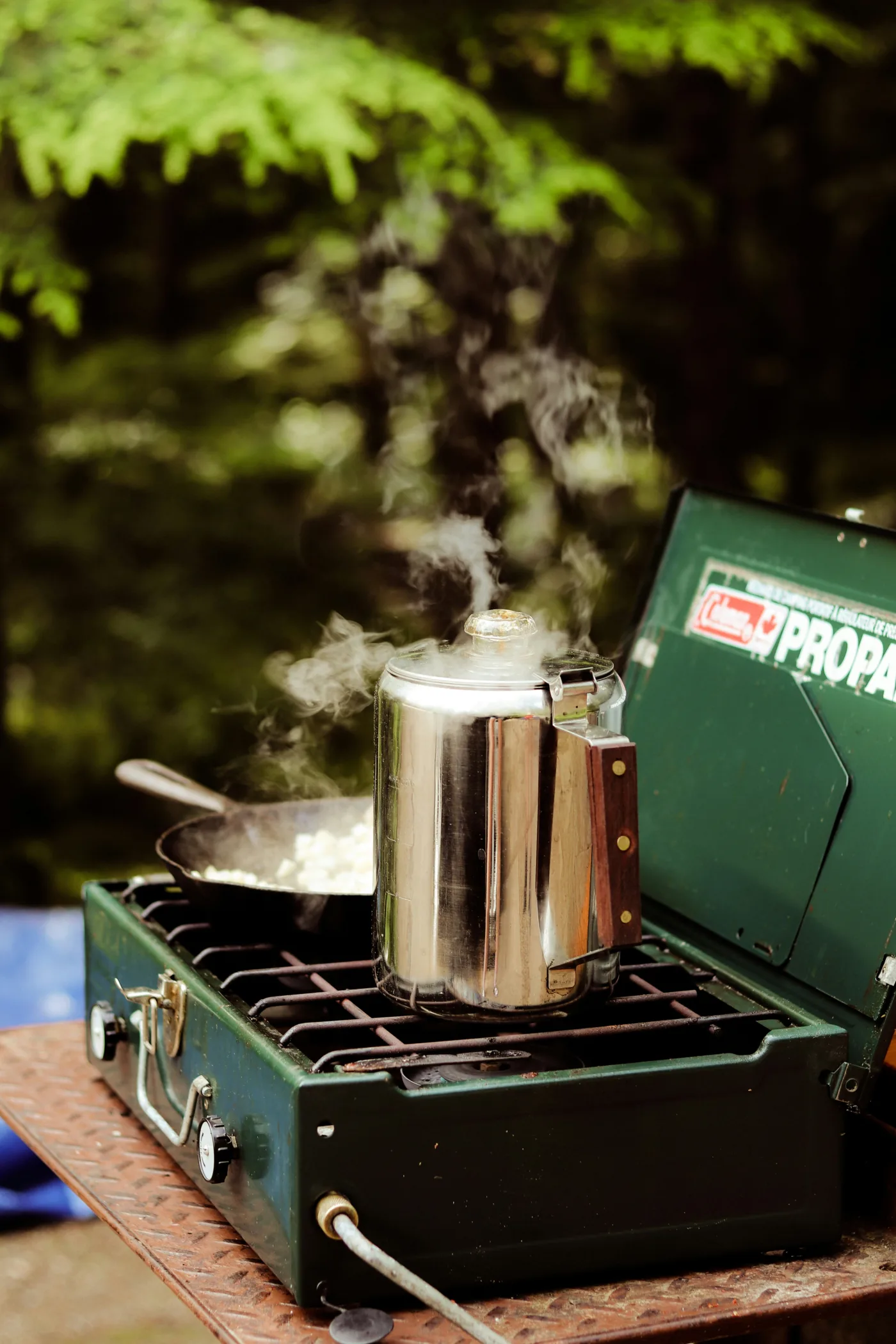
Cost and Burn Time: How Long Does Each Can Last?
Here’s a simple way to estimate burn time. Each pound of fuel holds about 21,000+ BTU of heat. Divide that by your stove’s BTU rating and you get roughly how many hours it runs on full blast. Simmering on low lasts much longer.
| Fuel container | Approx. heat inside | 7,650 BTU stove (full) | 12,000 BTU stove (full) |
|---|---|---|---|
| 8 oz butane can | ~10,600 BTU | ~1.4 hours | ~55 minutes |
| 16.4 oz propane bottle | ~22,100 BTU | ~2.9 hours | ~1.8 hours |
| 20 lb propane tank | ~430,000 BTU | ~56 hours | ~36 hours |
Rough estimates from fuel weight × average BTU per pound ÷ stove rating. Wind, cold, pot size and simmering change real results a lot. Coleman, for example, lists up to 1.25 hours on high for its 7,650 BTU butane stove on one 8.8 oz can.
So which is cheaper?
- For a weekend or two a year, it hardly matters. Butane stoves are often the cheapest to buy.
- Buy butane in bulk. A 12-pack usually costs far less per can than a 4-pack. At the time of writing, the GasOne 12-pack below worked out to roughly a third of the per-can price of a typical 4-pack.
- For lots of camping, propane wins. Hooking a dual fuel or propane stove to a refillable 20 lb tank (with an adapter hose) is usually the cheapest heat you can buy, and it cuts down on throwaway cans.
Weight, Size and Convenience
Butane: grab-and-go
The 8 oz can slides into a sideways compartment inside a suitcase-style stove and locks in place. Everything packs in one hard case. Great for car trunks, picnics and tailgates.
Propane: tough but bulky
Propane is stored at much higher pressure, so it needs a thick steel bottle. That makes each bottle heavier and bulkier, but almost indestructible. Big tanks are refillable.
Backpacking: neither
Pure propane bottles are too heavy for a pack, and pure butane is too weak in the cold. Backpackers use small screw-on isobutane-blend canisters instead.
Flying with fuel
You can’t fly with gas canisters in checked or carry-on bags. Plan to buy fuel at your destination, and check that the type you need is sold there.
Safety: Propane vs Butane
Both fuels are safe when used the right way. Both are also flammable and both make carbon monoxide when they burn. Most of the stoves in this guide say “outdoor use only” on the listing, and you should take that seriously.
- Butane can stoves: don’t use a pot, pan or griddle that hangs over the can compartment. Trapped heat can overheat the can. Don’t place two stoves side by side for the same reason.
- Use the safety features: most butane and dual fuel stoves here have a pressure-sensing shut-off or cartridge ejection system that releases the can if pressure gets too high.
- Check for leaks after connecting a propane bottle or hose: brush on soapy water and look for bubbles. CAMPLUX recommends this test before first use.
- Store cans cool and shaded. Don’t leave fuel in a hot car or in direct sun, and keep spare cans away from the stove while cooking.
- Disposal: burn cans until completely empty. Many areas recycle empty steel cans, while 1 lb propane bottles often go to household hazardous waste. Check your local rules.
If you also cook in wet weather, our guide to camping in the rain covers how to set up a safe, dry cooking area under a tarp.
Where Does Isobutane Fit In?

The small screw-top canisters backpackers use (from brands like MSR, Jetboil and Coleman) are usually a blend of isobutane and propane. Isobutane boils at about 11°F (−12°C), much better than normal butane, and the bit of propane adds extra push in the cold.
That makes blends the best middle ground for hiking: light like butane, but with better cold performance. They’re not quite as good as pure propane in deep cold, and as the canister empties, the propane tends to burn off first, so the last part of a can is weaker on frosty mornings.
If you’re backpacking, you want an ultralight canister stove. Three of the picks below (Coleman, Odoland and Caudblor) are this type. For many more options, see our guides to the best ultralight backpacking stoves under $30 and under $50.
Dual Fuel Stoves: The Easy Answer
A dual fuel stove takes an 8 oz butane can in its side compartment and has a port for a regulator or hose that connects a propane bottle. You get butane’s tidy convenience in summer and propane’s cold-weather muscle when you need it.
- For butane: line up the notch on the can’s collar with the stove, push it in and lock the lever.
- For propane: remove the butane can, attach the included regulator or hose to the stove, then screw on a 16.4 oz propane bottle hand-tight.
- Never connect both at once, and always follow your stove’s manual.
- Leak-check the propane connection with soapy water before lighting.
Five of the stoves in this guide are dual fuel, including our top pick. Note that some stoves are slightly less powerful on one fuel: the CAMPLUX, for example, is rated 7,200 BTU on butane and 6,500 BTU on propane.
Propane or Butane: Which Should You Choose?

| Your trip | Best fuel | Good picks |
|---|---|---|
| Summer car camping, picnics, tailgating | Butane | Chef Master 90027, Coleman Butane, Gas One Butane |
| Spring and fall camping (cold mornings) | Dual fuel | Grill Boss, Gas One GS-3400P, SHINESTAR |
| Winter or high, cold camps | Propane | Any dual fuel stove on propane, XtremepowerUS |
| Family or group cooking | Propane | XtremepowerUS 2-Burner, Grill Boss |
| Backpacking | Isobutane blend | Coleman Backpacking, Odoland, Caudblor |
| Home emergency kit | Dual fuel | Gas One GS-3400P, Chef Master 90235 kit |
Quick Comparison: Best Propane, Butane and Dual Fuel Camping Stoves
On a phone, swipe the table sideways. BTU and weights are as listed by each seller. Ratings from Amazon, checked November 2026.
| Stove | Fuel | Max BTU/hr | Weight | Amazon rating | Shop |
|---|---|---|---|---|---|
| Best overall Grill Boss Dual Fuel | Dual fuel | 12,000 | 4.41 lb | 4.6 (2,088) |  Check Price |
| Best premium propane XtremepowerUS 2-Burner | Propane | 25,516 total | 13 lb | 4.4 (881) | 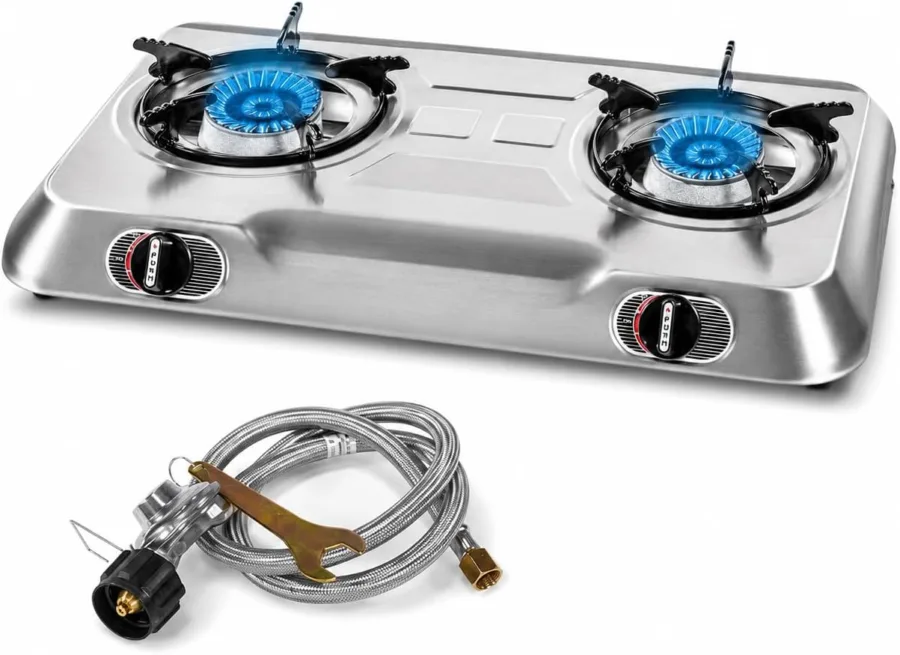 Check Price |
| Best value Gas One GS-3400P | Dual fuel | 8,000 | 3.1 lb | 4.6 (15,478) |  Check Price |
| Premium butane kit Chef Master 90235 Kit | Butane | 12,000 | See listing | 4.6 (43) | 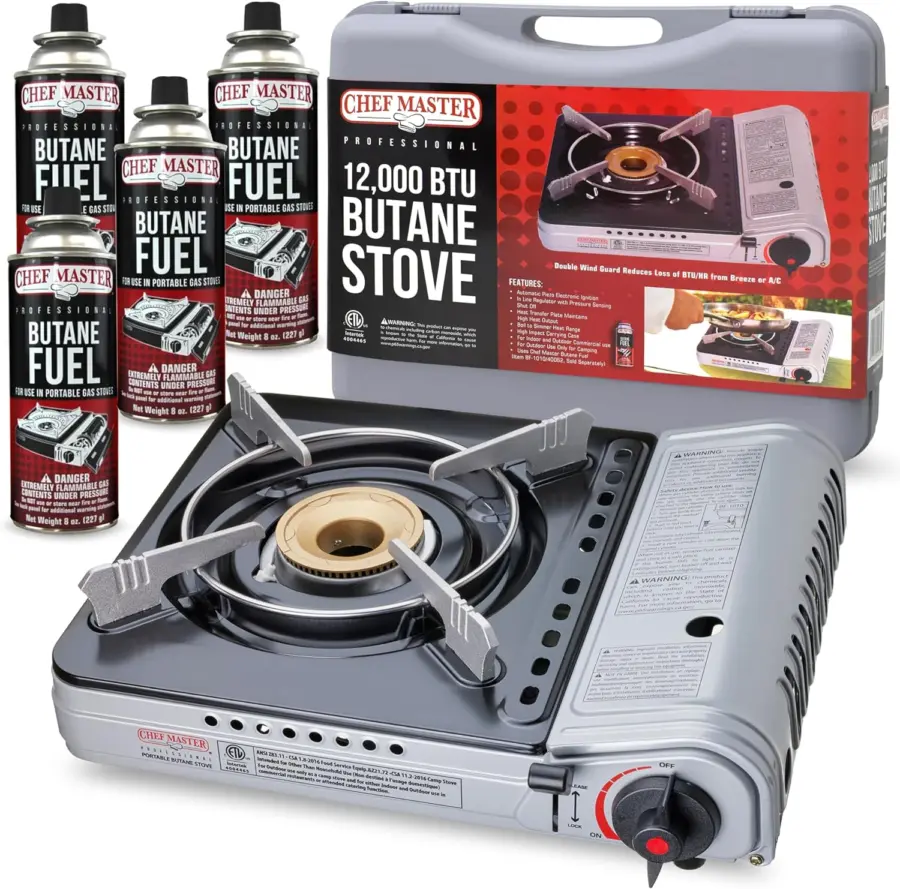 Check Price |
| Best with hose Gospowor Dual Fuel | Dual fuel | 10,000 | 3.5 lb | 4.5 (557) |  Check Price |
| Most safety features SHINESTAR Dual Fuel | Dual fuel | 7,800 | 4.15 lb | 4.5 (1,612) |  Check Price |
| CSA certified CAMPLUX Safari | Dual fuel | 7,200 / 6,500 | 3.31 lb | 4.4 (1,539) |  Check Price |
| Best butane stove Chef Master 90027 | Butane | 7,650 | 4 lb | 4.5 (417) |  Check Price |
| Easiest to clean Coleman Butane Stove | Butane | 7,650 | See listing | 4.6 (2,041) | 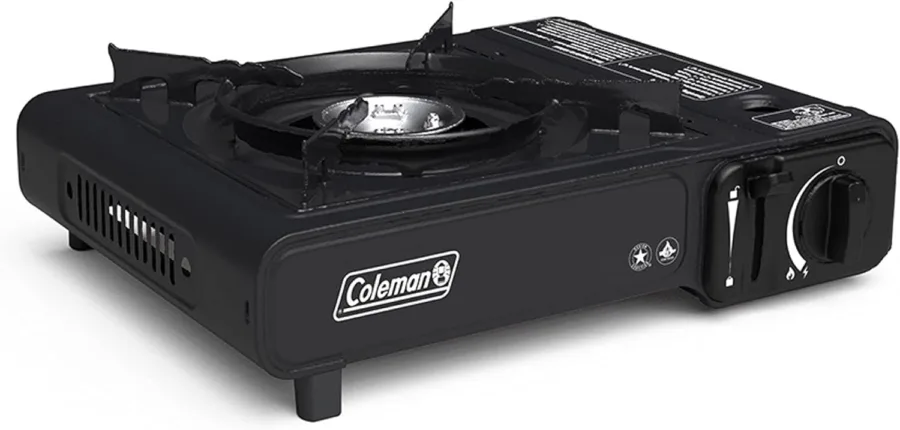 Check Price |
| Best budget butane Gas One Butane | Butane | 7,650 | 3.1 lb | 4.6 (2,894) | 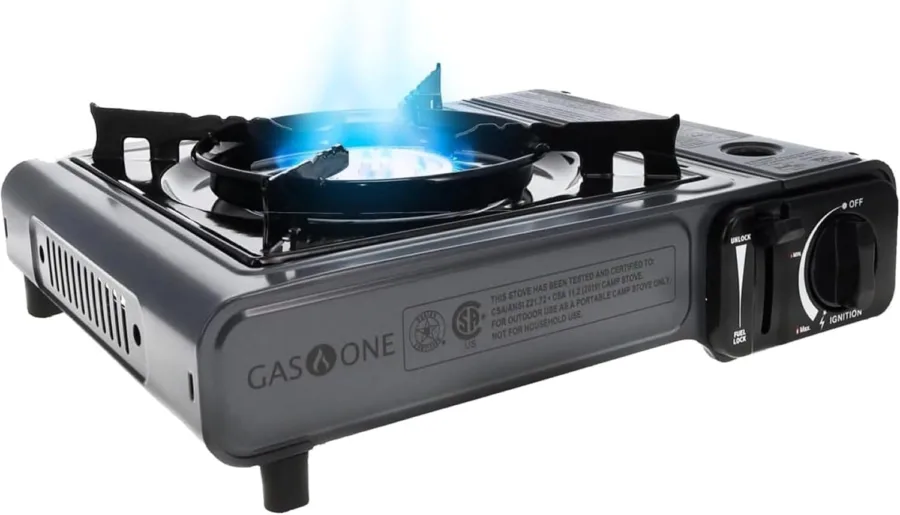 Check Price |
| Best for backpacking Coleman Backpacking | Canister blend | 10,000 | 6.7 oz | 4.6 (1,589) |  Check Price |
| Windproof canister Odoland Canister Stove | Canister | See listing | 15.8 oz | 4.5 (380) | 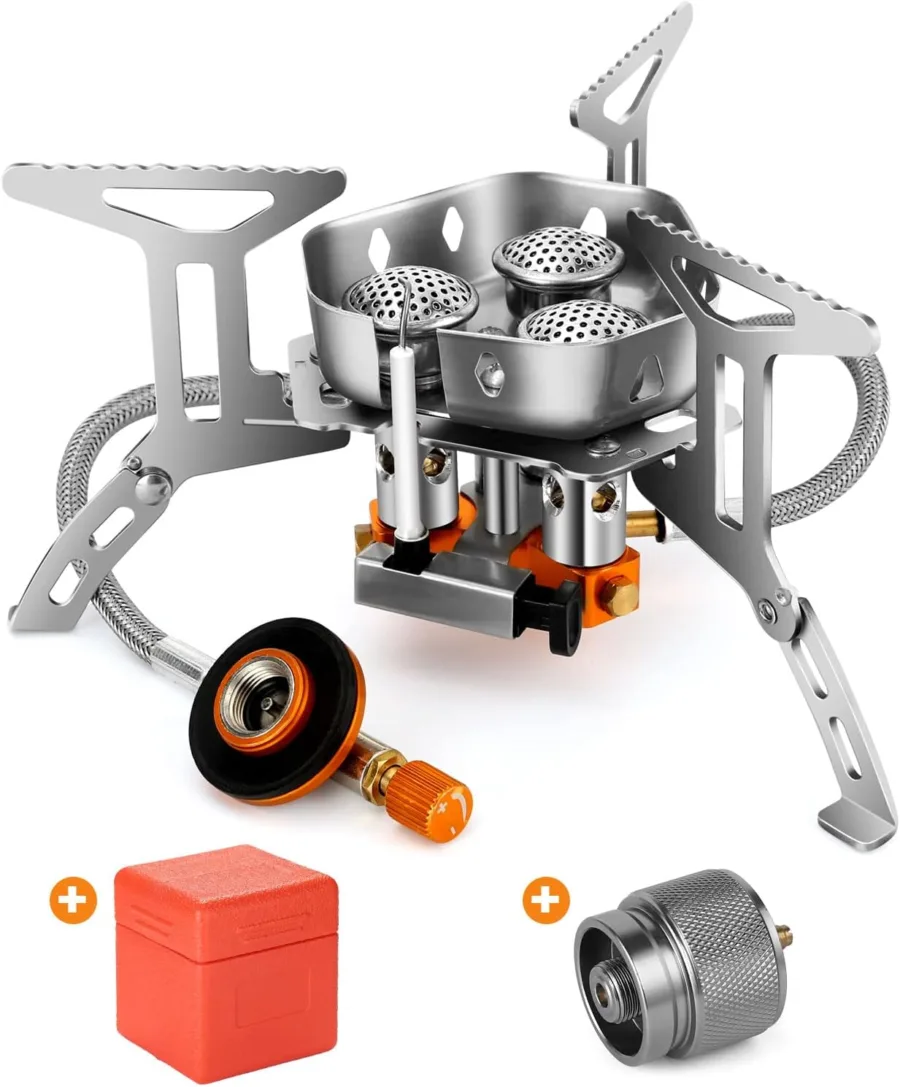 Check Price |
| Best budget option Caudblor Mini Stove | Canister + adapters | See listing | 9.6 oz | 4.5 (1,352) | 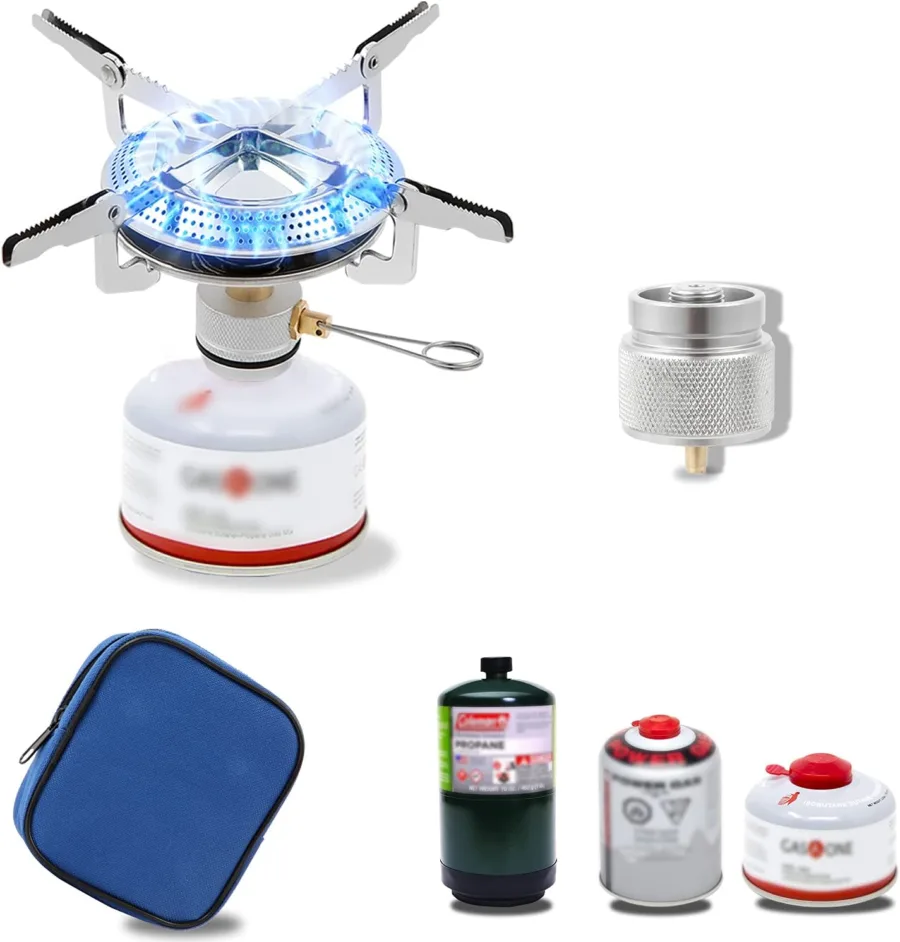 Check Price |
At the time of writing, most single-burner stoves here cost roughly $20–$45, the Grill Boss, Chef Master 90235 kit and XtremepowerUS more. Prices change often, so tap through for today’s price. Fuel is sold separately unless noted.
The Best Camping Stoves for Propane and Butane, Reviewed
Dual Fuel and Propane Stoves
1. Grill Boss Dual Fuel Camp Stove (Chef Master 90057)
Best for: Car campers who camp in all seasons and want strong heat on either fuel.
If you only buy one stove, make it one that doesn’t care which fuel you have. The Grill Boss (made by Chef Master, model 90057) runs on an 8 oz butane can or a propane bottle and puts out up to 12,000 BTU, about 50% more than a typical 7,650 BTU butane stove. That extra power matters for boiling big pots of water and for fighting wind.
It has a double wind guard, piezo push-button ignition and an automatic gas shut-off. At 4.41 lb and about 12 x 14 x 4 inches, it’s still a one-hand carry. Owners rate it 4.6 stars from 2,000+ ratings, and it sells over 1,000 a month.
Why it’s our top pick: it solves the whole propane vs butane debate. Use cheap, tidy butane on warm trips, then switch to propane for frosty mornings.
- Works with butane or propane.
- More power than most single burners.
- Double wind guard.
- Strong rating and sales history.
- Costs more than basic stoves.
- Heavier than a backpacking stove.
- Fuel sold separately.
2. XtremepowerUS Double Burner Propane Stove
Best for: Families, group camps, RV trips and anyone cooking two dishes at once.
When you’re feeding a crowd, one burner isn’t enough. The XtremepowerUS has two independently controlled burners at 12,758 BTU each, for 25,516 BTU total. Boil pasta water on one side and fry on the other.
It’s built from corrosion-resistant stainless steel, uses piezo ignition, and comes with a regulator and hose for propane. It measures about 27.5 x 16 x 4.75 inches and weighs 13 lb, so it’s a car-camping and campsite-table stove, not something you carry far.
Be aware: this is propane only, and it’s big. Check the listing to confirm which tank size the included hose fits before you buy fuel.
- Two full-power burners.
- Propane works in the cold.
- Stainless body wipes clean.
- Regulator and hose included.
- Heavy and wide.
- Propane only.
- Rating a bit lower (4.4).
3. Gas One GS-3400P Dual Fuel Stove
Best for: Budget-minded campers, beginners and home emergency kits.
The Gas One GS-3400P is one of the best-selling camping stoves on Amazon, with 15,000+ ratings at 4.6 stars and 30,000+ bought in a month. It’s a patented dual fuel design: it runs on an 8 oz butane can or a 16.4 oz propane bottle, and the propane converter regulator is included.
Output is 8,000 BTU, slightly more than most butane-only stoves. You get piezo ignition, an adjustable heat dial, and a pressure sensor cartridge ejection system that pops the butane can out if pressure gets too high. It weighs 3.1 lb and comes with a carrying case.
- Huge, very positive review base.
- Propane regulator included.
- Light and compact.
- Low price.
- Less power than the Grill Boss.
- No double wind guard.
4. Gospowor Dual Fuel Stove with Adapter Hose
Best for: Campers who want a stable stove that sits away from the propane bottle.
Instead of screwing the propane bottle straight onto the stove, Gospowor uses a 1.6 ft braided stainless steel hose. That keeps the bottle off to the side, so the stove sits lower and steadier. It also takes standard 8 oz butane cans.
It’s rated 10,000 BTU with auto-ignition, a windproof shield, overpressure protection and a canister safety lock. The ceramic-coated, detachable frame wipes clean easily. The listing says it comes with a carrying bag and griddle. It weighs 3.5 lb.
- Hose keeps the stove stable.
- Strong 10,000 BTU.
- Easy-clean coated frame.
- Smaller review base.
- Fuel not included.
5. SHINESTAR 7800 BTU Dual Fuel Camping Stove
Best for: Cautious first-timers and families.
SHINESTAR stacks up the safety features: a cartridge ejection system, safety lock and auto shut-off valve. It runs on 8 oz butane or 1 lb propane and comes with a propane adapter hose and carry case.
The 7,800 BTU aluminum burner is enough, according to the seller, to boil 4 cups of water in about 5 minutes. The piezo ignition is rated for 10,000+ lights. It weighs 4.15 lb and has 1,600+ ratings at 4.5 stars.
- Lots of safety features.
- Adapter hose included.
- Solid ratings.
- A little heavier than Gas One.
- Average power.
6. CAMPLUX Safari Dual Fuel Camping Stove
Best for: Campers who want certified safety parts and a slim, light stove.
CAMPLUX’s Safari is CSA certified for North American safety and includes a CSA-certified regulator and hose for a 16.4 oz propane bottle. It also has overpressure protection and a gas leakage protection device.
It’s honest about output: 7,200 BTU on butane and 6,500 BTU on propane. At 3.31 lb and just over 3 inches tall, it’s one of the slimmest here. CAMPLUX asks you to do a soapy-water leak test before use, which is good practice with any stove.
- CSA certified.
- Regulator and hose included.
- Slim and light.
- Lower BTU, especially on propane.
- 4.4-star rating.
Butane Camping Stoves
7. Chef Master 90235 Butane Stove + 4 Fuel Canisters
Best for: Warm-weather campers and emergency kits who want power and fuel in one box.
Most butane stoves top out at 7,650 BTU. Chef Master’s 90235 pushes 12,000 BTU from one burner, so it boils faster and handles bigger pans. It comes with four 8 oz butane canisters and a hard-shell carrying case, so you’re ready to cook the day it arrives.
Safety features include an in-line regulator and pressure-sensing shut-off, plus a wind guard and piezo ignition.
Be aware: it’s butane only, so it’s for above-freezing weather, and it has a small review base so far (about 40 ratings at 4.6 stars). The listed weight looks off, so we haven’t quoted it.
- Very powerful for butane.
- Fuel included.
- Good safety features.
- Butane only: weak in the cold.
- Few reviews so far.
- Pricey for a butane stove.
8. Chef Master 90027 Portable Butane Stove
Best for: Picnics, tailgates and summer car camping.
The Chef Master 90027 is a classic suitcase-style butane stove done well. It puts out 7,650 BTU, has piezo ignition, a wind guard, and the same in-line regulator with pressure-sensing shut-off as its bigger brother. It fits pans up to about 10 inches and packs into a hard carrying case.
It weighs about 4 lb and measures 14 x 12 x 5 inches. Ratings are good at 4.5 stars from 400+ reviews.
- Solid safety features.
- Wind guard.
- Hard case protects it.
- Butane only.
- Smaller review base than Gas One.
9. Coleman Classic 1-Burner Butane Stove
Best for: Campers who like a trusted brand and easy cleanup.
Coleman’s butane stove has a removable porcelain-coated grate, so spills come off easily, and a rust-proof aluminum burner. Instastart ignition lights it without matches, and a wind baffle shields the flame. The large base keeps pots stable while you stir.
It’s rated 7,650 BTU, comes with a carry case, and has 2,000+ ratings at 4.6 stars. Coleman lists up to 1.25 hours on high per 8.8 oz butane can.
- Grate lifts out to clean.
- Trusted brand.
- Stable base.
- Butane only.
- Bulkier footprint (15 x 10 in).
10. Gas One Portable Butane Stove (GS-1000)
Best for: Anyone who wants a cheap, reliable butane stove.
Gas One’s butane-only stove is one of the cheapest well-reviewed stoves here, with 2,800+ ratings at 4.6 stars and 6,000+ sold a month. It’s CSA approved, puts out 7,650 BTU, and has piezo ignition with a safety shut-off and a fuel cartridge ejection system.
It weighs 3.1 lb, comes with a carrying case, and Gas One notes it runs quietly. The trade-off: it’s butane only, so if you might camp in the cold, spend a little more on the dual fuel GS-3400P.
- Low price.
- CSA approved.
- Strong ratings.
- Butane only.
- No propane option.
Backpacking Canister Stoves (Isobutane Blends)
11. Coleman Classic 1-Burner Backpacking Stove
Best for: Hikers and backpackers who need a tiny, light stove.
This is a completely different kind of stove: a 6.7 oz folding burner that screws onto a small threaded fuel canister. Coleman lists its fuel type as propane/butane, meaning screw-on blend canisters.
It puts out 10,000 BTU, and Coleman says it boils 1 L of water in about 3.25 minutes. PerfectFlow pressure control aims to keep output steady as the canister empties and in tough conditions. It fits about a 6-inch pan and has 1,500+ ratings at 4.6 stars.
- Very light and small.
- Powerful for its size.
- Trusted brand.
- Small pots only.
- Ignition type not clearly listed.
- Less stable than a tabletop stove.
12. Odoland Windproof Backpacking Canister Stove
Best for: Backpackers who often cook in breezy spots.
Odoland’s canister stove has a windproof burner design, piezo ignition and comes with two connector types, so it can work with more fuel canister styles. It folds down into a carry case and weighs 15.8 oz.
The seller claims it boils 1 L of water in about 2 minutes, though that’s a manufacturer figure. It has a smaller review base (380+ ratings at 4.5 stars).
- Wind-resistant burner.
- Piezo ignition.
- Flexible fuel connectors.
- Heavier than the Coleman.
- Smaller review base.
13. Caudblor Small Backpacking Stove with Butane Adapter
Best for: Beginners and occasional campers on a tight budget.
The Caudblor is the cheapest stove in this guide, and it’s surprisingly flexible. It’s a small folding canister stove that weighs 9.6 oz, and the seller says it comes with an adapter for 8 oz butane cans and 1 lb propane bottles. So you can use whichever fuel is easiest to find.
Fold-out pot supports give it a wider, stable base for a small skillet, and the control valve adjusts from simmer to full heat. It has 1,300+ ratings at 4.5 stars.
- Lowest price here.
- Adapters add fuel options.
- Light.
- No piezo ignition listed.
- BTU not listed.
- Basic build.
Best Butane Fuel Canisters for Camping Stoves
Every butane stove above uses standard 8 oz butane canisters. Stock up so you never run out mid-meal, and always buy proper stove fuel (not lighter refill cans).
14. Chef Master Butane Fuel Canisters, 8 oz 4-Pack
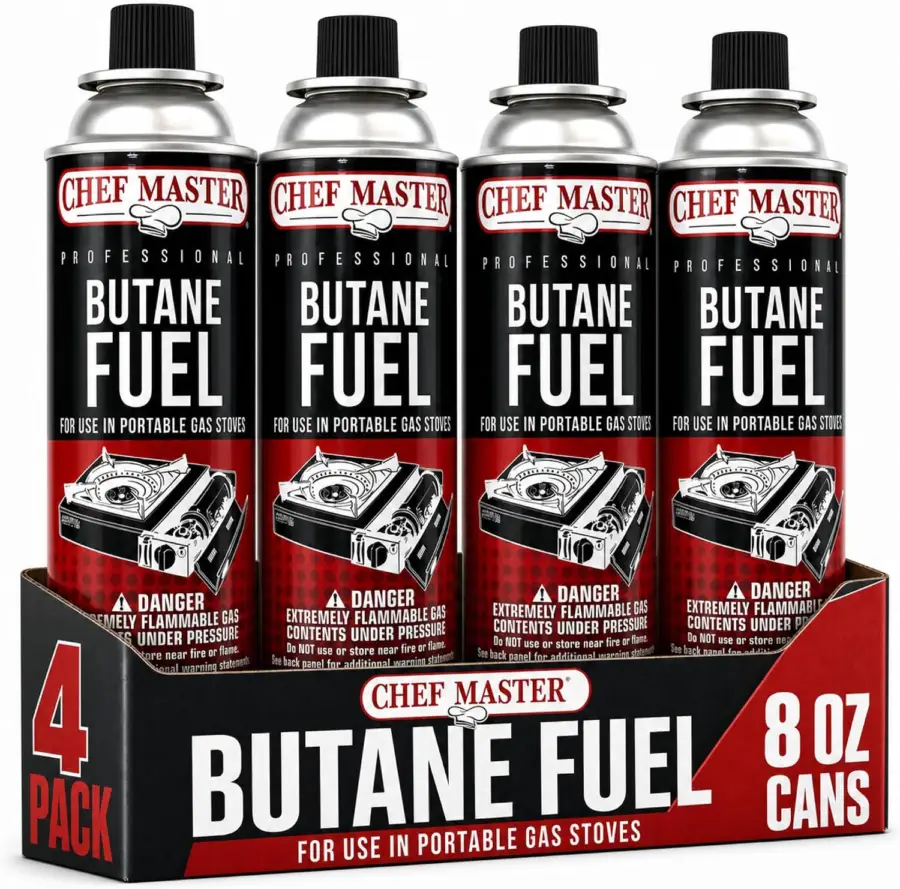
Best for: Topping up before a trip.
Chef Master’s 8 oz canisters have a notched collar that lines up with the stove for a correct fit, and a self-sealing nozzle. The listing quotes about 2 hours of burn or 4 hours of simmer per can (that depends on your stove’s output). They’re very popular, with 4,100+ ratings at 4.7 stars and 7,000+ sold a month.
- Well-rated, reliable fuel.
- Fits standard butane stoves.
- Higher cost per can than a 12-pack.
15. GasOne Butane Fuel Canisters, 12-Pack

Best for: Regular campers and emergency kits.
GasOne’s 12-pack is the smart buy if you cook with butane often. The cans automatically reseal when removed, so you can pop a half-used can out and save it. They also have a notched collar for easy alignment. With 9,400+ ratings at 4.8 stars, it’s the highest-rated product in this guide.
- Much lower cost per can.
- Top-rated.
- Reseals when removed.
- A lot to store at once.
Head-to-Head Comparisons
Grill Boss VS Gas One GS-3400P
| Feature | Grill Boss Dual Fuel | Gas One GS-3400P |
|---|---|---|
| Photo | | |
| Fuel | Butane or propane | Butane or propane |
| Max BTU | 12,000 More | 8,000 |
| Wind protection | Double wind guard Better | Standard |
| Weight | 4.41 lb | 3.1 lb Lighter |
| Ratings | 2,000+ | 15,000+ More |
| Price | Higher | Lower Cheaper |
| Shop | Check Price | Check Price |
Chef Master 90027 VS Coleman VS Gas One Butane
| Feature | Chef Master 90027 | Coleman Butane Stove | Gas One Butane |
|---|---|---|---|
| Photo | | | |
| BTU | 7,650 | 7,650 | 7,650 |
| Standout | Pressure shut-off, wind guard | Porcelain grate Cleanest | CSA approved |
| Ratings | 400+ | 2,000+ | 2,800+ Most |
| Price | Mid | Mid | Lowest Cheapest |
| Shop | Check Price | Check Price | Check Price |
Coleman VS Odoland VS Caudblor (Backpacking)
| Feature | Coleman Backpacking | Odoland Canister Stove | Caudblor Mini Stove |
|---|---|---|---|
| Photo | | | |
| Weight | 6.7 oz Lightest | 15.8 oz | 9.6 oz |
| BTU | 10,000 | See listing | See listing |
| Ignition | Not listed | Piezo Easier | Not listed |
| Price | Mid | Mid | Lowest Cheapest |
| Shop | Check Price | Check Price | Check Price |
Common Propane and Butane Stove Mistakes
- Taking a butane-only stove on a cold trip. If nights drop near freezing, bring propane or a dual fuel stove.
- Leaving the can in the cold overnight. Keep butane cans warm in your jacket or sleeping bag.
- Using an oversized griddle on a butane stove. It can trap heat over the can.
- Cooking in the tent vestibule “just this once.” Carbon monoxide is a real risk.
- Not checking for leaks after attaching a propane bottle or hose.
- Running out of fuel. Bring at least one spare can or bottle more than you think you need.
- Throwing partly full cans in the trash. Burn them empty and follow local disposal rules.
Frequently Asked Questions
Is propane or butane better for a camping stove?
Propane is better in cold weather and for big group cooking. Butane is lighter and tidier for warm-weather camping. If you camp in different seasons, a dual fuel stove that takes both is the best choice.
Does butane work in cold weather?
Not well. Butane boils at about 31°F (−0.5°C), so it gets weak as temperatures drop toward freezing and may barely run below it. Keeping the can warm helps, but propane is the better fuel for cold trips.
Is propane hotter than butane?
Not really. Pound for pound they hold almost the same energy. How hot your stove cooks depends mostly on its BTU rating and burner design. Propane just keeps its pressure better in the cold.
Can I use propane in a butane stove?
Only if the stove is designed as dual fuel. Never force a propane bottle onto a butane-only stove: propane is stored at much higher pressure and needs the right regulator.
Can I use butane in a propane stove?
Only dual fuel stoves are built for both. A propane-only stove has no fitting for an 8 oz butane can, so check the manual.
What is a dual fuel camping stove?
A stove that runs on either an 8 oz butane can or a propane bottle using an included regulator or hose. The Grill Boss, Gas One GS-3400P, Gospowor, SHINESTAR and CAMPLUX in this guide are all dual fuel.
Which lasts longer, a butane can or a propane bottle?
A 16.4 oz propane bottle holds about twice the fuel of an 8 oz butane can, so it lasts roughly twice as long on the same stove. On a 7,650 BTU stove at full power, expect around 1.4 hours from butane and nearly 3 hours from propane.
Is butane cheaper than propane?
Butane stoves are often cheaper to buy, and bulk 12-packs make butane affordable. But propane is usually cheaper per hour of cooking, especially from a refillable bulk tank.
What’s the difference between butane and isobutane?
Isobutane is a form of butane that boils at about 11°F (−12°C), so it works better in the cold. Backpacking canisters usually blend isobutane with propane. They screw onto small backpacking stoves, not suitcase-style butane stoves.
Can you use a butane or propane camp stove indoors?
Most camping stoves, including those in this guide, are labeled for outdoor use only. Both fuels make carbon monoxide, so never use them in a tent, car or closed room.
Can you refill butane canisters or 1 lb propane bottles?
Butane cans are single-use. Standard 1 lb propane bottles are designed to be disposable. Refillable 1 lb bottles and adapter hoses for bulk tanks exist and are the greener, cheaper option.
Which fuel is better at high altitude?
The bigger issue up high is cold. Propane or an isobutane-propane blend handles cold mountain mornings far better than pure butane.
Can I take camp stove fuel on a plane?
No. Gas canisters aren’t allowed in checked or carry-on bags. Buy fuel when you arrive.
How do I dispose of empty fuel canisters?
Burn the can completely empty, then follow your local rules. Many areas recycle empty steel cans, while 1 lb propane bottles often go to household hazardous waste collection.
What’s the best camping stove for beginners?
The Gas One GS-3400P. It’s cheap, dual fuel, easy to light, and has one of the largest review bases of any camping stove.
Final Verdict: Propane vs Butane Camping Stove
For warm-weather trips, butane is light, clean and convenient. For cold weather, wind and groups, propane is the stronger, cheaper long-term fuel. For most campers, the smartest choice is a stove that runs on both.
Our top pick is the Grill Boss Dual Fuel (12,000 BTU). The XtremepowerUS 2-Burner is the premium choice for groups, the Gas One GS-3400P the best value, the Gas One Butane the best budget butane stove, and the Coleman Backpacking Stove the pick for hikers.
Our winner: Check Grill Boss Dual Fuel on AmazonAll Stoves and Fuel in This Guide: Tap to See Today’s Price
Every product from this guide in one place. Tap a photo or button to check the latest price and reviews on Amazon.
Complete Your Camp: Readers’ Favorite Picks From Our Other Gear Guides
One top pick from each of our other buying guides. Tap a photo to see it on Amazon.



More Camp Kitchen & Backpacking Guides
Editorial disclosure and sources: This guide is based on manufacturer specifications, Amazon listing details, ratings and review counts checked in November 2026, and widely published fuel data (boiling points and approximate BTU per pound for propane and butane). Burn times are our rough estimates, and boil times are sellers’ claims. No hands-on testing is claimed. Always follow your stove’s manual. Specs, prices and stock change, so check the listing before you buy.
5 thoughts on “Propane vs Butane Camping Stove: Which Is Better? (2026 Guide + 13 Stoves Compared)”