
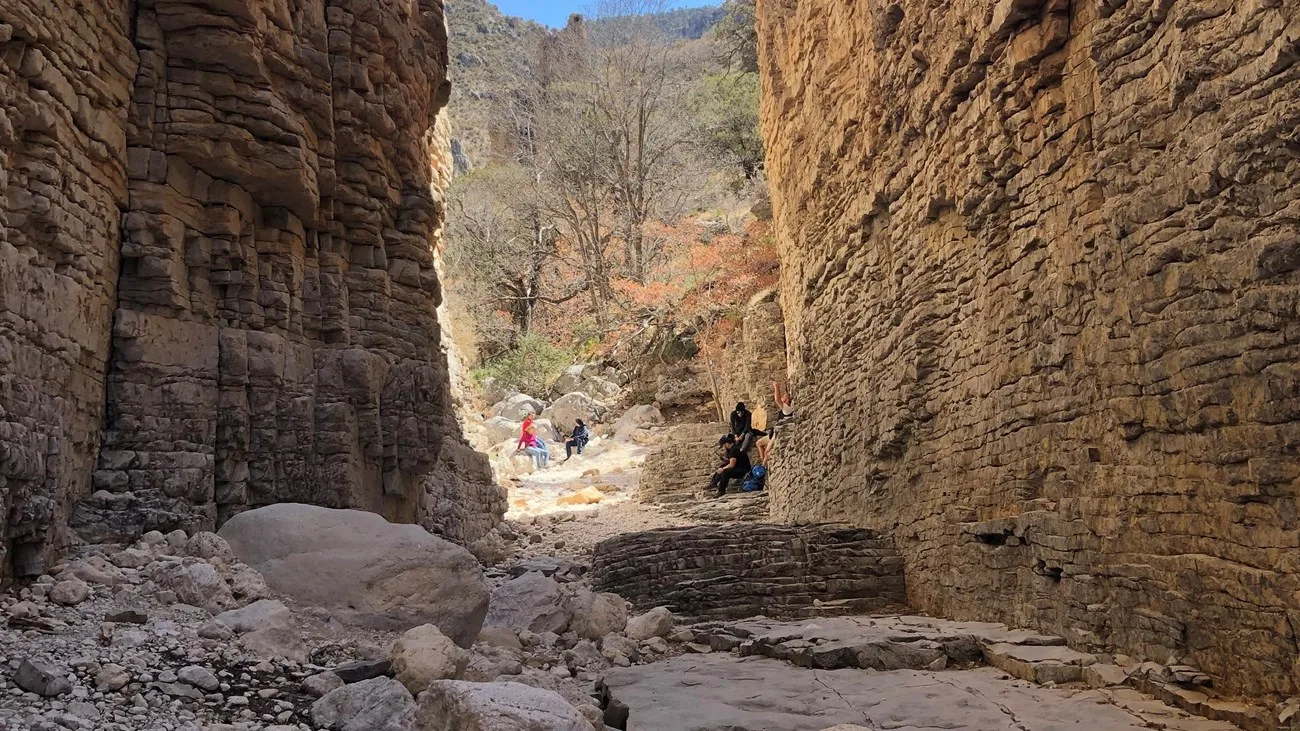
The first mile is a normal hiking trail. Then the path turns left into a dry, rocky wash, and everything changes. Now you’re hopping over boulders, picking your way through a canyon floor, and the walls are getting taller. Finally you reach a set of natural stone steps, climb them, and walk into a narrow hallway of limestone with walls rising high on both sides.
That’s the Devils Hall Trail in Guadalupe Mountains National Park, one of the most fun and unusual hikes in Texas. It’s not about a summit. It’s about the canyon itself.
This guide explains everything in plain English: the real distance (4.2 miles, per the park), why it’s rated strenuous, what each section looks like, the Hiker’s Staircase, when to see fall colors, and how to stay safe in the wash.
Quick answer
- Distance: 4.2 miles round trip (NPS). Older sources say 3.8.
- Elevation change: about 548 feet.
- Time: 3–5 hours.
- Difficulty: strenuous (rock scrambling, loose rock).
- Trailhead: Pine Springs Trailhead.
- Route: about 1 mile of trail, then about 1 mile of boulder-hopping in a wash to the Hiker’s Staircase and Devil’s Hall.
- Best time: fall (colors peak mid-October to mid-November) and spring.
- Don’t go: in wet or rainy weather.
- Dogs: not allowed.
Devils Hall Trail at a Glance
| Location | Guadalupe Mountains National Park, Texas |
| Trailhead | Pine Springs Trailhead |
| Distance | 4.2 miles round trip (out and back) |
| Elevation change | About 548 feet |
| Time | 3–5 hours |
| Difficulty | Strenuous |
| Terrain | Trail, then rocky wash with boulders |
| Highlights | Hiker’s Staircase, narrow limestone “hall,” fall color |
| Reservations | None needed |
| Fee | Park entry fee for adults |
| Pets | Not allowed |
Trail facts come from the National Park Service.
Where Is Devils Hall?
Devil’s Hall is in Pine Spring Canyon, in Guadalupe Mountains National Park in far West Texas, near the New Mexico border. It’s the same park that has Guadalupe Peak, the highest point in Texas.
How to get there
- The park is on US Highway 62/180, about 110 miles east of El Paso (roughly 2 hours) and about 55 miles southwest of Carlsbad, New Mexico.
- Turn into the Pine Springs area and follow signs to the Pine Springs Trailhead (near the campground and visitor center).
- There’s very little nearby: fill your gas tank and buy supplies before you arrive. Cell service is limited.
Parking
Pine Springs Trailhead is shared with Guadalupe Peak and other popular hikes, so it can fill up on weekends and during fall color season. If it’s full, park at the Pine Springs Visitor Center and walk the short connector trail.
Devils Hall Distance and Time
The current NPS figure is 4.2 miles round trip from Pine Springs Trailhead. You’ll see older guides list 3.8 miles. Use 4.2 for planning.
Plan on 3–5 hours. That sounds like a lot for 4 miles, but boulder-hopping in the wash is slow. You’ll spend a lot of time picking your line and stepping carefully.
What to Expect on the Devils Hall Trail
1. The first mile: a real trail
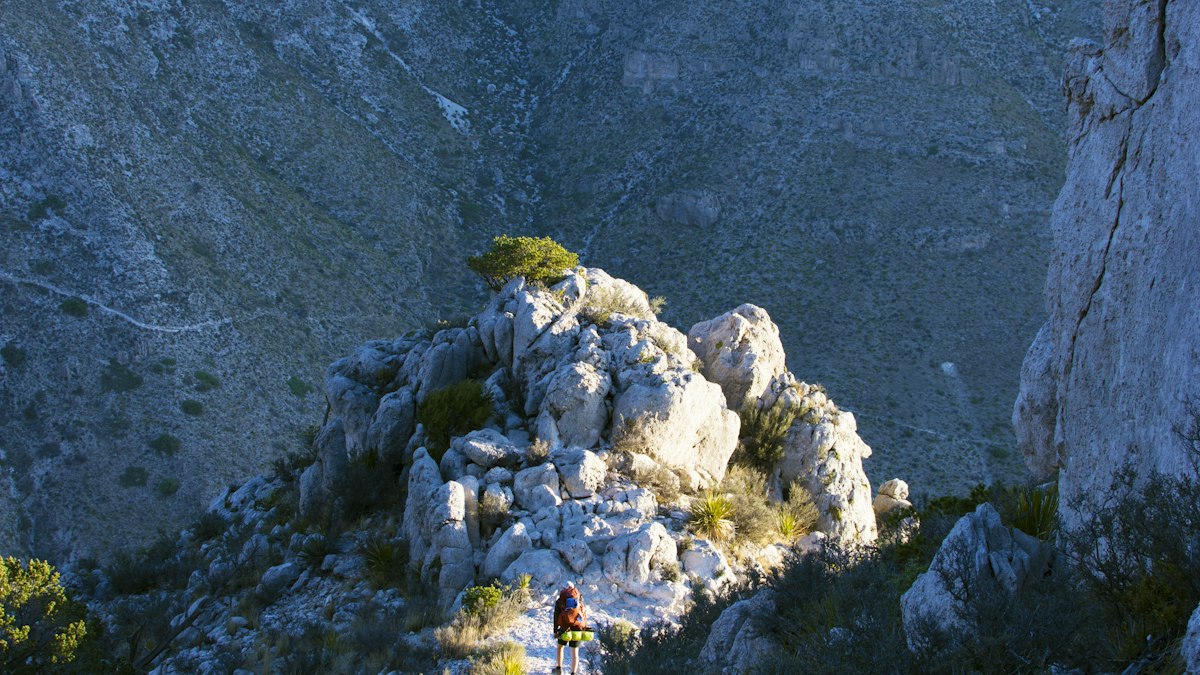
From Pine Springs Trailhead, follow signs for Devil’s Hall. The first mile is a built trail that climbs gently along the slopes above Pine Spring Canyon, through desert plants like sotol, agave and cholla, with views of the high cliffs of the Guadalupes. The NPS notes the route crosses two desert washes in this stretch.
2. Into the wash
After about a mile, the trail turns left and drops into the rocky wash of Pine Spring Canyon. Remember this spot. You’ll need to find it on the way back, and the NPS warns it can be easy to miss, especially near dark.
3. The boulder-hopping mile
Now the fun begins. For roughly another mile, there’s no real trail. You follow the canyon floor upstream, hopping over loose rocks, climbing around and over boulders, and choosing your own path. Some boulders are car-sized. You’ll use your hands for balance.
As you go, the canyon narrows and the walls grow taller. In fall, bigtooth maples and other trees in the canyon turn red, orange and yellow.
4. The Hiker’s Staircase
Near the end, you reach the Hiker’s Staircase, a set of natural limestone ledges stacked like giant steps. The rock layers broke off in flat slabs, so it really looks like a staircase built by hand, but it’s completely natural. Climb it carefully.
5. Devil’s Hall
Just past the staircase, the canyon pinches into Devil’s Hall: a narrow corridor with tall, smooth limestone walls on both sides, like a hallway with no roof. It’s cool, shady and quiet. Walk through and enjoy it. Past the hall, the canyon becomes much harder; this is the turnaround point for day hikers.
6. The way back
Return the same way. Climbing down boulders is often harder than going up. Watch carefully for the spot where the trail leaves the wash and climbs back up to the built trail. Look for signs, and check your GPS if you’re not sure.
Why Is Devils Hall Rated Strenuous?
The park rates it strenuous, even though it’s short. That’s because of:
- Rock scrambling over big boulders.
- Loose rock that shifts under your feet.
- No defined path in the wash.
- Slow pace, which means more time in the sun.
- Debris after storms: heavy late-summer rains can leave the wash full of loose rocks and new obstacles.
Is it good for beginners?
Fit beginners with good balance can do it on a dry day if they take their time. If you don’t enjoy climbing on rocks, try an easier trail like the Smith Spring Loop.
Can kids do it?
Older, active kids often love the boulder-hopping. Younger kids may struggle. The NPS notes that minors must be with an adult.
Best Time to Hike Devils Hall
| Season | What to expect | Verdict |
|---|---|---|
| Mid-October to mid-November | Peak fall color in the canyon, mild days | Best |
| December–February | Cool to cold, possible ice or snow, strong winds | Good on dry, calm days |
| March–May | Pleasant temperatures, very windy at times | Great |
| June–September | Hot, afternoon thunderstorms, flash floods | Early morning only, never in rain |
Guadalupe Mountains is famous for strong winds, especially in winter and spring. Check the forecast.
Wet Weather and Flash Flood Safety
The NPS is clear: don’t climb in the wash or canyon walls in wet or rainy conditions. Wet limestone is slippery, and storms can send water and debris down the wash. If rain is forecast, choose another day or another trail.
Fees and Rules
- Entry fee: required for all adult visitors (a per-person fee, good for 7 days). Federal passes are accepted. Check the NPS website for the current amount.
- No reservations needed for the day hike.
- No pets on trails.
- Leave No Trace: don’t build cairns, take rocks or disturb plants.
What to Bring
- Sturdy hiking shoes or boots with excellent grip.
- Trekking poles: the NPS recommends them for the wash (stow them for big scrambles). See our best hiking poles.
- Water: at least 2–3 liters per person.
- Snacks for a 3–5 hour hike.
- Headlamp: the NPS says late-afternoon hikers should carry a light, since the exit from the wash is hard to find after dark.
- Wind layer: it’s often very windy here.
- Sun protection and a first aid kit.
- Offline map.
Safety Tips
- Test each rock before you put your full weight on it.
- Keep your hands free for scrambling.
- Mark the wash exit in your mind (or drop a pin on your GPS app).
- Start early so you’re out before dark.
- Turn around if a scramble feels unsafe or the rock is wet.
- Watch for rattlesnakes in warm weather.
Devils Hall vs. Other Guadalupe Mountains Hikes
| Trail | Distance (round trip) | Difficulty | Highlight |
|---|---|---|---|
| Devil’s Hall | 4.2 mi | Strenuous | Hiker’s Staircase and narrow canyon |
| Guadalupe Peak | About 8.4 mi | Strenuous | Highest point in Texas |
| McKittrick Canyon (Pratt Cabin) | About 4.8 mi | Moderate | Fall color and historic cabin |
| Smith Spring Loop | About 2.3 mi | Moderate | Desert spring and shade |
| Pinery Trail | About 0.75 mi | Easy | Old stagecoach station ruins |
Suggested Day Plan
- Morning: arrive at Pine Springs, check weather and conditions at the visitor center.
- Mid-morning: hike Devil’s Hall (allow 3–5 hours).
- Afternoon: picnic, then the short Pinery Trail or the Smith Spring Loop.
- Next day: tackle Guadalupe Peak or visit McKittrick Canyon.
Frequently Asked Questions
How long is the Devils Hall Trail?
4.2 miles round trip, according to the NPS.
How long does it take?
3–5 hours, because the wash section is slow.
How hard is Devils Hall?
The park rates it strenuous because of boulder scrambling and loose rock.
Where does the trail start?
At Pine Springs Trailhead in Guadalupe Mountains National Park.
What is the Hiker’s Staircase?
A natural set of flat limestone ledges that look like giant stairs, just before Devil’s Hall.
Can you hike Devils Hall after rain?
No. The NPS says not to climb in the wash or canyon walls in wet or rainy conditions.
When are the fall colors?
Usually mid-October to mid-November.
Are dogs allowed?
No. Pets aren’t allowed on park trails.
Do you need a reservation?
No, but there’s a park entry fee for adults.
Is Devils Hall a slot canyon?
It’s a narrow limestone canyon passage that feels slot-like, but it’s wider and more open than a true slot canyon.
Is Devils Hall worth it?
Yes, if you enjoy scrambling. It’s one of the most memorable short hikes in Texas.
Final Thoughts
Devils Hall is a little adventure: an easy warm-up, a mile of boulder-hopping, a staircase built by nature and a stone hallway at the end. It’s harder than its mileage, but that’s what makes it fun.
Go on a dry day, wear grippy shoes, bring poles and a headlamp, and remember where the trail leaves the wash.
More Texas hikes: Guadalupe Peak, McKittrick Canyon, Santa Elena Canyon, Lost Mine Trail and the best winter hiking trails in the USA.
Official info: NPS Devil’s Hall Trail.